
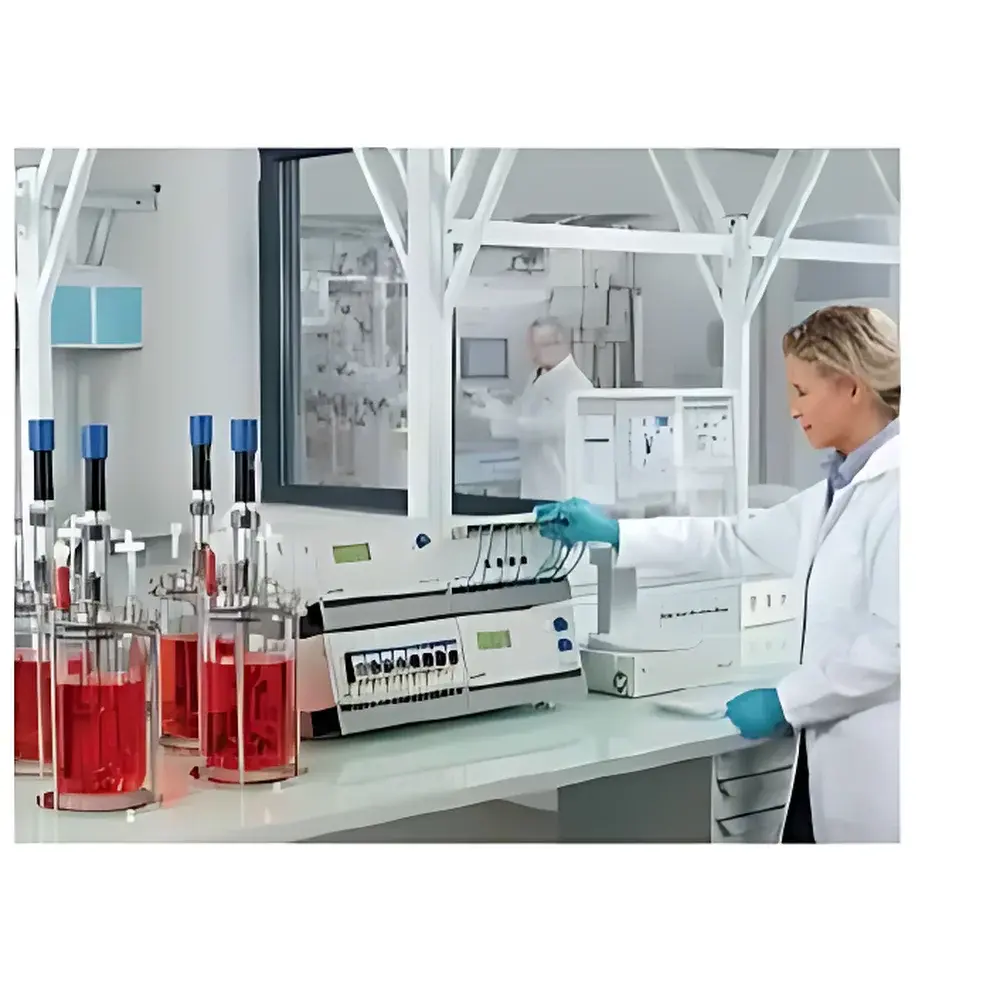
Eppendorf DASGIP Parallel Bioreactor System
| Brand | Eppendorf |
|---|---|
| Origin | Germany |
| Manufacturer Type | Original Equipment Manufacturer (OEM) |
| Import Status | Imported |
| Model | DASGIP |
| Price Range | USD 25,000 – 65,000 (FOB Hamburg) |
| Temperature Control Range | 2–12 °C (external jacket cooling only |
| full bioreactor operating range | 20–55 °C with integrated heating/cooling) |
| Working Volume Range | 0.2–3.8 L per vessel |
| Vessel Configuration | 1, 3, or 4 parallel vessels |
| Gas Flow Control | Individual thermal mass flow controllers (MFCs) per vessel |
| Aeration Options | Ring sparger or microbubble diffuser |
| Agitation | Top-driven magnetic or mechanical stirrer (vessel-dependent) |
| pH Range | 2.0–12.0 (with standard electrodes) |
| Dissolved Oxygen (DO) Range | 0–200% air saturation |
| Sterilization Method | Autoclavable (121 °C, 20 min, 1.1 bar gauge) for glass vessels |
Overview
The Eppendorf DASGIP Parallel Bioreactor System is an engineered platform for high-fidelity, multi-vessel bioprocess development in upstream biomanufacturing and academic cell culture research. Built upon a modular architecture, it enables simultaneous operation of up to four independently controlled stirred-tank bioreactors—each equipped with real-time monitoring and closed-loop control of critical process parameters including temperature, pH, dissolved oxygen (DO), agitation speed, gas flow rates (O₂, N₂, air, CO₂), and antifoam addition. The system operates on the principle of scalable, reproducible microbial and mammalian cell cultivation under defined physicochemical conditions, supporting both fed-batch and perfusion modes. Its design conforms to fundamental bioreactor engineering principles—including mass transfer optimization via calibrated sparging, precise heat exchange through jacketed vessels or Peltier-based modules, and shear-sensitive impeller configurations—ensuring physiological relevance across scales from lab-scale screening to process definition.
Key Features
- Modular scalability: Configurable for 1-, 3-, or 4-vessel parallel operation with synchronized or independent parameter control per vessel
- Integrated thermal mass flow controllers (MFCs) enabling precise, dynamic gas blending (e.g., O₂/N₂/CO₂) and individual DO setpoint tracking
- Flexible vessel compatibility: Supports autoclavable borosilicate glass vessels (0.2–3.8 L working volume) and pre-sterilized BioBLU single-use bioreactors with standardized 12/14 mm top ports
- Dual aeration architecture: Selectable ring spargers for high-mass-transfer microbial applications or microbubble diffusers for shear-sensitive mammalian and stem cell cultures
- Robust sterilization compliance: Glass vessels validated for steam sterilization at 121 °C, 20 min, 1.1 bar gauge; single-use vessels certified for gamma irradiation (25–40 kGy) and ISO 13485-compliant manufacturing
- Electrode integration: Standardized BNC and mini-DIN interfaces accommodate pH, DO, conductivity, and Redox sensors from multiple OEMs; automatic electrode calibration routines embedded in DASGIP Control software
Sample Compatibility & Compliance
The DASGIP system accommodates diverse biological systems including bacterial (E. coli, Bacillus), yeast (Pichia pastoris, S. cerevisiae), insect (Sf9), and mammalian (CHO, HEK293, iPSC-derived lines) cultures. Vessel materials meet USP Class VI and EU Pharmacopoeia 3.1.9 requirements for extractables and leachables. Process data acquisition complies with ALCOA+ principles (Attributable, Legible, Contemporaneous, Original, Accurate, Complete, Consistent, Enduring, Available) and supports audit trails required under FDA 21 CFR Part 11 when configured with electronic signature and role-based access control in DASware Control. All hardware components are CE-marked and conform to IEC 61000-6-2 (EMC immunity) and IEC 61010-1 (safety for laboratory equipment).
Software & Data Management
DASGIP Control provides deterministic real-time control with <100 ms loop cycle time and synchronized logging at user-defined intervals (1 s to 60 min). DASware Control (v5.x) extends functionality with Design of Experiments (DoE) workflow templates, multivariate statistical process monitoring (MSPC), and automated report generation compliant with GLP documentation standards. Data export supports CSV, HDF5, and ASAM-ODS formats for integration into LIMS or MES platforms. Remote access is enabled via TLS 1.2-secured web interface or OPC UA server, permitting real-time supervision and intervention from external networks without compromising firewall integrity.
Applications
- Strain selection and media optimization for recombinant protein expression
- Process characterization studies under QbD (Quality by Design) frameworks
- Scale-down model validation for commercial bioreactor campaigns
- Stem cell expansion under xeno-free, low-shear conditions using BioBLU Flex vessels
- Continuous perfusion process development with integrated harvest and feed pumps
- Metabolic flux analysis requiring tightly coupled DO/pH/gas composition control
FAQ
Is the DASGIP system compliant with 21 CFR Part 11 for regulated environments?
Yes—when deployed with DASware Control’s validated configuration (including electronic signatures, audit trail, and user access controls), it meets FDA 21 CFR Part 11 requirements for electronic records and signatures.
Can I integrate third-party analytical devices such as HPLC or Raman spectrometers?
Yes—DASware supports OPC UA and Modbus TCP protocols for bidirectional communication with external analyzers, enabling real-time feedback control loops.
What is the maximum allowable pressure for glass vessel operation?
Standard DASGIP glass vessels are rated for 1.5 bar absolute pressure; optional pressure-rated variants support up to 3 bar absolute with integrated safety relief valves.
Does the system support adaptive feeding strategies based on online metabolite measurements?
Yes—customizable feed algorithms can be scripted in DASware using live inputs from connected analyzers or calculated variables (e.g., VCD trends, OUR estimates).
How is sensor drift compensated during long-duration runs?
DASGIP Control includes scheduled automatic recalibration routines and slope/offset correction tools; all calibration events are timestamped and logged with operator ID and justification.




