
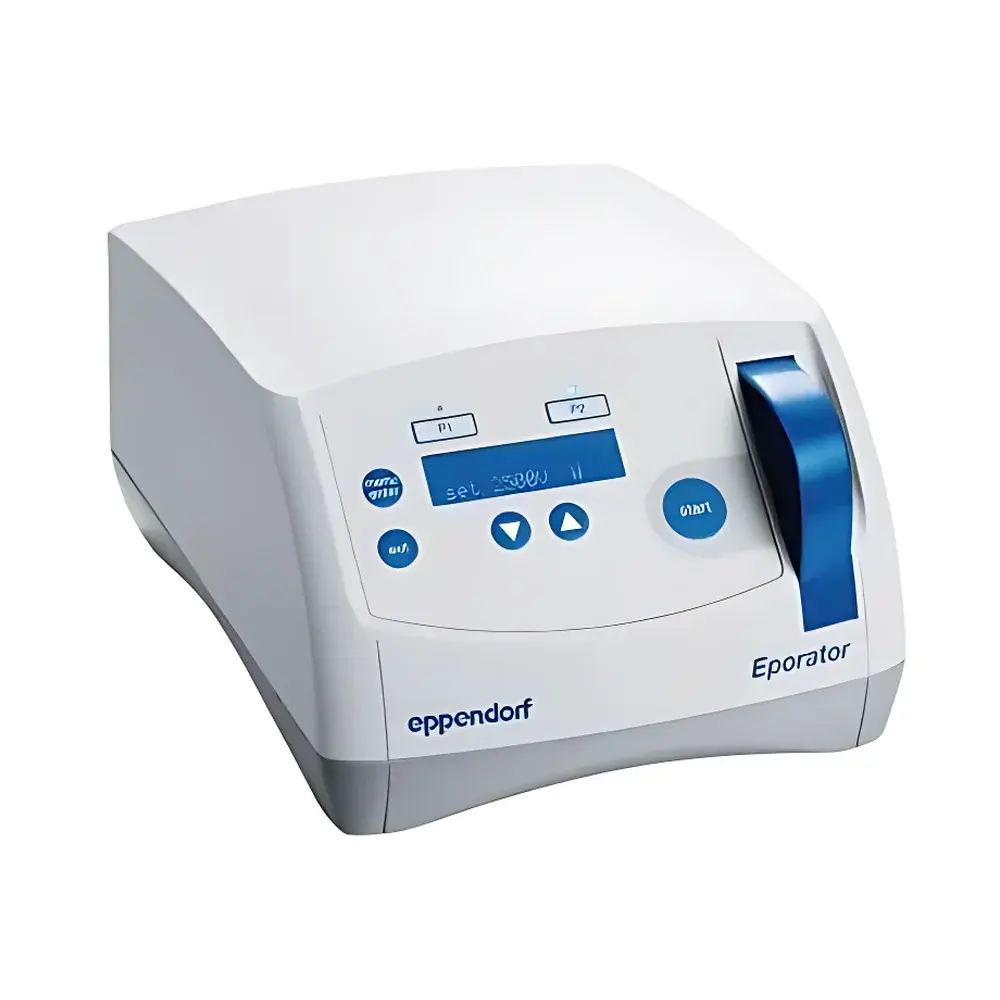
Eppendorf Eporator Electroporator
| Brand | Eppendorf |
|---|---|
| Origin | Germany |
| Model | Eporator |
| Voltage Range | 200–2500 V |
| Pulse Duration | 5 ms |
| Capacitance | 10 µF |
| Resistance | 600 Ω |
| Pulse Waveform | Exponential Decay |
| Dimensions (W×D×H) | 19 × 27.5 × 12.5 cm |
| Weight | 3.2 kg |
| Power Supply | 100–240 V, 50–60 Hz |
| Interface | USB 2.0 |
Overview
The Eppendorf Eporator Electroporator is a compact, benchtop electroporation system engineered for reproducible and efficient nucleic acid and macromolecule delivery into prokaryotic and eukaryotic cells. It operates on the principle of transient membrane permeabilization via controlled high-voltage exponential decay pulses—inducing reversible pore formation in cellular membranes to facilitate uptake of plasmid DNA, RNA, proteins, and other small charged molecules. Designed specifically for routine transformation of bacteria (e.g., E. coli), yeast (e.g., Saccharomyces cerevisiae), and select microbial strains, the Eporator delivers a fixed, factory-calibrated pulse duration of 5 ms—optimized to balance transfection efficiency with cell viability across standard electroporation protocols. Its robust architecture integrates safety-critical circuitry to suppress arcing during pulse discharge, ensuring operator protection and consistent electrical performance under variable sample conductivities.
Key Features
- Fixed 5 ms exponential decay pulse—precisely calibrated for high-efficiency plasmid DNA transformation in common laboratory strains
- Dual programmable parameter sets—enabling rapid recall of frequently used voltage/capacitance configurations without re-entry
- Integrated cuvette holder with mechanical interlock—prevents activation unless an electroporation cuvette is fully seated, minimizing accidental discharge
- Intuitive LED display with dedicated function keys—providing immediate visual feedback of selected voltage, stored protocols, and operational status
- USB 2.0 interface supporting GLP-compliant data export—facilitating audit-ready documentation of pulse parameters, timestamps, and user identifiers for regulated environments
- Compact footprint (19 × 27.5 × 12.5 cm) and lightweight design (3.2 kg)—optimized for space-constrained biosafety cabinets and shared core facility workstations
Sample Compatibility & Compliance
The Eporator supports standard 0.1 cm and 0.2 cm gap electroporation cuvettes (not included), compatible with volumes from 20–100 µL. It is validated for use with chemically competent and electrocompetent E. coli strains (e.g., DH5α, TOP10), Bacillus subtilis, Pseudomonas aeruginosa, and baker’s yeast. While not intended for mammalian cell electroporation due to its fixed pulse duration and absence of square-wave capability, it meets essential safety requirements per IEC 61010-1 for laboratory electrical equipment. Its firmware architecture supports traceable parameter logging aligned with Good Laboratory Practice (GLP) documentation workflows, and the USB data export function enables integration into electronic lab notebook (ELN) systems compliant with 21 CFR Part 11 when paired with appropriate access controls.
Software & Data Management
No proprietary software installation is required—the Eporator functions as a USB Human Interface Device (HID) for direct parameter logging. When connected to a Windows or macOS host, it exports timestamped CSV files containing date/time, user ID (if entered manually via keypad), applied voltage, and protocol identifier. This native data export eliminates third-party drivers and supports seamless import into LIMS or ELN platforms. Audit trails are maintained locally on-device for up to 100 recent runs; older entries are overwritten on a FIFO basis. All exported records include device serial number and firmware version—critical for instrument qualification (IQ/OQ) and regulatory submissions.
Applications
- Routine plasmid transformation in bacterial cloning workflows
- Yeast plasmid introduction for gene expression and synthetic biology constructs
- Delivery of CRISPR-Cas9 ribonucleoprotein (RNP) complexes into Gram-positive bacteria
- Electrotransformation of environmental isolates with low natural competence
- Teaching laboratory instruction in molecular microbiology and genetic engineering techniques
FAQ
What types of cells is the Eporator validated for?
The Eporator is validated for bacterial (e.g., E. coli, B. subtilis) and yeast (S. cerevisiae) electrotransformation. It is not suitable for mammalian, plant, or insect cells.
Does the Eporator support adjustable pulse durations?
No—it delivers a fixed 5 ms exponential decay pulse. This setting is optimized for standard microbial transformation protocols and cannot be modified.
Can I connect the Eporator to a networked LIMS system?
Yes—via USB 2.0, exported CSV files can be ingested by LIMS or ELN platforms supporting standardized data import formats. No middleware or API is provided.
Is the device compliant with ISO/IEC 17025 or FDA 21 CFR Part 11?
The Eporator itself is not certified to these standards, but its data export functionality supports implementation within laboratories maintaining such compliance—provided appropriate procedural controls (e.g., user authentication, file integrity checks) are externally enforced.
What safety features prevent electrical hazards during operation?
The unit incorporates arc-suppression circuitry, a mechanical cuvette interlock switch, and automatic discharge detection that halts operation if residual capacitance exceeds safe thresholds prior to pulse initiation.




