
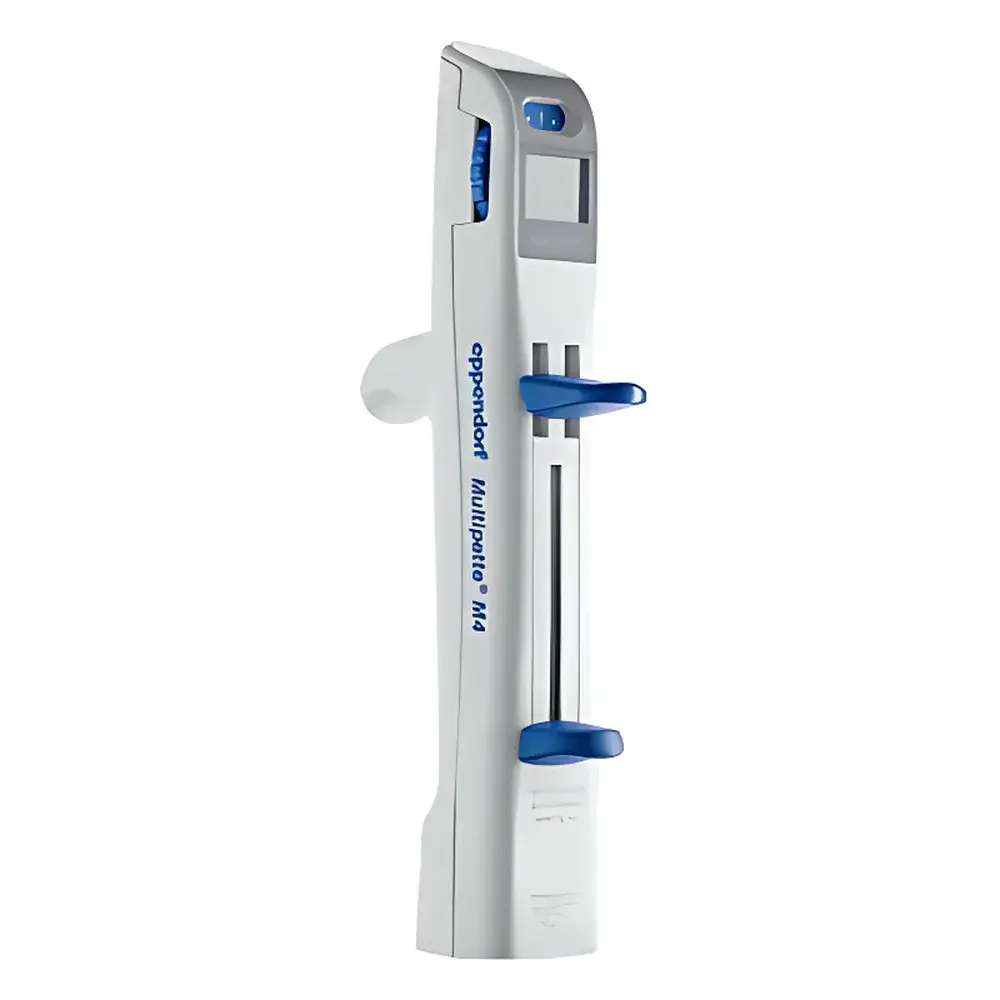
Eppendorf Multipette M4 Manual Continuous Dispenser
| Brand | Eppendorf |
|---|---|
| Origin | Germany |
| Manufacturer Type | Original Equipment Manufacturer (OEM) |
| Import Status | Imported |
| Model | Multipette M4 |
| Instrument Type | Single-Channel Manual Dispenser |
| Automation Level | Manual |
| Channels | 1 |
| Volume Range | 1 µL – 10 mL |
| Maximum Reservoir Capacity | 50 mL |
| Accuracy | ±0.3% |
| Principle | External Piston (Positive Displacement) |
Overview
The Eppendorf Multipette M4 is a precision-engineered manual continuous dispenser designed for high-reproducibility liquid handling in regulated and demanding laboratory environments. Unlike air-cushion (gas-piston) pipettes, the Multipette M4 operates on an external piston (positive displacement) principle: the piston makes direct contact with the liquid inside the Combitip—eliminating compressible air columns and rendering dispensing performance independent of liquid density, vapor pressure, viscosity, or surface tension. This architecture ensures metrological traceability and consistent volumetric delivery across challenging fluid classes, including glycerol-rich solutions (>80% v/v), ethanol–water mixtures, acetonitrile, DMSO, cell lysates, serum, and low-volume toxic or biohazardous agents. Its design complies with ISO 8655-3 (volumetric accuracy and precision requirements for positive displacement pipettes) and supports GLP/GMP-aligned workflows where operator-induced variability must be minimized.
Key Features
- External piston mechanism enables direct liquid–piston contact—no air gap, no evaporation-induced error, no viscosity-dependent volume loss
- Automatic Combitip recognition via integrated optical sensor; displays current tip volume and remaining capacity without manual calculation
- Single aspiration enables up to 100 consecutive dispense steps—ideal for serial dilutions, plate filling, reagent addition, and QC sample preparation
- Integrated step counter with memory retention: if interrupted mid-sequence (e.g., by door opening or workflow pause), the device retains the last executed step—no re-initialization required
- Central Combitip ejector lever allows one-handed, glove-compatible tip ejection—even when wearing thick lab gloves or handling hazardous materials
- Ergonomic handle with textured grip and balanced weight distribution reduces hand fatigue during extended use (validated per ISO 5356-1 ergonomic assessment criteria)
- Calibration-friendly design: piston assembly accessible without tools; supports user-performed verification per ISO/IEC 17025 internal calibration protocols
Sample Compatibility & Compliance
The Multipette M4 accommodates a broad spectrum of liquid classes unsuitable for standard air-displacement pipettes: high-viscosity fluids (up to 500 mPa·s), volatile solvents (e.g., chloroform, hexane), foaming aqueous buffers (e.g., Triton X-100 >0.1%), and biosafety level 2 (BSL-2) or higher agents—including infectious clinical specimens, radiolabeled tracers (e.g., ³H-thymidine), and cytotoxic compounds. All wetted parts are chemically resistant to common organic solvents and sterilizable via autoclaving (121°C, 20 min) or hydrogen peroxide vapor (HPV) treatment. The device meets CE marking requirements under Directive 2014/30/EU (EMC) and 2011/65/EU (RoHS), and its mechanical construction adheres to DIN EN 61326-1 for laboratory equipment electromagnetic compatibility.
Software & Data Management
While the Multipette M4 is a standalone manual instrument with no embedded software or connectivity, it integrates seamlessly into digital lab ecosystems through documented, auditable operation. Each unit includes a factory-issued calibration certificate traceable to PTB (Physikalisch-Technische Bundesanstalt), with optional annual recalibration services available via Eppendorf’s ISO/IEC 17025-accredited service centers. For laboratories operating under FDA 21 CFR Part 11, the device supports compliant record-keeping when used in conjunction with electronic lab notebooks (ELNs) that capture operator ID, date/time stamps, lot numbers of Combitips, and volume logs. Its mechanical simplicity eliminates firmware validation burdens—making it ideal for legacy-compliant QC labs maintaining paper-based SOPs.
Applications
- Preparation of multi-level calibration standards for HPLC, GC, and ICP-MS analysis
- Dispensing viscous PCR master mixes containing high-concentration MgCl₂ or trehalose stabilizers
- Accurate transfer of radioactive labeling reagents in radioimmunoassay (RIA) workflows
- High-throughput dispensing of enzyme solutions into 96-well microplates for kinetic assays
- Safe handling of pathogenic samples in BSL-2+ containment hoods—minimizing aerosol generation and cross-contamination risk
- QC release testing of pharmaceutical excipients (e.g., polysorbate 80, propylene glycol) where density-independent volume delivery is mandated per USP
FAQ
Does the Multipette M4 require electrical power or batteries?
No—it is fully mechanical and requires no power source.
Can it be calibrated in-house?
Yes; piston travel and volume output can be verified using gravimetric methods per ISO 8655-6, with optional adjustment tools available from Eppendorf.
Is it compatible with third-party tips?
No—only original Eppendorf Combitips are supported to guarantee dimensional tolerance, sealing integrity, and piston–tip interface repeatability.
What is the maximum recommended viscosity for reliable operation?
Up to 500 mPa·s at 20°C; for fluids exceeding this, pre-wetting and slower dispensing speed are advised.
How often should the piston seal be replaced?
Under typical usage (≤500 dispense cycles/day), the fluoropolymer piston seal maintains performance for ≥12 months; replacement kits and service intervals are detailed in the maintenance manual (Doc. No. 5211 000.012).



