
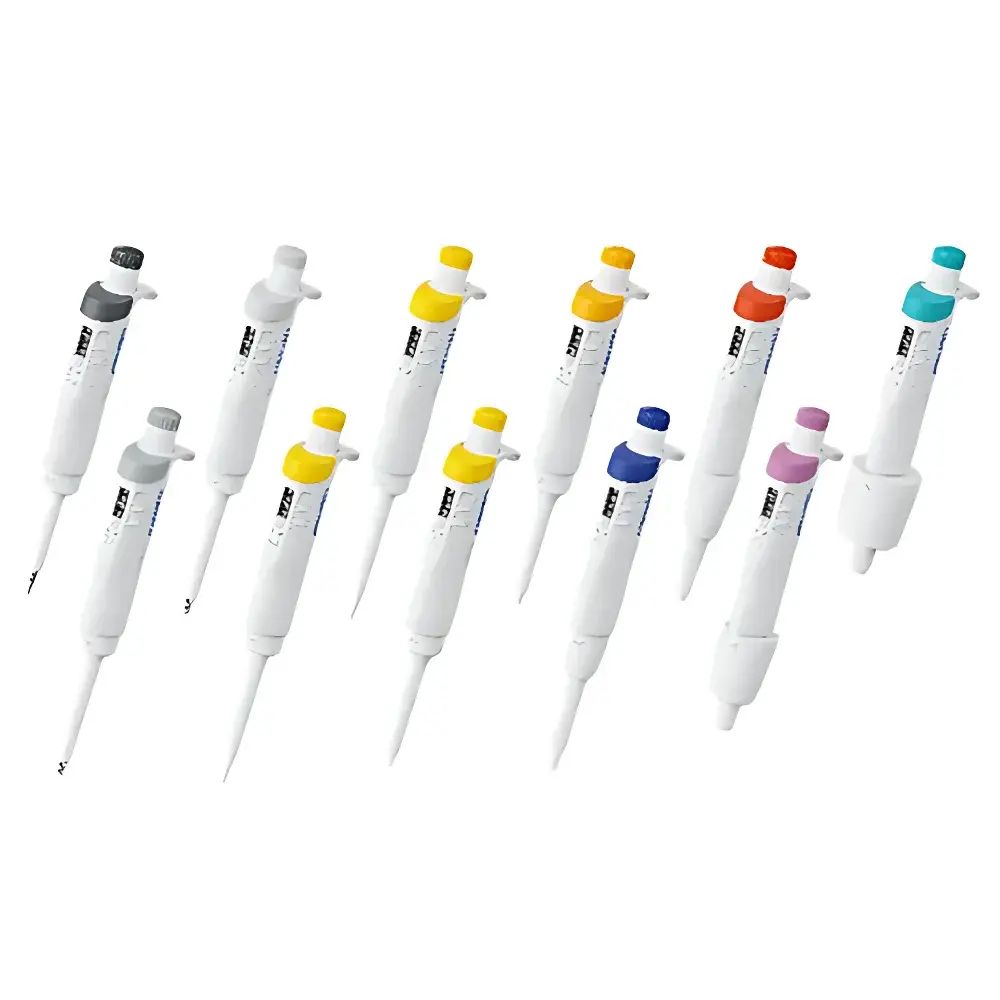
Eppendorf Research® 3 neo Manual Pipette
| Brand | Eppendorf |
|---|---|
| Origin | Germany |
| Manufacturer Type | Original Equipment Manufacturer (OEM) |
| Product Origin | Imported |
| Model | Research 3 neo |
| Instrument Type | Single-Channel Pipette |
| Automation Level | Manual |
| Channels | 1 |
| Volume Range | 2.5 µL – 10 mL |
| Maximum Capacity | 10 mL |
Overview
The Eppendorf Research® 3 neo is a high-precision, single-channel manual air-cushion pipette engineered for reproducible liquid handling across diverse laboratory environments—from routine QC testing to demanding molecular biology workflows. Utilizing gas-piston technology with optimized internal air displacement dynamics, the Research 3 neo ensures consistent aspiration and dispensing accuracy across its full volume range (2.5 µL to 10 mL), independent of operator technique variability. Its design adheres strictly to ISO 8655-2:2022 standards for gravimetric performance verification and complies with ISO 8655-5 for ergonomic evaluation. The pipette’s core architecture integrates mechanical stability, thermal inertia management, and low-friction piston sealing—critical for minimizing evaporation-induced error in low-volume transfers and maintaining calibration integrity over extended use cycles.
Key Features
- Two-button operation: Dedicated volume adjustment/liquid handling button and separate tip ejection button—reducing hand fatigue and cross-contamination risk.
- Ergonomic dual-mode volume setting: “Fast” gear-shift mechanism enables 40% faster volume changes between preset increments; “Easy” mode allows precise one-handed fine-tuning with tactile feedback.
- Volume lock system: Prevents accidental volume drift during transport or multi-step protocols—essential for GLP-compliant documentation and audit readiness.
- PhysioCare Concept integration: Curved body contour, ultra-low operating force (<0.8 N for aspiration at 10 mL), and balanced center-of-gravity reduce musculoskeletal strain—validated per ISO 10075-3 ergonomics guidelines.
- Density correction function: Compensates for viscosity, vapor pressure, and surface tension effects when handling ethanol, glycerol, serum, or high-salt buffers—enabling accurate delivery without recalibration.
- Tip attachment/detachment optimization: Elastic tip cone design lowers required insertion/ejection force by up to 35%, mitigating repetitive stress injury (RSI) risk per EU Directive 2002/44/EC on mechanical vibration exposure.
- Full autoclavability: Certified for steam sterilization at 121 °C, 1 bar, 20 min without disassembly; compatible with H2O2 vapor sterilization and UV-C irradiation (254 nm, ≥1000 J/m²).
Sample Compatibility & Compliance
The Research 3 neo accommodates standard conical polypropylene tips (including low-retention and filter types) from major global suppliers (e.g., Eppendorf, USA Scientific, Thermo Fisher). It supports compliant operation with viscous liquids (up to 500 mPa·s), volatile solvents (e.g., acetone, chloroform), and temperature-sensitive biological samples (4–37 °C ambient range). Regulatory alignment includes adherence to ISO/IEC 17025:2017 for calibration traceability, FDA 21 CFR Part 11 readiness via optional electronic logbook integration, and compatibility with GMP/GLP documentation workflows through serialized unit identification and maintenance history tracking.
Software & Data Management
While inherently analog, the Research 3 neo supports digital ecosystem integration via optional accessories: ColorTag™ 1 labeling kits enable visual protocol differentiation without ink-based marking; QR-coded serial plates facilitate asset tracking in LIMS environments. When paired with Eppendorf’s Pipette Calibration Manager (PCM) software suite, users can archive calibration certificates, generate ISO 17025-compliant uncertainty budgets, and schedule preventive maintenance alerts—ensuring continuous compliance with laboratory quality management systems (QMS).
Applications
- Quantitative PCR setup and NGS library preparation requiring sub-microliter precision
- Cell culture media formulation and dilution series generation under sterile hood conditions
- Clinical chemistry assay calibration and reference material dispensing
- High-throughput ELISA plate filling with minimized inter-operator variability
- Pharmaceutical dissolution testing where density-dependent volume correction is critical
- Academic teaching labs emphasizing ergonomic best practices and metrological traceability
FAQ
Is the Research 3 neo suitable for handling corrosive solvents such as concentrated acids or bases?
Yes—its chemically resistant anodized aluminum housing and PTFE-coated piston assembly provide compatibility with common lab solvents; however, prolonged exposure to >30% nitric acid or hydrofluoric acid is not recommended.
Can the pipette be calibrated in-house using standard gravimetric methods?
Yes—full calibration procedures follow ISO 8655-6 and are supported by Eppendorf’s certified calibration kits (Cat. No. 0030 115.001), including traceable weights and distilled water certified to ISO 3696 Grade 1.
Does the density adjustment feature require external software or firmware updates?
No—the density correction is implemented mechanically via adjustable spring tension and requires no electronics or connectivity.
What is the recommended recalibration interval under ISO/IEC 17025 accreditation?
Annual calibration is standard; however, laboratories performing >500 daily pipettings or operating in environments with >±5 °C temperature fluctuation should implement quarterly verification.
Are replacement parts (e.g., seals, tips cones) available with documented shelf life and lot traceability?
Yes—all consumable components carry CE marking, batch-specific CoA, and 36-month shelf-life certification under ISO 13485:2016 for medical device components.



