
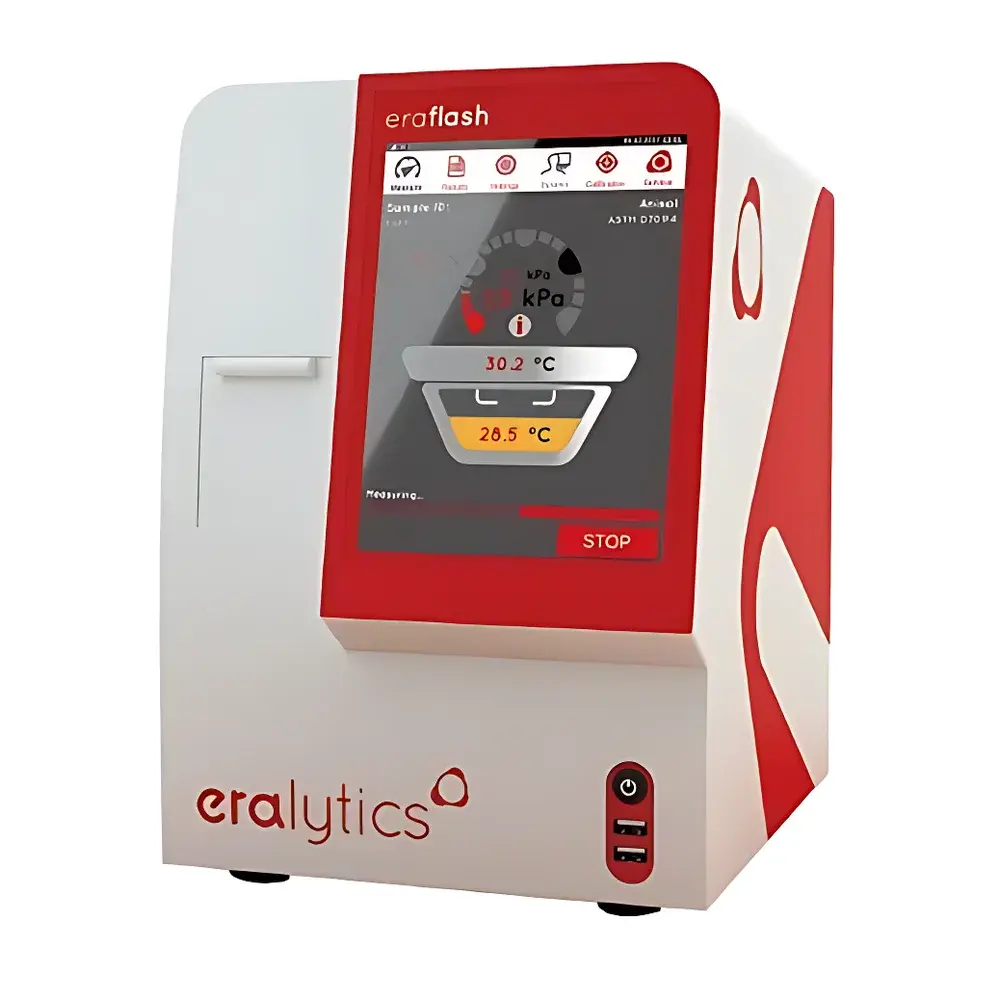
Eraflash ERAFLASH Micro Closed-Cup Flash Point Analyzer
| Brand | ERALYTICS |
|---|---|
| Origin | Austria |
| Model | ERAFLASH |
| Detection Method | Closed-Cup |
| Operation Mode | Fully Automatic |
| Applicable Standards | ASTM D6450, ASTM D7094, SH/T 0768 |
| Repeatability | Excellent |
| Ignition Method | Electric Arc Ignition |
| Temperature Range | −25 °C to 420 °C (standard configuration: 0 °C to 200 °C |
| Sample Volume | 1 mL (ASTM D6450), 2 mL (ASTM D7094) |
| Cooling/Heating Technology | Patented PBT (Peltier-Based Thermoregulation) |
| Data Storage Capacity | >100,000 test reports with full audit trail |
| Power Supply | 85–264 V AC or 12 V DC |
| Sample Throughput | Up to 12 samples/hour |
| Temperature Accuracy | ±0.1 °C |
| Integrated Pollution Monitoring | CPT (Contamination Prevention Technology) |
| Optional Modules | EF01-HTM (high-temp module, up to 420 °C), EF02 LT (low-temp module, −40 °C to 120 °C with external chiller) |
Overview
The Eraflash ERAFLASH Micro Closed-Cup Flash Point Analyzer is an advanced, fully automated instrument engineered for precise and safe determination of flash point in volatile petroleum products, solvents, biofuels, and chemical intermediates. It implements the Continuous Closed-Cup Flash Point (CCCFP) method defined in ASTM D6450 and ASTM D7094 — a thermodynamically rigorous approach that simulates real-world sealed-vessel conditions under controlled pressure elevation (≥20 kPa). Unlike traditional Pensky-Martens (ASTM D93) or Tagliabue (ASTM D56) open- or semi-closed cup methods, the ERAFLASH eliminates exposure to open flame and minimizes vapor release through its hermetically sealed measurement chamber and electric arc ignition system. This design directly addresses laboratory safety imperatives while delivering high reproducibility across highly volatile, low-flash-point materials — including gasoline blends, ethanol fuels, acetone, ether, and halogenated hydrocarbons.
Key Features
- Patented PBT (Peltier-Based Thermoregulation) technology enables rapid, bidirectional temperature control from −25 °C to 420 °C — achieving sub-second thermal response and eliminating reliance on external chillers for routine operation (0–200 °C range operates autonomously).
- CPT (Contamination Prevention Technology) integrates self-cleaning electrode surfaces and adaptive arc ignition timing to minimize carbon buildup and extend maintenance intervals — critical for testing dirty or polymerizing samples such as used lubricants or biodiesel blends.
- Real-time combustion profile visualization provides qualitative insight into vapor flammability behavior, supporting root-cause analysis of anomalous ignition events or sample contamination.
- Fuel dilution assessment protocol automates quantification of unburned hydrocarbon ingress in engine oils — aligned with OEM service specifications and predictive maintenance workflows.
- Comprehensive onboard data governance: all test parameters, raw sensor outputs, alarm logs, and operator actions are timestamped and stored with cryptographic integrity — compliant with GLP/GMP documentation requirements and FDA 21 CFR Part 11 audit-trail standards.
- Flexible power architecture supports both standard AC input (85–264 V) and 12 V DC operation — enabling field deployment, mobile labs, or integration into vehicle-based diagnostic platforms.
Sample Compatibility & Compliance
The ERAFLASH accommodates a broad spectrum of liquid-phase samples, including transparent and opaque fluids, Newtonian and non-Newtonian liquids, and thermally sensitive formulations. Its 1–2 mL sample requirement reduces hazardous waste generation and lowers consumables cost per test. Regulatory alignment extends beyond primary flash point standards (ASTM D6450/D7094, SH/T 0768) to include method equivalency with ASTM D93, GB/T 261, EN ISO 2719, ISO 13736, IP 34, JIS K2265, and EN ISO 3679/3680. Instrument validation protocols support IQ/OQ/PQ execution per ISO/IEC 17025 and ASTM E2500 guidelines. All firmware and software updates undergo traceable version control and are documented in the instrument’s internal compliance log.
Software & Data Management
The ERAFLASH runs on embedded Linux-based firmware with a web-accessible user interface (no client installation required). Test methods are configured via intuitive wizards with built-in parameter constraints to prevent out-of-spec operation. Raw thermal curves, pressure transients, and ignition event timestamps are exportable in CSV and PDF formats. The system maintains a secure local database capable of storing over 100,000 complete test records — each containing full metadata (operator ID, calibration status, environmental conditions, pass/fail flags). Role-based access control (RBAC), electronic signatures, and configurable retention policies ensure alignment with ISO 17025 Clause 7.5 and EU Annex 11 requirements for analytical data integrity.
Applications
- Quality control of refinery streams, gasoline oxygenates, and jet fuel blends per ASTM D1655 and DEF STAN 91-91.
- Regulatory submission testing for REACH, CLP, and GHS classification of flammable liquids (UN GHS Category 1–4).
- Research into alternative fuel stability, including hydrogenated esters, synthetic paraffins, and alcohol-to-jet (ATJ) pathways.
- Field verification of fuel adulteration or contamination in aviation refueling operations.
- Development and validation of low-flash-point battery electrolytes and next-generation refrigerants.
FAQ
What distinguishes CCCFP (ASTM D6450/D7094) from traditional closed-cup methods like ASTM D93?
CCCFP measures flash point under dynamically increasing pressure within a sealed cell, capturing true thermodynamic equilibrium of vapor–air mixtures — whereas D93 relies on intermittent air exchange and manual ignition, introducing variability and safety risk.
Can the ERAFLASH operate without external cooling at sub-ambient temperatures?
Yes — the base configuration supports autonomous operation from 0 °C to 200 °C. For measurements below 0 °C, the EF02 LT module (−40 °C to 120 °C) requires an external recirculating chiller; however, no cryogenic gases or dry ice are needed.
How does the instrument handle samples prone to residue formation or electrode fouling?
CPT technology automatically adjusts arc duration and electrode polarity during ignition cycles, coupled with periodic thermal desorption pulses — reducing manual cleaning frequency by up to 70% compared to conventional spark-gap systems.
Is remote monitoring and data export supported?
Yes — the integrated web server allows real-time status viewing, method editing, and report download via HTTPS. Data exports comply with ASTM E1461 and ISO/IEC 17025 digital record retention requirements.
What calibration and verification procedures are recommended?
Daily performance verification using certified reference materials (e.g., n-decane, cyclohexane) is advised. Full calibration traceable to NIST SRMs is performed annually or after major hardware service — with certificates archived in the onboard compliance log.




