
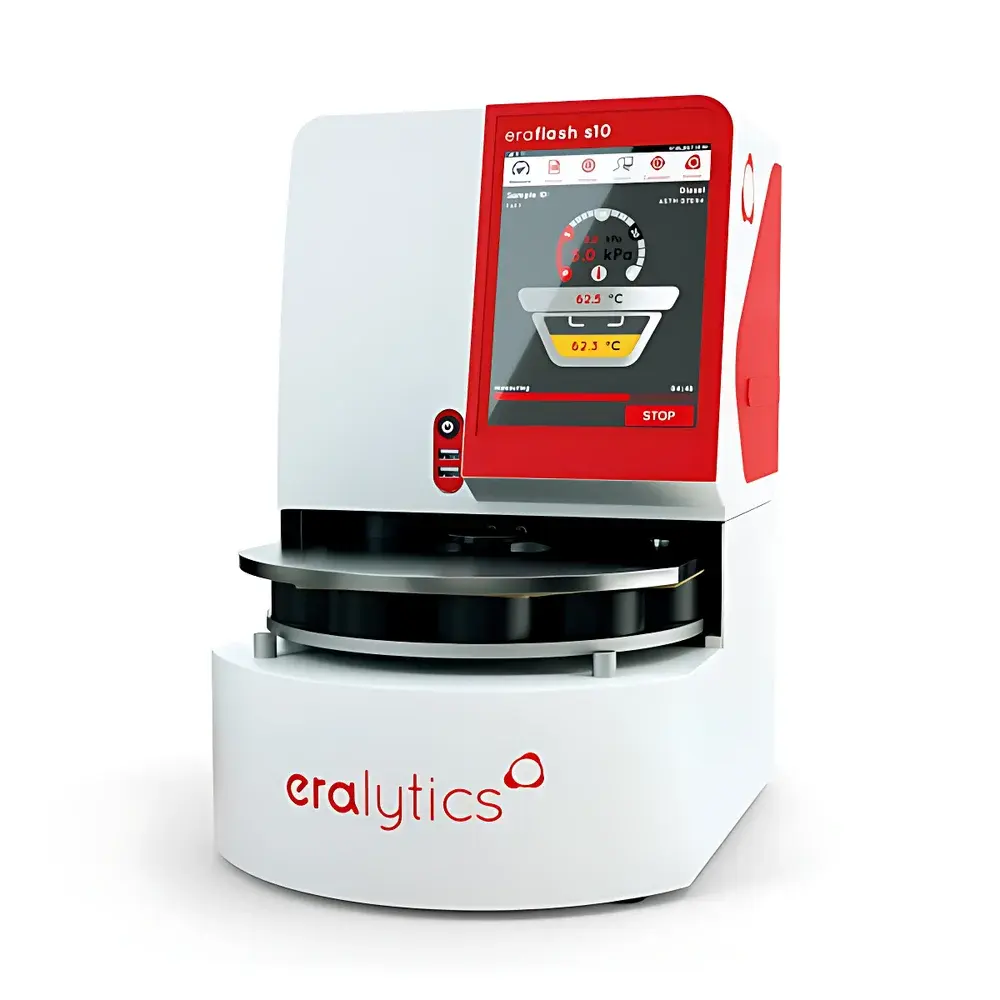
Eraflash S10 Fully Automated 10-Position Micro Flash Point Analyzer
| Brand | ERALYTICS |
|---|---|
| Origin | Austria |
| Model | Eraflash S10 |
| Detection Method | Closed-Cup (ASTM D93 / ISO 2719 / IP 34 / GB/T 261 / SH/T 0768) |
| Temperature Range | −25 °C to 200 °C (optional high-temp module up to 420 °C) |
| Temperature Accuracy | ±0.1 °C |
| Test Duration | 3–5 min per sample (including cup cleaning) |
| Sample Volume | 1 mL or 2 mL |
| Auto-sampler Capacity | 10 positions |
| Data Storage | 100,000 test records |
| Display | 7-inch full-color capacitive touchscreen (Chinese UI) |
| Interfaces | 3× USB, 1× Ethernet, 1× RS232, LIMS-compatible serial protocol |
| Power Supply | 85–263 VAC, 47–63 Hz, 70 W |
| DC Option | 12 V / 4 A |
| Dimensions | 220 × 320 × 280 mm |
| Weight | 8 kg |
Overview
The Eraflash S10 is a fully automated, 10-position micro flash point analyzer engineered for precision and regulatory compliance in petroleum, chemical, fragrance, coatings, and hazardous materials laboratories. It implements the true closed-cup (CCC-FP) measurement principle—fully sealed sample containment throughout the entire test cycle—to replicate the thermodynamic and vapor-pressure equilibrium conditions specified in international closed-cup standards including ASTM D93, ISO 2719, IP 34, GB/T 261, and SH/T 0768. Unlike open-cup or semi-sealed instruments, the CCC-FP architecture ensures that ignition occurs only within a defined, pressure-stable headspace, delivering metrologically traceable results with high inter-laboratory reproducibility. Designed for routine QC and safety classification workflows, the Eraflash S10 operates across a wide thermal range (−25 °C to 200 °C standard; extendable to 420 °C with optional high-temperature module), enabling reliable flash point determination for volatile solvents, viscous base oils, diluted fuels, and heat-sensitive fragrance formulations.
Key Features
- True closed-cup flash point measurement (CCC-FP patented technology) ensuring strict adherence to ASTM D93 and ISO 2719 boundary conditions
- Integrated 10-position auto-sampler with independent parameter assignment per vial—supports unattended batch testing of up to 100 samples per day
- Intelligent cup recognition: automatic detection of empty or misloaded cups with skip logic and visual status coding on touchscreen
- Micro-sample capability: 1 mL or 2 mL volume requirement minimizes consumption of high-value or hazardous materials and reduces waste generation
- Onboard Peltier-based cooling and PID-controlled heating enable rapid, stable temperature ramping and precise isothermal hold without external chillers or accessories
- Full-cycle automation: sample introduction, temperature equilibration, ignition sequence, post-test cup cleaning, and thermal cooldown—all executed autonomously
- Embedded safety architecture: spark ignition inside hermetically sealed chamber eliminates open flame exposure; thermal interlocks prevent operator contact with hot surfaces
- Compact benchtop form factor (220 × 320 × 280 mm, 8 kg) suitable for fixed laboratories, mobile analytical units, and field deployment—including vehicle-mounted operation via 12 V DC input
Sample Compatibility & Compliance
The Eraflash S10 accommodates diverse sample matrices without method revalidation: low-flash hydrocarbons (e.g., acetone, diethyl ether), high-viscosity lubricants (SAE 50+), thermally labile essential oils, water-miscible solvents, and fuel blends—including biodiesel-diesel mixtures. Its adaptive heating profile and programmable dwell times support specialized protocols such as fuel dilution analysis (per ASTM D93 Annex A1) and contamination screening via combustion curve profiling. The instrument complies with GLP and GMP data integrity requirements: all measurements are time-stamped, user-logged, and stored with full audit trail metadata (operator ID, method name, calibration status, environmental ambient reading). Raw data export formats (CSV, XML) and native LIMS integration via RS232 or TCP/IP ensure seamless alignment with enterprise laboratory informatics systems governed by FDA 21 CFR Part 11 and EU Annex 11.
Software & Data Management
Controlled via an intuitive 7-inch capacitive touchscreen interface with full Chinese language support, the embedded firmware provides real-time graphical visualization of temperature ramp, vapor concentration evolution, and ignition event timing. Up to 100,000 complete test records—including raw sensor traces, pass/fail flags, and operator annotations—are retained onboard with cyclic overwrite protection. Data export supports USB mass storage, network file transfer, or direct LIMS push using configurable delimiter-separated or structured XML payloads. Firmware updates are performed via USB or over-the-air (OTA) through Ethernet—maintaining version traceability per ISO/IEC 17025 clause 5.9. All software modules undergo annual verification against NIST-traceable reference standards, and method templates can be locked, password-protected, and digitally signed to enforce SOP consistency across multi-site operations.
Applications
- Petroleum refining: Flash point verification of naphthas, kerosenes, diesel fractions, and residual fuels per ASTM D93 and ISO 3405
- Hazardous materials classification: UN GHS Category 1–4 flammability assessment for SDS authoring and transport compliance (UN TDG, ADR, IMDG)
- Fragrance & flavor R&D: Flash point screening of essential oil blends, isolates, and solvent-based concentrates per IFRA-recommended protocols
- Coatings & inks: Safety evaluation of acrylic resins, alkyd varnishes, and UV-curable monomers under variable humidity and temperature conditions
- Fuel quality control: Detection of gasoline contamination in diesel, ethanol dilution in gasoline, and biodiesel oxidation stability indicators
- Academic & forensic labs: Rapid flash point screening of unknown liquids during evidence triage or material identification workflows
FAQ
What closed-cup standards does the Eraflash S10 comply with?
It meets ASTM D93 (Method A and B), ISO 2719, IP 34, GB/T 261, and SH/T 0768—validated using certified reference materials traceable to NIST SRM 1989 and BAM RM 022.
Can the instrument test samples below 0 °C?
Yes—the standard configuration supports tests from −25 °C, making it suitable for cryogenic solvents and refrigerants without external cooling accessories.
Is method validation required when switching between sample types?
No—adaptive thermal profiling and auto-calibrating vapor detection eliminate need for manual method reconfiguration; only sample volume and expected flash point range require entry.
How is data integrity ensured for regulated environments?
All test records include digital signatures, immutable timestamps, operator authentication logs, and full electronic audit trails compliant with 21 CFR Part 11 and EU Annex 11.
Does the system support remote monitoring or troubleshooting?
Yes—Ethernet connectivity enables secure remote desktop access (with customer authorization), firmware OTA updates, and real-time diagnostic telemetry for predictive maintenance scheduling.





