
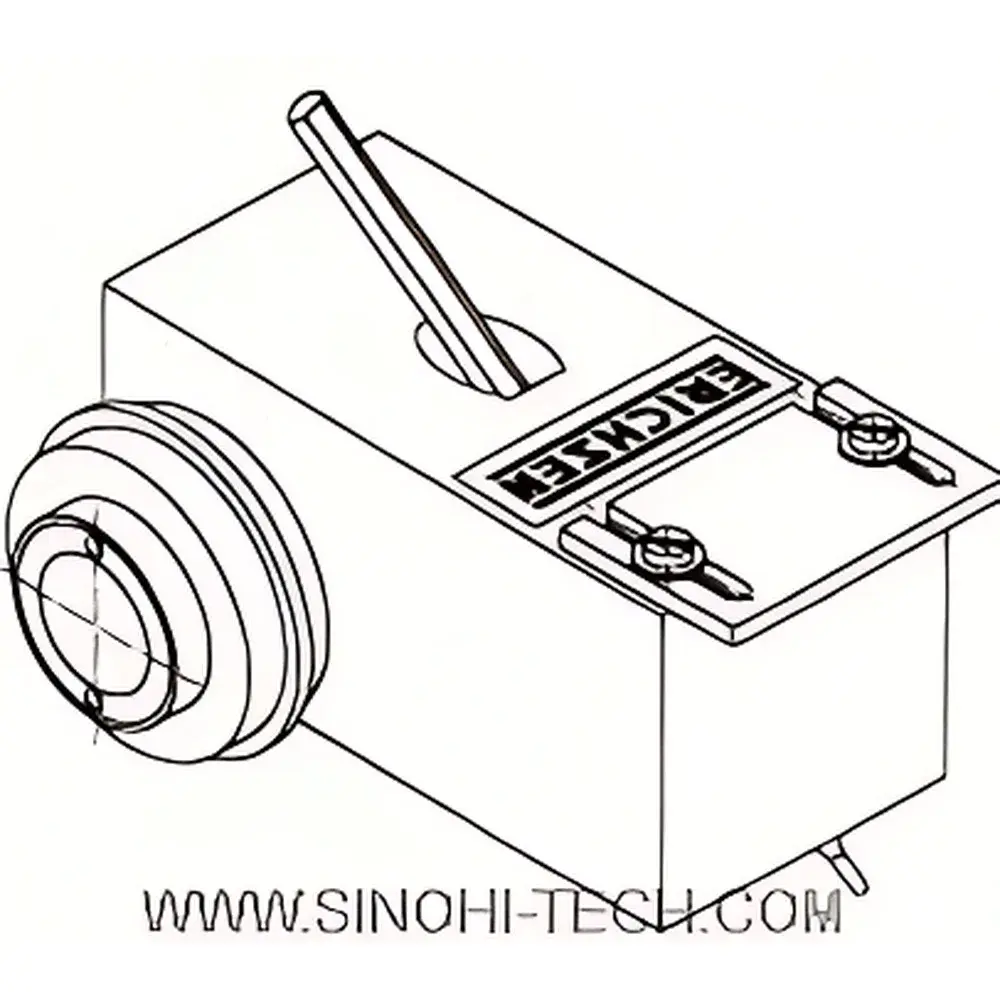
Erichsen #291 Pencil Hardness Tester
| Origin | Germany |
|---|---|
| Supplier Type | Authorized Distributor |
| Import Status | Imported |
| Model | #291 |
| Pricing | Upon Request |
Overview
The Erichsen #291 Pencil Hardness Tester is a precision mechanical instrument designed for standardized scratch hardness evaluation of organic coatings, lacquers, and thin film systems applied on rigid substrates. It operates on the principle of controlled lateral indentation using graphite pencils of defined hardness grades, conforming to internationally recognized test methodologies—including DIN 53154, ASTM D3363, ISO 15184, and JIS K 5600-5-4. Unlike indentation-based hardness testers (e.g., Buchholz or Barcol), this device quantifies coating resistance to surface scratching under reproducible kinematic conditions: a fixed 45° angle of incidence and a regulated normal force of 7.5 ± 0.1 N. The resulting assessment—expressed as the highest pencil grade that produces no visible substrate penetration—serves as an empirical, comparative index widely adopted in R&D labs, quality control departments, and coil coating production lines where rapid, non-destructive pass/fail screening is required.
Key Features
- Engineered compliance with Wolff-Wilborn standard geometry: maintains constant 45° pencil orientation and uniform loading throughout the stroke.
- Mechanically stabilized pressure application eliminates operator-dependent variability in force and angle—critical for inter-laboratory reproducibility.
- Integrated carriage system with low-friction linear guidance ensures smooth, consistent 10 cm/s traverse speed across the test panel.
- Adjustable pencil protrusion depth (5 mm ± 0.2 mm) secured via precision clamping mechanism; compatible with standard hexagonal graphite pencils (2.0–2.5 mm core diameter).
- Robust aluminum alloy chassis with anodized finish for long-term dimensional stability and resistance to workshop environmental exposure.
Sample Compatibility & Compliance
The #291 tester accommodates flat, rigid panels up to 150 × 150 mm and minimum thickness of 0.5 mm (e.g., steel, aluminum, glass, or plastic substrates). It is validated for use with cured thermoset and thermoplastic coatings ≥ 20 µm thick. Note: coatings containing high-volume flake pigments (e.g., aluminum, mica) or excessive pigment loading (>45% PVC) may yield non-representative results due to localized stress concentration at particle edges; alternative methods such as pendulum hardness (DIN 53187) or nanoindentation are recommended for such systems. All test procedures align with GLP documentation requirements and support audit-ready reporting when integrated with compliant laboratory information management systems (LIMS).
Software & Data Management
While the #291 is a manually operated mechanical instrument without embedded electronics, its test protocol is fully compatible with digital workflow integration. Erichsen provides traceable calibration certificates and standardized test record templates (PDF/Excel) compliant with ISO/IEC 17025 documentation structures. When used alongside Erichsen’s optional digital force verification kit (Model FK-200), real-time load validation can be logged and archived to satisfy FDA 21 CFR Part 11 requirements for electronic records and signatures. Raw test outcomes—i.e., the transition point between “marking” and “cutting” pencils—are recorded as discrete ordinal values (e.g., “2H → 3H”) and mapped to tabulated hardness scales referenced in ASTM D3363 Annex A1.
Applications
- Quality assurance of architectural and automotive topcoats during batch release testing.
- In-line hardness monitoring of continuous coil coating processes (pre-paint and post-cure stages).
- Formulation development of UV-curable, waterborne, and high-solids industrial coatings.
- Comparative benchmarking of anti-scratch additives (e.g., silica nanoparticles, fluorinated acrylates) in polymer matrices.
- Supplier qualification audits requiring third-party verified hardness data per OEM specifications (e.g., Ford WSS-M2P178-B, GMW14872).
FAQ
What pencil grades are included with the standard #291 kit?
The base configuration (Order No. 0038.01.31) includes 17 calibrated pencils spanning 6B to 9H hardness, manufactured to DIN 6738 tolerances and individually certified for graphite core geometry and binder consistency.
Is recalibration required between tests?
No periodic recalibration is needed—the mechanical design is inherently drift-free. However, daily verification of pencil protrusion (5 mm), sandpaper grit (P400, ISO 6344), and applied force (via optional FK-200 sensor) is recommended per ISO 15184 Clause 7.2.
Can the #291 be used on curved surfaces?
No. The instrument requires full planar contact between the base plate and test specimen. Curved or textured substrates must be evaluated using alternative methods such as the Erichsen Cupping Test (ISO 1520) or cross-cut adhesion assessment (ISO 2409).
How is pencil tip geometry standardized before testing?
Each pencil is sharpened using the supplied Erichsen precision sharpener (Order No. 89 0114), then abraded on P400 silicon carbide paper until the graphite edge forms a clean, chisel-shaped profile with ≤ 0.1 mm radius—verified optically under 10× magnification.
Related Products



