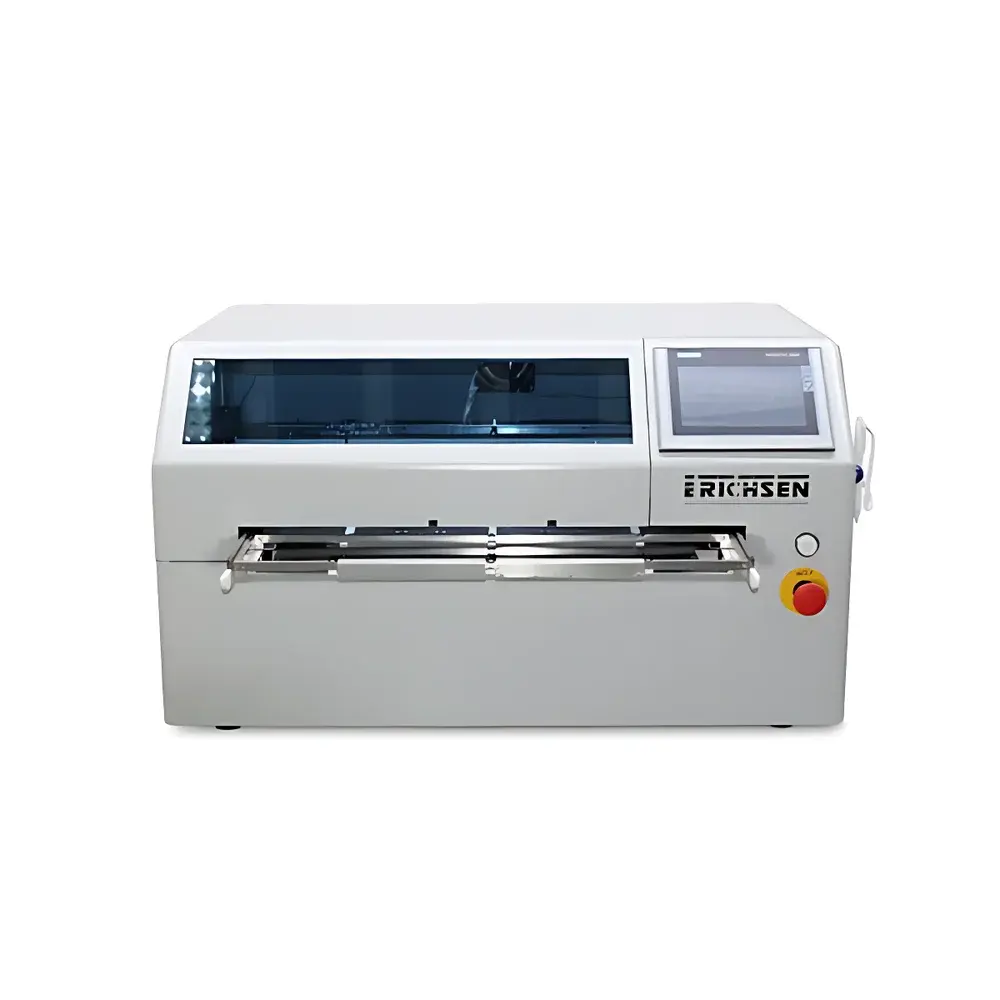
ERICHSEN 432 Gradient Oven
| Brand | ERICHSEN (Germany) |
|---|---|
| Origin | Germany |
| Model | ERICHSEN 432 |
| Voltage | 230 V, 50/60 Hz |
| Power | 3400 VA |
| Heating Area | 520 × 100 mm |
| Test Area | 500 × 70 mm |
| Number of Heating Elements | 45 |
| Linear Gradient Range | 30–320 °C (max ΔT = 100 °C) |
| Step Gradient Options | 2-, 3-, or 4-step (max ΔT per step = 50 °C) |
| Heating Rate | 2–30 °C/min (programmable) |
| Bake Time Setting | Minutes and seconds |
| Temperature Control Accuracy | ±2 °C (≤200 °C), ±3 °C (≤250 °C), ±5 °C (≤320 °C) |
| Sample Pressure Platform | Automatic reciprocating, 16 kP |
| Dimensions (W×D×H) | 465 × 720 × 595 mm |
| Weight | 50 kg |
Overview
The ERICHSEN 432 Gradient Oven is a precision-engineered laboratory instrument designed for the controlled thermal simulation of industrial curing and drying processes—particularly for automotive coatings, powder paints, resins, and polymer-based surface finishes. Unlike conventional convection ovens, the 432 employs a microprocessor-controlled resistive heating platform with 45 individually insulated heating elements to generate highly reproducible linear or discrete stepwise temperature gradients across its 500 × 70 mm test zone. This architecture enables direct correlation between lab-scale testing and real-world oven profiles encountered in automotive paint lines, coil coating facilities, and industrial finishing systems. Its core application lies in accelerated evaluation of thermal stability, discoloration onset (e.g., yellowing of binders), pigment degradation, adhesion loss, and chemical resistance under spatially resolved thermal stress—critical parameters governed by ISO 2810, ASTM D5894, and SAE J2527.
Key Features
- Microprocessor-driven gradient control with intuitive alphanumeric keypad and multilingual interface (English, French, German)
- Programmable linear gradients from 30 °C to 320 °C, with maximum differential temperature of 100 °C across the test area
- Selectable 2-, 3-, or 4-step gradients—each segment maintained at a stable, independently verified setpoint; unheated elements default to ambient (recorded as 23 °C)
- Heating rate adjustable from 2 to 30 °C/min, enabling precise replication of ramp profiles found in industrial cure cycles
- Integrated automatic pressure platform (16 kP) ensures uniform contact between substrate and heating surface during thermal exposure
- High-accuracy thermal control: ±2 °C ≤200 °C; ±3 °C ≤250 °C; ±5 °C ≤320 °C (verified per DIN EN 60584-2 calibration protocols)
- Compliant with DIN VDE 0700 Part 1 safety standards; Class I protection; suitable for non-hazardous laboratory environments (18–25 °C, RH <85%)
Sample Compatibility & Compliance
The ERICHSEN 432 accommodates a broad range of coated substrates—including steel, aluminum, plastic panels, and composite test coupons—up to 520 × 100 mm in footprint. Dual-film applicators allow side-by-side deposition of two distinct coating formulations on a single panel, reducing material consumption and inter-sample variability. Liquid coatings are applied via precision drawdown bars or spray nozzles (backside and edge masking supported); powder coatings utilize electrostatic spraying over magnetically secured or masked substrates. Chemical challenge testing supports standardized reagent placement (e.g., H₂SO₄ for acid rain simulation, NaOH for alkaline cleaner exposure, brake fluid, avian enzymatic solutions, and resin solvents) with 2–3 cm spacing and timed droplet delivery (≈0.05 mL per spot). All procedures align with GLP documentation requirements, and temperature logging meets FDA 21 CFR Part 11 audit-trail readiness when integrated with validated external data acquisition systems.
Software & Data Management
While the 432 operates via embedded firmware without PC dependency, its menu-driven interface stores up to 10 preconfigured step-gradient programs with full parameter recall (ramp rate, dwell time, segment temperatures). Real-time temperature mapping is displayed per heating zone during operation, and final gradient profiles—including element-wise status (active/inactive)—are exportable via RS-232 or optional USB interface for traceability. When deployed in regulated QC labs, the system supports electronic signature workflows and user-access-level controls consistent with ISO/IEC 17025 accreditation frameworks. Calibration certificates conform to DIN EN ISO/IEC 17025 and include uncertainty budgets referenced to NIST-traceable thermocouple standards.
Applications
- Rapid optimization of bake schedules for OEM automotive topcoats and primer-surfacer systems
- Root-cause analysis of thermal-induced defects: binder yellowing, pigment blooming, intercoat delamination
- Validation of coating formulation robustness against localized overheating in complex geometries
- Accelerated aging studies correlating gradient exposure to field performance metrics (e.g., gloss retention, chalking, blistering)
- Qualification of new powder coatings under variable cure windows prior to production line integration
- Supporting R&D compliance with automotive OEM specifications (e.g., VW TL 226, Ford WSS-M2P175-B, GMW 14872)
FAQ
What is the maximum operating temperature of the ERICHSEN 432 Gradient Oven?
The instrument supports continuous operation up to 320 °C, with linear gradients spanning 30–320 °C and a maximum achievable temperature differential of 100 °C.
Can the 432 simulate non-linear oven profiles?
It generates strictly linear or discrete step gradients; non-linear (e.g., exponential or segmented ramp-and-soak) profiles require external controller integration via analog output ports.
Is the temperature gradient verified across the entire test area?
Yes—calibration includes point measurements at ≥9 locations across the 500 × 70 mm zone using certified Class 1 thermocouples per DIN EN 60584-2.
Does the system meet regulatory requirements for GMP environments?
As a standalone instrument, it satisfies mechanical and electrical safety compliance (DIN VDE 0700); full GMP alignment requires documented IQ/OQ/PQ protocols and integration with validated LIMS or ELN platforms.
How is repeatability ensured between test runs?
Repeatability is maintained through closed-loop PID control of each heating element, active thermal compensation, and mechanical stabilization of the pressure platform—validated at ≤±1.5 °C standard deviation over 20 consecutive cycles under identical settings.