
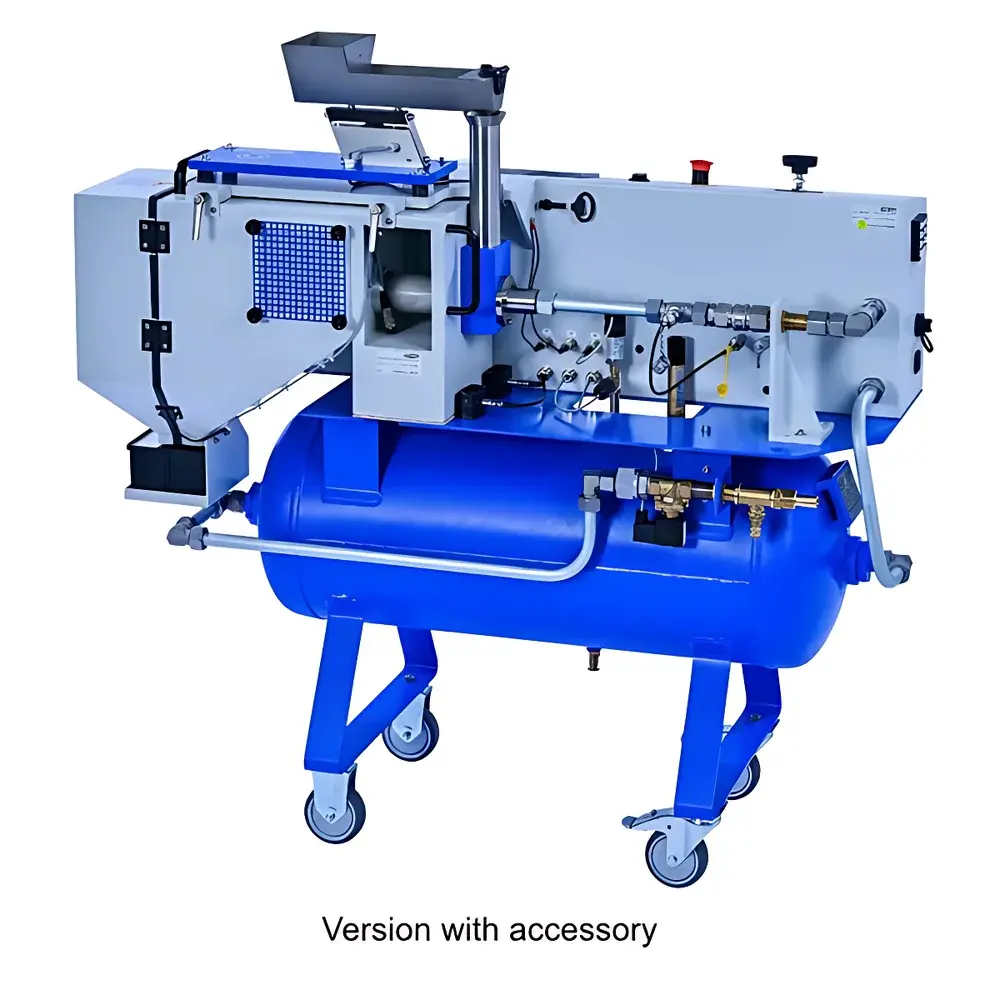
ERICHSEN 508 Select Stone Chip Impact Tester
| Brand | ERICHSEN (Germany) |
|---|---|
| Origin | Germany |
| Model | ERICHSEN 508 Select |
| Compliance Standards | VDA 233-202, SAE J400 |
| Control Interface | 7-inch capacitive touchscreen with password-protected user levels |
| Sample Clamping Options | Manual or pneumatic (VDA module) |
| Module Switching Time | <90 seconds |
| Impact Energy Range | 0.1–2.0 J (adjustable via drop height and projectile mass) |
| Projectile Types | Steel spheres (Φ3 mm, Φ6 mm, Φ10 mm), hardened steel cones (SAE), custom projectiles per specification |
Overview
The ERICHSEN 508 Select Stone Chip Impact Tester is a modular, standards-compliant impact resistance evaluation system engineered for automotive OEMs, Tier-1 suppliers, and materials laboratories requiring precise, repeatable assessment of coating and substrate performance under simulated stone-chip conditions. Based on the principle of controlled free-fall impact mechanics, the instrument delivers calibrated kinetic energy to test specimens via standardized projectiles—enabling quantitative evaluation of chipping resistance, edge protection, and interlayer adhesion integrity. Its dual-standard architecture supports both VDA 233-202 (German Automotive Industry Association) and SAE J400 (Society of Automotive Engineers) methodologies without hardware replacement—making it uniquely suited for global R&D validation workflows where cross-regional compliance reporting is mandatory.
Key Features
- Modular design enables rapid interchange between VDA and SAE test configurations in under 90 seconds—no tools or recalibration required.
- 7-inch industrial-grade capacitive touchscreen with intuitive hierarchical menu navigation and three-tier password protection (operator, supervisor, administrator) to enforce procedural integrity and prevent unauthorized parameter changes.
- VDA module supports both manual clamping (for small-batch QA checks) and pneumatic clamping (for high-throughput production line integration), ensuring consistent specimen positioning and minimizing operator-induced variability.
- SAE module features a rigid, kinematically aligned fixture optimized for flat-panel testing per J400’s specified impact angle (30° ± 2°) and projectile trajectory constraints.
- Impact energy is precisely controlled through independent adjustment of drop height (10–200 mm in 1-mm increments) and selectable projectile mass (0.5 g to 25 g), enabling full coverage of low-energy chip initiation and high-energy substrate deformation regimes.
- Integrated safety interlocks, transparent polycarbonate shielding, and emergency stop circuitry comply with EN ISO 13857 and EN 60204-1 for laboratory and light-industrial environments.
Sample Compatibility & Compliance
The 508 Select accommodates flat or slightly curved panels up to 300 × 300 mm and 5 mm thickness, including painted steel, aluminum, plastic composites (PP, ABS, PC/ABS), and multi-layer coated substrates. Specimen mounting conforms to VDA 233-202 Annex A (clamped edge, 10 mm overhang) and SAE J400 Section 4 (rigidly supported, no overhang). All mechanical components—including guide tubes, impact anvils, and clamping jaws—are manufactured from hardened stainless steel and traceably certified to DIN EN ISO 9001. The system is fully compatible with GLP and IATF 16949-aligned documentation workflows; audit trails for test parameters, operator ID, timestamp, and module configuration are automatically embedded in exported data files.
Software & Data Management
No proprietary software installation is required—the built-in firmware provides complete test definition, execution logging, and result export via USB 2.0 or Ethernet (TCP/IP). Each test record includes raw impact parameters (height, mass, projectile type), operator credentials, environmental metadata (optional external temperature/humidity input), and pass/fail flags against user-defined acceptance thresholds. Export formats include CSV (for statistical process control integration) and PDF reports compliant with ISO/IEC 17025 clause 7.8.2. For enterprise deployment, optional API access supports integration with LIMS platforms and satisfies FDA 21 CFR Part 11 requirements for electronic records and signatures when paired with network-authenticated user accounts.
Applications
- Evaluation of cathodic electrodeposition (CED) primer performance under gravel impact stress.
- Comparative analysis of clear coat formulations for chip resistance and crack propagation behavior.
- Validation of adhesive bonding strength in multi-material vehicle body structures (e.g., steel-aluminum hybrids).
- Qualification of thermoplastic elastomer (TPE) fender liners and wheel arch liners per OEM-specific chip resistance targets.
- Supporting ASTM D3170 (chipping resistance of coatings) correlation studies where angular impact geometry differs from standard falling-dart protocols.
FAQ
Does the 508 Select require annual calibration by an accredited lab?
Yes—ERICHSEN recommends traceable calibration every 12 months or after 5,000 impacts, whichever occurs first. Calibration certificates include verification of drop height repeatability (±0.2 mm), projectile mass tolerance (±0.5%), and energy deviation (<±1.5% at nominal setting).
Can third-party projectiles be used?
Only projectiles supplied by ERICHSEN or certified to DIN 50103-1 (hardness ≥60 HRC, sphericity ≤0.5 µm) are supported. Non-certified projectiles void warranty and invalidate compliance claims.
Is pneumatic clamping compatible with SAE J400 testing?
No—pneumatic clamping is exclusive to the VDA module. SAE J400 mandates rigid, non-deformable support; therefore, the SAE fixture uses M8 threaded inserts and hardened steel locating pins per Figure 2 of the standard.
What environmental conditions must be maintained during testing?
Testing shall be conducted at 23 ± 2 °C and 50 ± 5 % RH per VDA 233-202 Section 5.1. The instrument does not regulate ambient conditions but includes sensor inputs for external climate monitoring integration.
How is impact location repeatability ensured across multiple tests?
A laser alignment system (optional accessory) projects a crosshair onto the specimen surface, referenced to the guide tube axis with ±0.1 mm positional accuracy. Mechanical stops on the VDA clamping plate further constrain lateral displacement during loading.
Related Products





