
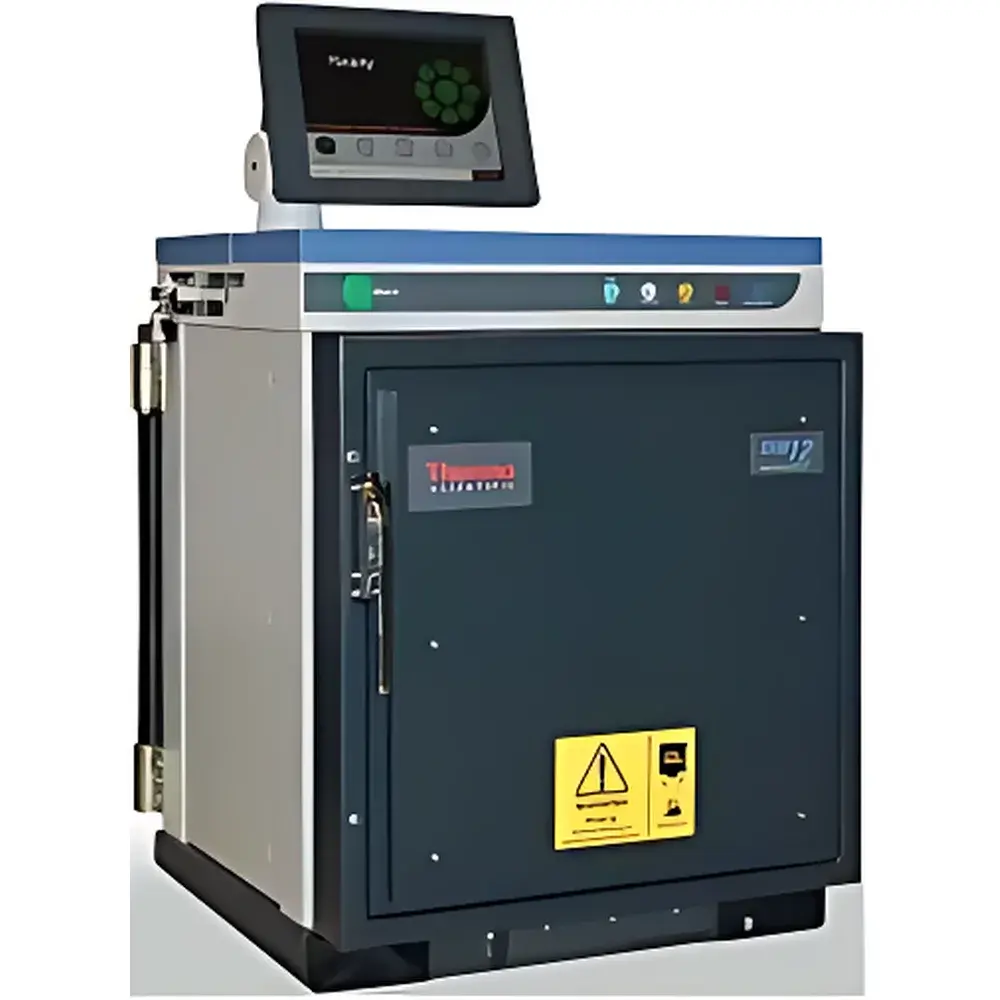
Thermo Fisher SAM12 Small-Item Radiation Monitor
| Brand | Thermo Fisher |
|---|---|
| Origin | USA |
| Model | SAM12 |
| Instrument Type | Gamma Radiation Dose Rate & Activity Monitor |
| Detector Configurations | 4-detector or 6-detector array |
| Shielding Options | 25 mm or 50 mm lead |
| Energy Range | 50 keV – 2 MeV |
| Background | 0.1 µSv/h |
| Minimum Detectable Activity (MDA) | 70 Bq (⁶⁰Co), 180 Bq (¹³⁷Cs) for 4-detector |
| Detection Efficiency (4π geometry) | 40% @ ⁶⁰Co, 16% @ ¹³⁷Cs, 26% @ ¹³³Ba (4-detector) |
| Measurement Units | Bq, kBq, dpm, pCi, µCi, mCi, Ci |
| Measurement Time | 3–300 s |
| False Alarm Rate | ≤0.1% |
| Detection Probability | ≥95% at 10 s dwell |
| Regulatory Compliance | Designed for compliance with ANSI N42.34, IEC 62327, and applicable ISO 7205 / ISO 8529-2 protocols |
Overview
The Thermo Fisher SAM12 Small-Item Radiation Monitor is an engineered gamma radiation screening system designed for rapid, quantitative activity assessment of tools, personal protective equipment (PPE), laboratory consumables, and other low-volume items in nuclear medicine departments, radiopharmaceutical manufacturing facilities, decommissioning sites, and research laboratories. Unlike handheld survey meters, the SAM12 employs a fixed-geometry, multi-detector scintillation array configured in either 4- or 6-detector layouts to deliver reproducible 4π counting efficiency under controlled shielding conditions. Its measurement principle is based on gamma-ray spectroscopy using NaI(Tl) detectors coupled with digital pulse-height analysis, enabling energy-dependent activity quantification without manual calibration per radionuclide. The system operates within a defined energy window (50 keV – 2 MeV), optimized for common gamma emitters including 60Co, 137Cs, 133Ba, and 57Co — critical for routine contamination control and release verification per ALARA principles.
Key Features
- Modular detector architecture: Select between 4-detector (144,400 mm² total active area, 823 cm³ detection volume) or 6-detector (216,600 mm², 1235 cm³) configurations to balance throughput and sensitivity requirements.
- Optimized lead shielding: Standard 50 mm Pb shielding reduces background to ≤0.1 µSv/h, ensuring high signal-to-noise ratio and sub-100 Bq detection limits for key isotopes — validated per ANSI N42.22 methodology.
- Configurable measurement protocol: Adjustable dwell time (3–300 s), user-selectable activity units (Bq, dpm, pCi, etc.), and programmable alarm thresholds support both rapid screening and high-confidence release decisions.
- Dual-door or single-door cabinet options accommodate varying workflow integration needs while maintaining consistent geometry and shielding integrity.
- Digital spectral processing engine provides real-time gross count rate, net activity, and energy-compensated dose rate (µSv/h) — traceable to NIST-traceable reference sources.
Sample Compatibility & Compliance
The SAM12 accommodates objects up to 30 cm × 30 cm × 15 cm (W × D × H) placed centrally on the internal tray. Its uniform detection geometry ensures consistent 4π efficiency across the measurement volume, minimizing positional uncertainty. The system meets design and performance criteria outlined in ANSI N42.34 (Performance Criteria for Hand-Held Instruments for the Detection and Identification of Radionuclides) and IEC 62327 (Hand-held instruments for photon and neutron detection). While not a personal dosimeter, its output supports regulatory documentation required under 10 CFR Part 20, EURATOM Directive 2013/59, and ISO 20553 (Radiological protection — Sampling and monitoring of radioactive contamination). All firmware and configuration files are timestamped and support audit-ready data export compliant with GLP/GMP record-keeping standards.
Software & Data Management
Controlled via Thermo Fisher’s proprietary SAMSuite software, the SAM12 enables instrument setup, method definition, result review, and report generation through a Windows-based interface. Each measurement generates a structured XML log containing detector ID, acquisition parameters, raw spectra (optional), net counts, MDA calculation, and operator ID. Audit trails record all configuration changes, user logins, and calibration events. Export formats include CSV (for LIMS integration), PDF (certified reports), and XML (for automated QA/QC pipelines). Software supports 21 CFR Part 11-compliant electronic signatures when deployed with validated domain authentication and role-based access control.
Applications
- Routine clearance of lab tools and PPE prior to disposal or reuse in low-level radioisotope handling areas.
- Final release verification of decontaminated components from decommissioned nuclear infrastructure.
- Quality assurance testing of shielded containers used for radiopharmaceutical transport.
- Supporting ISO/IEC 17025-accredited laboratories in establishing traceable activity measurement uncertainty budgets.
- Training and procedural validation for radiation protection officers (RPOs) and health physics technicians.
FAQ
What radionuclides is the SAM12 calibrated for?
The SAM12 is factory-characterized for 60Co, 137Cs, 133Ba, and 57Co. Custom efficiency calibrations can be performed onsite using certified reference sources traceable to national metrology institutes.
Can the SAM12 distinguish between multiple radionuclides in a mixed sample?
Yes — its NaI(Tl) detectors provide sufficient energy resolution to separate major gamma peaks (e.g., 662 keV of 137Cs and 1173/1332 keV of 60Co), enabling semi-quantitative multi-nuclide analysis when combined with spectral deconvolution in SAMSuite.
Is annual recalibration required?
Per Thermo Fisher recommendations and ISO/IEC 17025 clause 6.4.10, full system performance verification — including background, MDA, and efficiency — should be conducted at least annually or after any physical modification to shielding or detector layout.
Does the SAM12 meet FDA or EMA regulatory expectations for pharmaceutical facility use?
While not an FDA-cleared medical device, the SAM12 satisfies technical requirements for environmental monitoring and material release in GMP-regulated radiopharmaceutical production, as referenced in USP <1251> and EMA Guideline on Radiopharmaceuticals (CHMP/QWP/389157/2020).







