
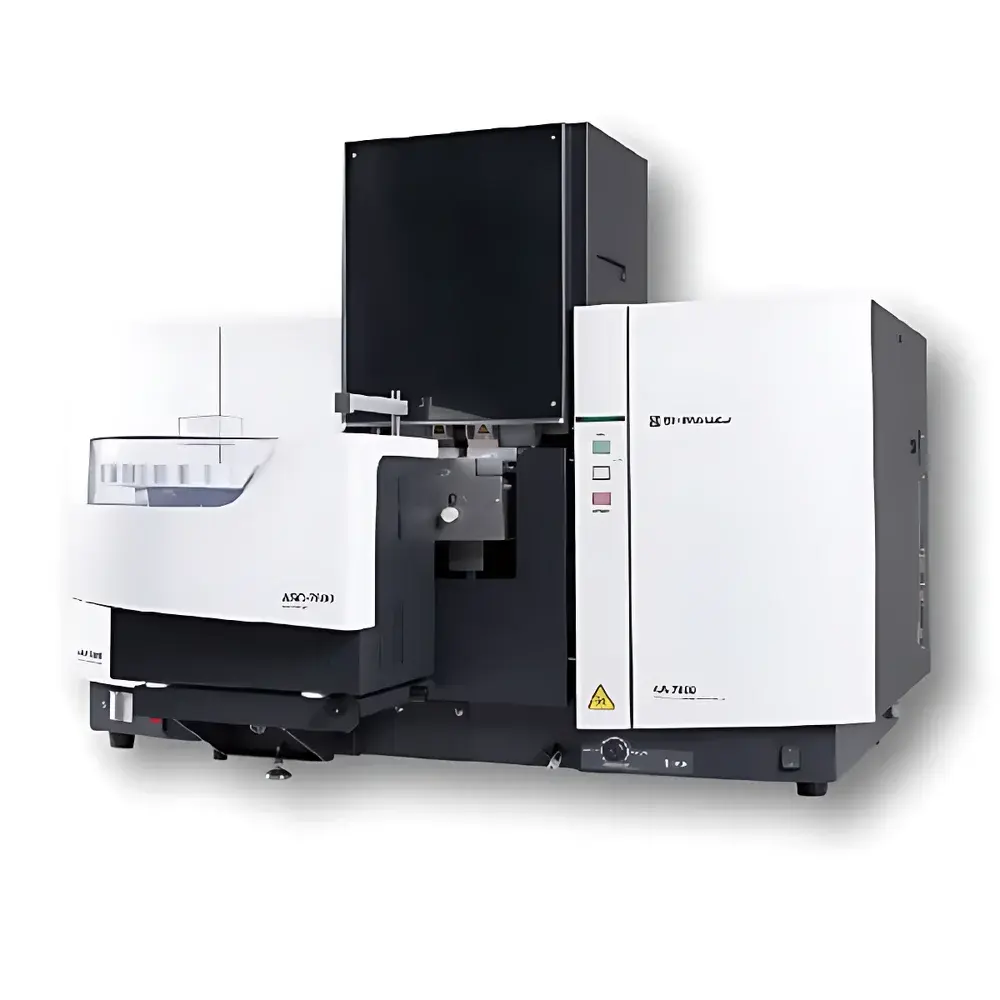
Shimadzu AA-7800 Flame and Graphite Furnace Atomic Absorption Spectrophotometer
| Brand | Shimadzu |
|---|---|
| Origin | Japan |
| Model | AA-7800 |
| Instrument Type | Flame–Graphite Furnace Hybrid |
| Optical System | Single-beam (dual-beam stabilized for flame mode) |
| Monochromator | Grating-based dispersive element |
| Detector | Solid-state photodiode array |
| Background Correction | Deuterium Lamp + Self-reversal (Self-Absorption) Method |
| Spectral Resolution | 0.1 nm |
| Sensitivity | Flame mode — 0.1 µg/mL Pb |
| Repeatability (RSD) | <0.3% |
| Detection Limit (Cu) | ≤6 µg/L |
Overview
The Shimadzu AA-7800 is a high-performance, dual-configuration atomic absorption spectrophotometer engineered for quantitative elemental analysis across diverse laboratory environments—from routine quality control in environmental and food testing labs to trace-metal characterization in pharmaceutical and metallurgical research. Operating on the fundamental principle of atomic absorption spectroscopy (AAS), the instrument measures ground-state atom concentration in a gaseous atomic vapor by quantifying the attenuation of characteristic hollow cathode lamp (HCL) radiation at element-specific wavelengths. Its hybrid architecture supports both flame atomization (for higher-concentration samples with robust precision) and electrothermal graphite furnace atomization (for sub-ppt level detection), enabling method flexibility without hardware reconfiguration. The AA-7800 integrates a thermally stable optical bench, digitally controlled temperature ramping for graphite furnace programs, and an advanced background correction system combining deuterium arc and self-reversal techniques—ensuring accurate absorbance measurement even in complex matrices with spectral or structured background interference.
Key Features
- Dual-atomization platform: Configurable as flame-only (AA-7800F/F/AAC), graphite furnace-only (AA-7800G), or integrated flame/graphite furnace (AA-7800FG/AFG) with manual or automated atomizer switching.
- Enhanced optical throughput: Proprietary 3D optical path design increases radiant flux to the detector, improving signal-to-noise ratio and lowering graphite furnace detection limits to world-class levels.
- Intelligent lamp management: Eight-position automatic lamp turret with dedicated high-output HCL slots (positions 7 and 8); simultaneous activation of two lamps for multi-element sequential analysis or reference-channel optimization.
- Integrated high-stability HCL power supply: Eliminates external power units; delivers precise current regulation and pulse modulation for improved emission intensity, long-term stability, and extended lamp lifetime—particularly beneficial for volatile elements (e.g., As, Se, Sb, Bi, Pb, Zn).
- Comprehensive safety architecture: Real-time gas leak detection with automatic ignition lockout; mechanical interlock via MAC accessory to prevent accidental flame ignition during graphite furnace operation; flame-out auto-shutdown upon fuel cutoff; UL94 V-0 rated flame-retardant housing materials.
Sample Compatibility & Compliance
The AA-7800 accommodates aqueous solutions, digested biological tissues, acid-leached soil extracts, and diluted industrial effluents. Its graphite furnace module accepts sample volumes from 5–50 µL with programmable drying, pyrolysis, and atomization stages—supporting matrix modification and platform-assisted stabilization per ISO 11170 and ASTM D5686 guidelines. Flame mode complies with EPA Method 7000B and ISO 11885 for metals in water. The system meets GLP/GMP documentation requirements through audit-trail-enabled software (see below), and its background correction methodology aligns with USP and ICH Q2(R2) recommendations for specificity validation in elemental impurity testing.
Software & Data Management
Controlled via Shimadzu’s LabSolutions AAS software, the AA-7800 supports full method development, calibration curve generation (linear, quadratic, or weighted least-squares), QC sample scheduling, and automated report generation. All instrument parameters—including lamp current, slit width, integration time, and furnace temperature ramps—are stored with timestamps and user IDs. The software includes 21 CFR Part 11-compliant features: electronic signatures, role-based access control, immutable audit trails, and data integrity safeguards for regulated environments. Raw spectral data and peak integration logs are exportable in CSV, XML, and PDF formats for LIMS integration.
Applications
- Environmental monitoring: Quantification of heavy metals (Pb, Cd, Cr, Ni, Cu, Zn) in drinking water, wastewater, and sediment per EPA and EU WFD directives.
- Pharmaceutical quality control: Elemental impurity screening (ICH Q3D) in active pharmaceutical ingredients (APIs) and excipients using graphite furnace AAS.
- Food safety: Detection of toxic elements (As, Hg, Cd) in infant formula, seafood, and fortified cereals at regulatory action levels.
- Clinical and biological research: Trace metal profiling (Fe, Zn, Cu, Mn) in serum, whole blood, and tissue homogenates.
- Geological and metallurgical analysis: Alloy composition verification and ore grade assessment following ISO 17294-2 protocols.
FAQ
What atomization modes does the AA-7800 support?
The AA-7800 offers flame, graphite furnace, or combined flame/furnace configurations depending on model variant (F, G, FG, or AFG). All variants share identical optical and electronics architecture.
Is background correction fully automated?
Yes—the deuterium lamp and self-reversal methods operate automatically based on selected analytical wavelength and lamp type, with real-time background subtraction applied prior to absorbance calculation.
Can the AA-7800 be used in regulated pharmaceutical laboratories?
Yes—when operated with LabSolutions AAS under validated conditions, it satisfies FDA 21 CFR Part 11, EU Annex 11, and ICH Q2(R2) data integrity and traceability requirements.
What maintenance is required for long-term stability?
Routine cleaning of burner heads and graphite tubes, annual alignment verification, and biannual calibration of furnace temperature sensors using NIST-traceable standards are recommended per Shimadzu’s PM schedule.
Does the system support hydride generation or cold vapor accessories?
No—the AA-7800 is optimized for flame and electrothermal atomization only; hydride/cold vapor functionality requires integration with Shimadzu’s separate HGA or CVAA modules (not included).
Related Products




