
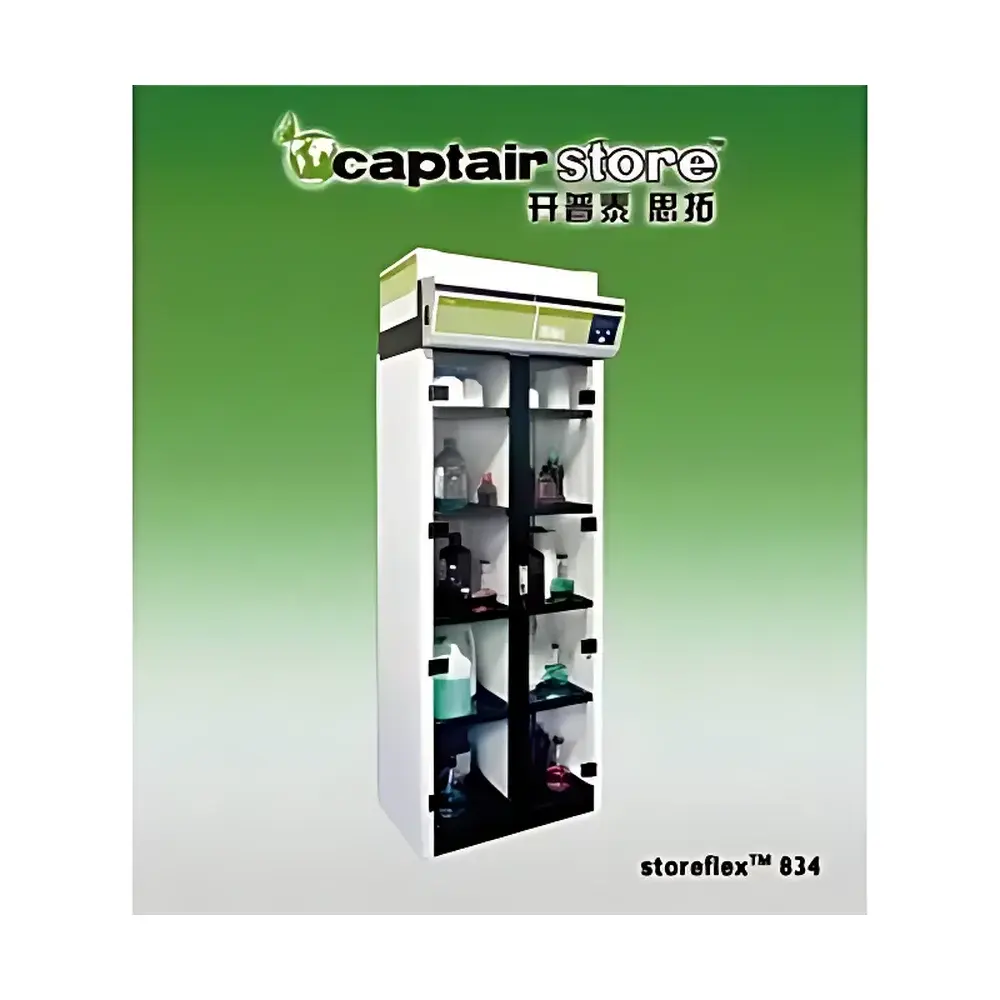
Erlab 834 Ductless High-Efficiency Chemical Storage Cabinet
| Brand | Erlab |
|---|---|
| Origin | France |
| Model | 834 |
| Construction | Polypropylene (PP) cabinet body with modular molecular filtration system |
| Filtration Architecture | Multi-stage, customizable filter modules (acid, base, solvent, aldehyde, amine-specific media) |
| Safety Redundancy | Integrated safety pre-filter for fail-safe operation upon primary filter saturation |
| Control System | Microprocessor-based panel with fan status monitoring, real-time airflow verification, and optional filter saturation alert (Molecode S sensor module) |
| Compliance | Conforms to French Standard NFX 15-211 for ductless fume containment cabinets |
| Certification | Validated per SGS and Intertek (formerly ITS) test reports |
Overview
The Erlab 834 Ductless High-Efficiency Chemical Storage Cabinet is an engineered containment solution designed for the safe, long-term storage of hazardous laboratory chemicals without requiring external ducting or facility exhaust infrastructure. It operates on the principle of active recirculation: ambient air inside the cabinet is drawn through a precisely configured multi-stage molecular filtration system, where volatile organic compounds (VOCs), acidic vapors (e.g., HCl, HNO₃), basic gases (e.g., NH₃), aldehydes, amines, and halogenated solvents are adsorbed or chemically neutralized by high-capacity, application-specific filter media. The purified air is then returned to the laboratory environment—ensuring continuous air quality improvement while eliminating cross-contamination risks between incompatible reagents. Unlike passive storage cabinets, the 834 integrates real-time airflow dynamics and pressure-differential monitoring to maintain negative internal pressure relative to the lab, preventing unfiltered leakage during door operation or filter aging.
Key Features
- Modular filtration architecture: Filter modules consist of stacked, replaceable cartridges—each containing up to three distinct molecular media layers (e.g., activated carbon + potassium permanganate + zeolite) tailored to specific chemical classes used in the lab.
- Fail-safe dual-filter redundancy: A dedicated safety pre-filter is installed upstream of the main module; it remains inert until primary filter saturation is detected, at which point it automatically engages to maintain >99.9% removal efficiency—validated per ISO 10121-1 for breakthrough resistance.
- PP monolithic construction: Entire interior—including walls, sills, and adjustable shelves—is fabricated from virgin polypropylene (PP), offering full resistance to concentrated acids (e.g., 98% H₂SO₄), alkalis (e.g., 50% NaOH), oxidizers, and halogenated solvents without stress cracking or dimensional degradation.
- Secure, ergonomic access: Twin transparent polycarbonate doors with integrated mechanical lock system (keyed-alike or master-key options available); door gaskets meet ASTM D1056 for compression set resistance over 10,000 cycles.
- Intelligent control interface: Embedded microcontroller monitors fan RPM, static pressure differential across filters, and cumulative runtime; optional Molecode S sensor module provides dual-point detection—ambient lab air sampling + post-filter effluent analysis—enabling predictive filter replacement scheduling.
Sample Compatibility & Compliance
The 834 cabinet supports segregation of mutually incompatible substances—including oxidizers and organics, acids and bases, pyrophorics and water-reactives—via independent compartmentalization enabled by its five-height-adjustable PP shelves (3 L spill-containment capacity per shelf). Each shelf features raised edges and non-slip surface texture to prevent bottle displacement. All configurations comply with NFX 15-211 (French standard for ductless containment devices), and third-party validation reports from SGS and Intertek confirm performance against EN 14175-3 (fume cupboard testing methodology) and ISO 16000-3 (indoor air VOC measurement protocols). While not a fume hood substitute for active manipulation, the 834 meets OSHA 1910.1200 (HCS) and CLP Regulation (EC No. 1272/2008) requirements for secondary containment and exposure minimization during storage.
Software & Data Management
The cabinet’s control unit logs timestamped events—including fan activation/deactivation, airflow deviations (>±10% nominal), and filter saturation alerts—with local storage for ≥12 months. When integrated with Erlab’s optional LabManager™ network gateway (sold separately), data exports via encrypted HTTPS to centralized LIMS or EHS platforms. Audit trails comply with FDA 21 CFR Part 11 requirements for electronic records: user authentication, immutable timestamps, and operator action logging. Filter lifecycle history—including installation date, chemical exposure profile, and saturation threshold crossings—is retained for GLP/GMP traceability and regulatory inspection readiness.
Applications
- Academic and industrial research laboratories storing diverse reagent inventories under space-constrained or renovation-sensitive conditions.
- Pharmaceutical QC labs requiring segregation of ICH Q5-defined stability-indicating standards and reference materials.
- Environmental testing facilities managing EPA Method 8081/8270 analyte stock solutions (PCBs, PAHs, pesticides) with documented vapor suppression.
- University teaching labs deploying tiered chemical storage aligned with NFPA 45 hazard classification and GHS pictogram zoning.
- Contract development and manufacturing organizations (CDMOs) maintaining cGMP-aligned storage logs for API intermediates and solvents.
FAQ
How is filter service life determined?
Filter lifespan is calculated dynamically based on cumulative exposure time, measured airflow rate, and real-time concentration profiles from the Molecode S sensors—not fixed calendar intervals. Typical service life ranges from 6–24 months depending on chemical volatility, storage density, and frequency of door openings.
Can the cabinet be relocated without recertification?
Yes—the 834 requires no structural modification or HVAC integration; relocation only necessitates electrical connection verification and post-move airflow calibration using Erlab’s certified field service procedure (documented in ISO/IEC 17025-accredited report).
Is it suitable for peroxide-forming solvents like diethyl ether?
Yes—when equipped with peroxide-specific catalytic media (Erlab Ref. FIL-PEX), the system continuously decomposes hydroperoxides below detectable accumulation thresholds; validated per ASTM D7279 for autoxidation inhibition efficacy.
Does it meet US EPA or California Air Resources Board (CARB) compliance for VOC emissions?
While not classified as an emission source under Title 40 CFR Part 60, the 834 reduces net lab VOC load by >95% versus passive storage—supporting LEED IEQ Credit 4.1 and CARB BAAQMD Rule 1168 reporting for institutional sustainability programs.
Related Products



