
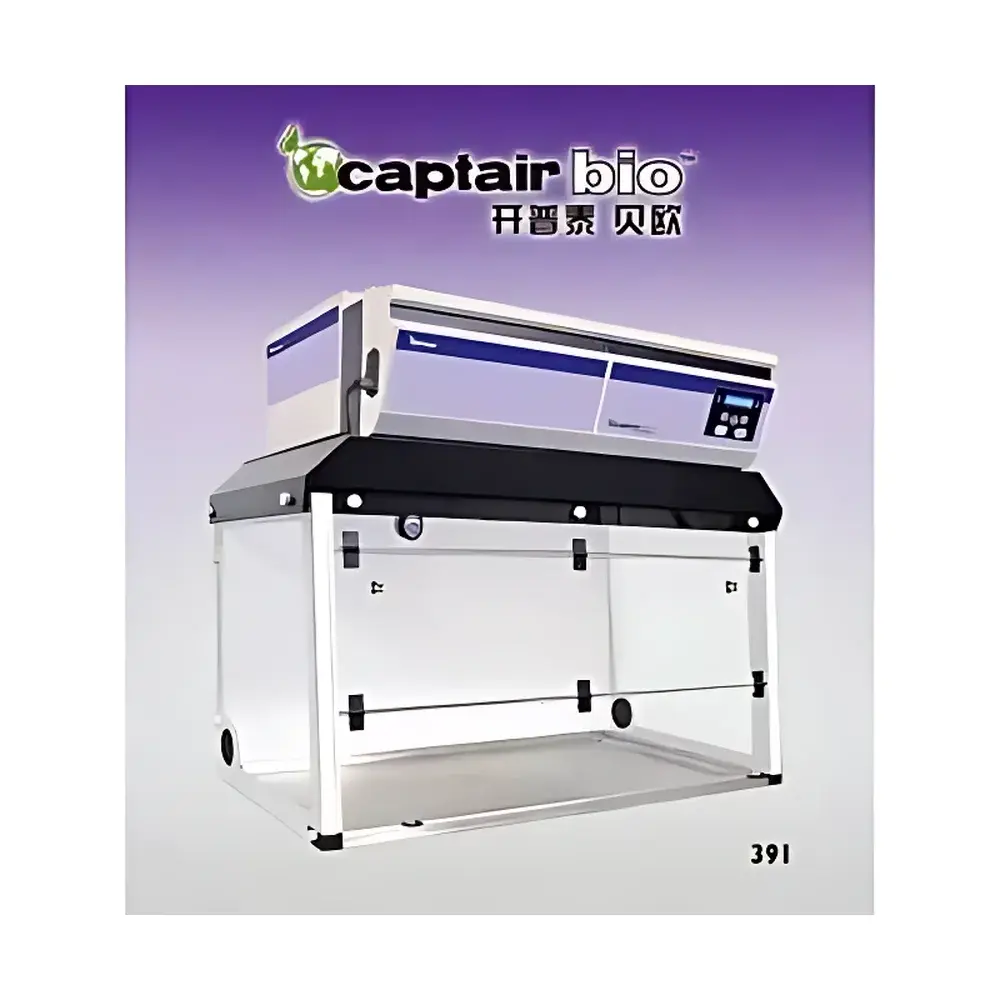
Erlab Biocap 391 PCR Purification Workstation
| Brand | Erlab |
|---|---|
| Origin | France |
| Model | Biocap 391 |
| Instrument Type | Horizontal Laminar Flow Clean Bench |
| Cleanliness Class | ISO Class 5 (Class 100) Equivalent |
| Airflow Velocity | ≥0.3 m/s |
| HEPA Filter Grade | H14 (99.999% @ 0.3 µm) |
| Air Volume | 230 m³/h |
| Dimensions (W×D×H) | External 1010 × 677 × 950 mm, Internal 969 × 523 × 640 mm |
| Operating Voltage/Frequency | 100–240 V / 50–60 Hz |
| Power Consumption | 58 W |
| Sound Pressure Level | 52 dB(A) |
| Cabinet Pressure | Positive Pressure Relative to Ambient |
Overview
The Erlab Biocap 391 is a purpose-engineered horizontal laminar flow purification workstation designed exclusively for polymerase chain reaction (PCR) and other nucleic acid amplification workflows where sample integrity is paramount. Unlike general-purpose clean benches or biosafety cabinets, the Biocap 391 operates on a positive-pressure horizontal airflow principle—drawing ambient laboratory air through an integrated H14-grade HEPA filter (efficiency ≥99.999% at 0.3 µm), then delivering unidirectional, particle-free laminar flow across the work surface toward the operator. This configuration ensures that the internal workspace remains free of exogenous DNA, RNA, and RNase/DNase contaminants originating from room air or operator shedding. Critically, the cabinet maintains a stable positive pressure differential relative to the surrounding environment, preventing ingress of unfiltered air—even during frequent hand entry/exit. The inclusion of a timer-controlled ultraviolet (UV-C, 254 nm) lamp enables automated decontamination between runs, mitigating carryover contamination risks inherent in sequential PCR setups.
Key Features
- Horizontal laminar airflow architecture optimized for PCR sample protection—not personnel or environmental safety—distinguishing it from Class II biosafety cabinets.
- H14 HEPA filtration system certified to EN 1822-1:2022 standards, providing ≥99.999% particle removal efficiency at the most penetrating particle size (MPPS) of 0.3 µm.
- Stable positive-pressure interior (typically +15–25 Pa above ambient), validated to prevent infiltration during dynamic operation with repeated glove or hand insertion.
- Integrated low-noise centrifugal blower delivering consistent airflow velocity ≥0.3 m/s across the full work surface (per ISO 14644-3:2019 Annex B).
- UV-C lamp (254 nm) with programmable digital timer, enabling scheduled irradiation cycles to degrade residual nucleic acids and reduce cross-contamination risk.
- Energy-efficient design: 58 W total power draw, compliant with IEC 61000-3-2 harmonic current emission limits.
- Universal input power supply (100–240 V, 50–60 Hz), supporting global deployment without voltage conversion hardware.
Sample Compatibility & Compliance
The Biocap 391 is intended for use with open-tube PCR setup, qPCR plate handling, cDNA synthesis, cloning, and NGS library preparation—where maintaining template purity is non-negotiable. It is not rated for biohazardous or toxic material containment (i.e., not a biosafety cabinet per NSF/ANSI 49 or EN 12469). Its design aligns with ISO/IEC 17025:2017 requirements for controlled environments in testing laboratories and supports GLP-compliant documentation when paired with external audit logs. While not FDA 21 CFR Part 11–validated out-of-the-box, its UV timer functionality and stable airflow performance are compatible with internal SOPs governing contamination control in molecular diagnostics and research labs.
Software & Data Management
The Biocap 391 operates via a dedicated electromechanical control panel with tactile push-button interface—no embedded software, firmware updates, or network connectivity. This analog architecture eliminates cybersecurity vulnerabilities and ensures deterministic, repeatable operation over time. UV exposure duration is set manually (0–60 min increments); airflow remains continuously active during operation unless manually switched off. For laboratories requiring electronic traceability, integration with external environmental monitoring systems (e.g., temperature, humidity, particulate counters) is supported via standard 4–20 mA or Modbus RTU interfaces on optional accessory modules (sold separately).
Applications
- Pre-PCR reagent preparation and master mix assembly under nucleic acid–free conditions.
- Handling of low-copy-number templates, single-cell lysates, or clinical specimens highly susceptible to background contamination.
- Post-PCR cleanup steps where amplicon carryover must be avoided prior to sequencing or hybridization.
- CRISPR guide RNA complex assembly and ribonucleoprotein (RNP) formulation.
- Quality control environments validating extraction kits, reverse transcription reagents, or Taq polymerases.
FAQ
Is the Biocap 391 suitable for handling infectious agents or hazardous chemicals?
No. It provides no personnel or environmental protection and is not certified as a biosafety cabinet or chemical fume hood.
Why is a horizontal flow design preferred over vertical flow for PCR applications?
Horizontal flow ensures exhaust air moves away from the operator and does not recirculate over the sample zone—minimizing risk of aerosolized DNA/RNA deposition onto open tubes.
Does the H14 filter require replacement? How often?
Yes. Filter service life depends on ambient particulate load; typical replacement interval is 12–24 months under standard lab conditions, verified by in-situ airflow and pressure drop monitoring.
Can the UV lamp be used while the unit is operating?
No. UV illumination is interlocked with the main airflow system and only activates when the blower is off and the sash is closed.
Is calibration or certification included with purchase?
Factory-assembled units ship with a Certificate of Conformance (CoC) verifying airflow velocity, filter integrity (via DOP/PAO scan), and electrical safety. On-site IQ/OQ validation support is available through Erlab-certified service partners.



