
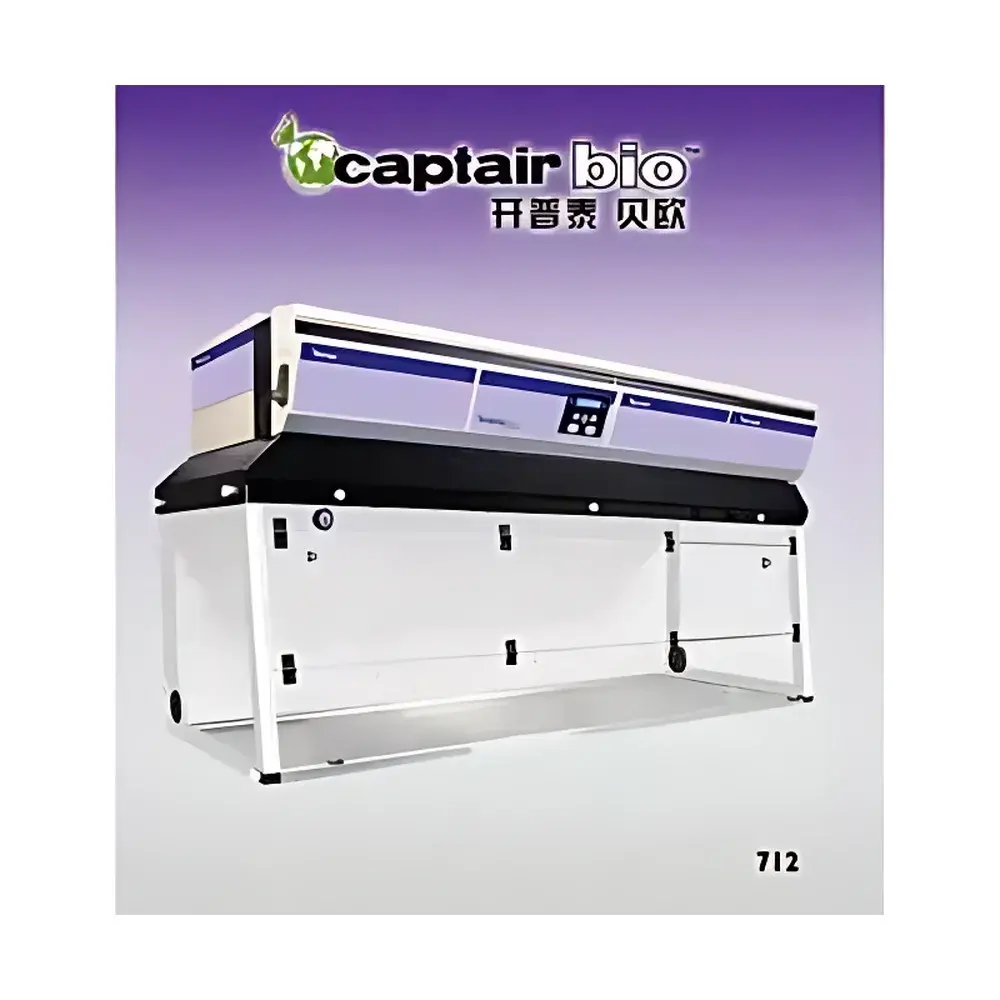
Erlab Biocap 712 PCR-Specific Horizontal Laminar Flow Clean Bench
| Brand | Erlab |
|---|---|
| Origin | France |
| Model | Biocap 712 |
| Instrument Type | Horizontal Laminar Flow Clean Bench |
| Cleanliness Class | ISO Class 5 (Class 100) |
| Air Velocity | > 0.3 m/s |
| Filtration | H14 HEPA Filter (EN 1822-1:2019) |
| Airflow Volume | 460 m³/h |
| Dimensions (W×D×H) | External 1750 × 689 × 950 mm |
| UV Lamp | Timer-Controlled, 254 nm |
| Power Supply | 100–240 V AC, 50–60 Hz |
| Total Power Consumption | 105 W |
| Sound Pressure Level | 55 dB(A) |
| Fan Quantity | 2 |
| Compliance | EN 12464-1, ISO 14644-1, IEC 61000-6-3 |
Overview
The Erlab Biocap 712 is a purpose-engineered horizontal laminar flow clean bench explicitly designed for polymerase chain reaction (PCR) and other nucleic acid–sensitive molecular biology applications. Unlike general-purpose clean benches or biosafety cabinets, the Biocap 712 prioritizes sample integrity over personnel protection—addressing the critical need to eliminate exogenous DNA and RNA contamination from ambient air, operator shedding, or residual carryover between runs. Its operational principle relies on unidirectional, horizontally directed airflow generated by two independently controlled centrifugal fans. Ambient laboratory air is drawn through an H14-grade HEPA filter (tested per EN 1822-1:2019, ≥99.995% efficiency at MPPS), producing ISO Class 5 (equivalent to Federal Standard 209E Class 100) conditions across the entire work surface. The filtered air flows parallel to the work plane at a uniform velocity exceeding 0.3 m/s, minimizing turbulence and preventing vertical recirculation that could reintroduce contaminants. Exhaust air is discharged forward—away from the operator’s breathing zone—eliminating retrograde aerosol migration into the sterile field. This configuration ensures that the operator acts as a passive barrier rather than a contamination source, aligning with best practices defined in ISO/IEC 17025 and CLSI EP25-A guidelines for molecular diagnostics laboratories.
Key Features
- Dedicated PCR workflow architecture: Optimized horizontal laminar flow path prevents cross-contamination between pre- and post-amplification zones.
- H14 HEPA filtration system: Validated particle retention ≥99.995% at most penetrating particle size (MPPS ≈ 0.1–0.2 µm), compliant with EN 1822-1:2019 and ISO 14644-1 Class 5 requirements.
- Integrated UV-C germicidal lamp (254 nm): Programmable timer-controlled irradiation cycle ensures consistent decontamination of internal surfaces between experiments without manual intervention.
- Dual-fan redundancy: Two independent centrifugal blowers maintain stable airflow velocity (>0.3 m/s) across full depth—even under partial filter loading—and support continuous operation during scheduled maintenance.
- Low-noise engineering: Acoustic design achieves ≤55 dB(A) at 1 m distance, meeting EN ISO 7779 and ISO 3744 noise emission standards for laboratory environments.
- Universal power compatibility: Auto-ranging 100–240 V AC input with 50–60 Hz frequency tolerance enables seamless deployment across global laboratory infrastructures.
Sample Compatibility & Compliance
The Biocap 712 supports open-vessel handling of PCR master mixes, primers, templates, and post-PCR products without risk of airborne nuclease-mediated degradation or amplicon carryover. Its horizontal flow geometry eliminates the vertical downflow interference common in Class II biosafety cabinets—where operator-generated particles may settle onto samples despite inward face velocity. The unit complies with key international standards governing cleanroom performance and electromagnetic compatibility: EN 12464-1 (lighting and indoor air quality for cleanrooms), ISO 14644-1 (classification of air cleanliness), IEC 61000-6-3 (EMC emission limits), and EN 61000-6-2 (immunity requirements). It is not certified as a biological safety cabinet per NSF/ANSI 49 or EN 12469; its design intent is strictly sample protection—not personnel or environmental containment.
Software & Data Management
The Biocap 712 operates via a microprocessor-based control panel with tactile buttons and LED indicators for fan status, UV lamp activation, and timer countdown. While it does not incorporate networked software or data logging capabilities, all operational parameters—including UV exposure duration, fan runtime, and filter service intervals—are traceable via built-in event counters and mechanical logbooks aligned with GLP documentation practices. Optional calibration certificates (traceable to national metrology institutes) and filter integrity test reports (per ISO 14644-3 Annex B) are available upon request to support FDA 21 CFR Part 11–aligned audit readiness and ISO/IEC 17025 accreditation requirements.
Applications
- Pre-PCR setup: Template dilution, primer reconstitution, master mix preparation, and reaction tube loading.
- Cloning workflows requiring RNase-free environments, including cDNA synthesis and in vitro transcription.
- NGS library preparation steps prior to amplification, especially where low-input or single-cell protocols demand ultra-low background contamination.
- Quality control testing of commercial PCR kits and reference materials in ISO 13485–certified diagnostic manufacturing facilities.
- Teaching laboratories conducting standardized molecular biology modules under ISO/IEC 17025–referenced training protocols.
FAQ
Why is a horizontal laminar flow bench preferred over a Class II biosafety cabinet for PCR?
Because Class II cabinets protect both operator and sample via inward airflow and recirculated downflow—introducing risk of operator-derived DNA/RNA aerosols settling onto open tubes. The Biocap 712 eliminates this vector by directing filtered air horizontally across the work surface and exhausting forward.
Does the Biocap 712 require annual certification?
Yes—per ISO 14644-3 and EU GMP Annex 1, HEPA filter integrity testing, airflow velocity mapping, and UV irradiance validation should be performed annually or after filter replacement.
Can the unit be integrated into a segregated PCR lab zoning scheme?
Yes—it is routinely deployed in “pre-PCR only” zones, physically separated from post-amplification areas, in accordance with CLSI MM19-A and ISO 15189:2022 molecular testing requirements.
What maintenance is required for the H14 filter?
Filter life depends on ambient particulate load; typical replacement interval is 18–24 months. Pre-filters should be cleaned monthly, and pressure differential across the HEPA must be monitored weekly using the integrated manometer port.
Is the UV lamp intensity validated?
UV output is factory-calibrated to deliver ≥100 µW/cm² at 254 nm on the work surface. Users must verify irradiance annually using a NIST-traceable UV radiometer per ISO/IEC 17025 clause 6.4.3.



