
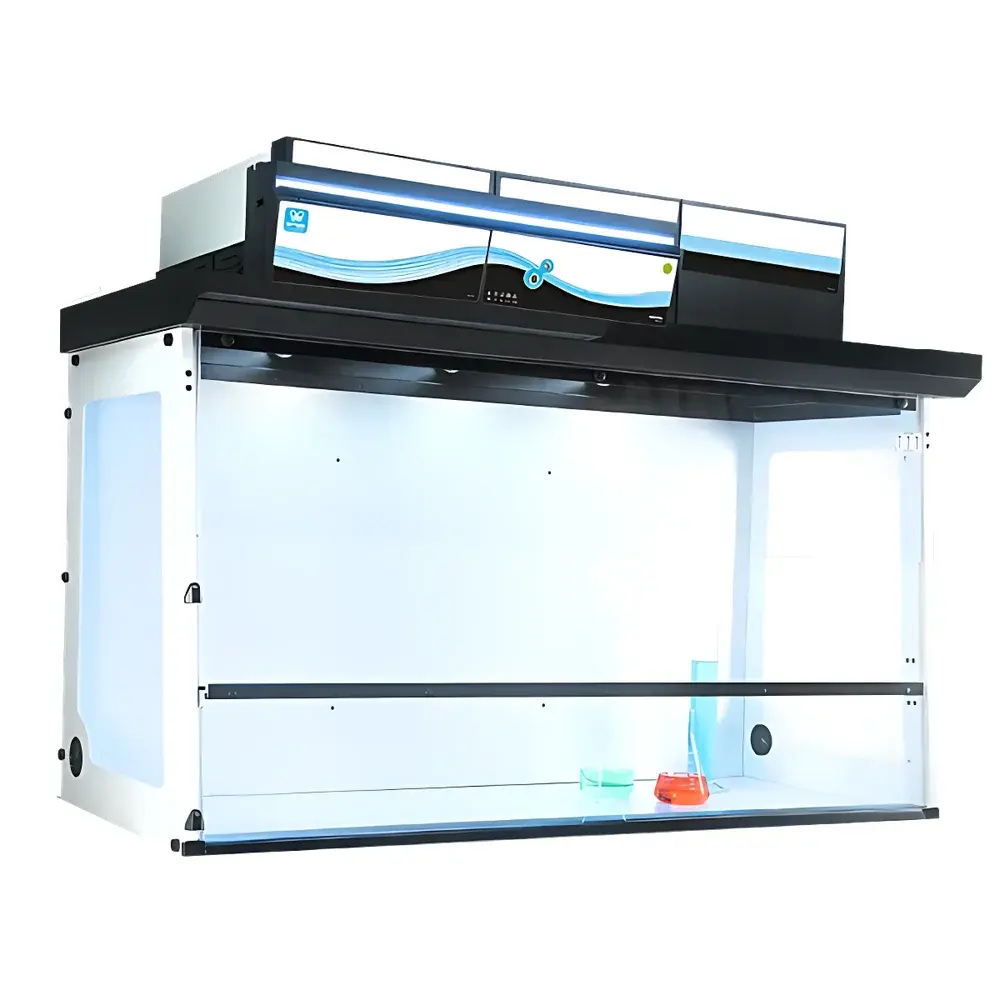
Erlab Captair Smart 633 Ductless Fume Hood
| Brand | Erlab |
|---|---|
| Origin | Jiangsu, China |
| Manufacturer Type | Authorized Distributor |
| Country of Origin | China |
| Model | 633 |
| Cabinet Construction | All-Steel Ductless Fume Hood |
| External Dimensions (W×D×H) | 1620 mm × 751 mm × 1332–1518 mm |
| Average Face Velocity | 0.4–0.6 m/s |
| Airflow Capacity | 660 m³/h |
| Lighting | Integrated LED Tubes |
| Rated Power | 160 W |
| Weight | 80.9 kg |
| Safety Certification | Compliant with JG/T 385–2012 (China), AFNOR NF X 15-211:2009 (France), SEFA 9 / BS 7989 (UK/USA), DIN 12927 (Germany), EN 1822:1998 (HEPA H14 & ULPA U17 filtration) |
Overview
The Erlab Captair Smart 633 is a high-performance, all-steel ductless fume hood engineered for precision containment and operator safety in modern analytical, environmental, and quality control laboratories. Unlike conventional ducted hoods requiring complex HVAC integration and external exhaust infrastructure, the Captair Smart 633 operates on a closed-loop recirculation principle: an integrated centrifugal blower draws contaminated air from the work area through a multi-stage molecular filtration system—comprising pre-filters, activated carbon media (optimized for broad-spectrum organic vapors), and optional HEPA H14 or ULPA U17 particulate filters per EN 1822:1998. Treated air is returned to the laboratory environment at ≥99.995% efficiency for particulates and >95% for targeted volatile compounds, eliminating reliance on building exhaust systems while maintaining strict face velocity compliance (0.4–0.6 m/s) across its full operational height range (1332–1518 mm). Its design adheres to internationally harmonized performance standards—including JG/T 385–2012, AFNOR NF X 15-211:2009, SEFA 9, BS 7989, and DIN 12927—ensuring consistent validation readiness for GLP, ISO/IEC 17025, and EPA-compliant environmental testing workflows.
Key Features
- All-steel monocoque construction with epoxy-powder-coated finish for corrosion resistance and structural rigidity under continuous operation.
- Intelligent safety monitoring via patented eGuard® status ring: dynamic LED halo illumination provides real-time visual feedback—steady white (normal), pulsing amber (face velocity deviation), rapid red flash (fan failure or filter saturation).
- Dual-audible alarm system with distinct tone patterns corresponding to specific fault conditions, enabling immediate operator response without interface interaction.
- Ergonomic front panel geometry: 15° forward tilt improves line-of-sight access; elliptical sash opening accommodates natural arm articulation; central splash guard minimizes lateral chemical dispersion; radius-edged work surface reduces forearm fatigue during extended procedures.
- Integrated high-efficiency LED lighting (≥1000 lux at work surface) with glare-free diffusion and low thermal output, preserving sample integrity and operator visual acuity.
Sample Compatibility & Compliance
The Captair Smart 633 is validated for safe handling of low-to-moderate volatility organic solvents (e.g., acetone, ethanol, dichloromethane, hexane), dilute aqueous acids/bases, and non-radioactive particulate-generating processes typical in environmental sample preparation (EPA Method 3500 series), wastewater analysis, and pharmaceutical stability testing. It is not intended for perchloric acid, hydrofluoric acid, radioactive isotopes, or high-boiling-point compounds (>200 °C) without supplemental filtration validation. All filtration media are replaceable as certified consumables with traceable lot documentation. The unit bears CE marking per EN 1822:1998 for filter classification and conforms to electrical safety requirements under IEC 61010-1. Full compliance documentation—including factory calibration reports, airflow verification certificates, and third-party test summaries—is provided with each unit shipment.
Software & Data Management
The eGuard® remote monitoring platform enables secure web-based or mobile application access (iOS/Android) for real-time status tracking, historical airflow logging, filter life estimation (based on cumulative runtime and VOC exposure profiles), and configurable email/SMS alerts. Audit trails record all user-initiated configuration changes, alarm events, and maintenance actions—supporting 21 CFR Part 11–aligned electronic record integrity when deployed in regulated environments. Data exports are available in CSV format for integration into LIMS or laboratory-wide asset management systems. Firmware updates are delivered over-the-air with version-controlled release notes and rollback capability.
Applications
- Environmental laboratories performing EPA-compliant soil/water extraction, solvent evaporation, and standard solution preparation.
- QC/QA labs conducting routine titrations, pH calibration, and reagent dispensing where ducted infrastructure is unavailable or cost-prohibitive.
- Research facilities requiring flexible benchtop containment for teaching labs, pilot-scale synthesis, or transient analytical workflows.
- Pharmaceutical R&D labs handling non-sterile intermediate compounds under GMP-aligned engineering controls.
- University core facilities seeking scalable, energy-efficient containment solutions with minimal facility modification.
FAQ
Does the Captair Smart 633 require external ductwork or make-up air systems?
No. It is a fully self-contained recirculating system requiring only a standard 230 V AC power supply and no connection to building exhaust or HVAC.
How often must the molecular filters be replaced?
Filter service intervals depend on usage intensity and chemical profile; typical replacement occurs every 6–12 months under moderate organic solvent use. eGuard® provides predictive alerts based on runtime and sensor-derived saturation metrics.
Can this unit be used for perchloric acid digestion?
No. Perchloric acid applications require specialized wash-down ducted hoods with stainless-steel interiors and dedicated scrubber systems. The Captair Smart 633 is not rated for oxidizing acids or high-temperature fuming operations.
Is airflow velocity automatically compensated for sash position changes?
Yes. The brushless DC motor adjusts rotational speed in real time to maintain constant face velocity across the full vertical sash travel range (1332–1518 mm), verified per AFNOR NF X 15-211:2009 Annex B protocols.
What documentation is supplied for regulatory audits?
Each unit ships with a Factory Acceptance Test (FAT) report, EN 1822 filter certification, JG/T 385–2012 conformance statement, and eGuard® audit log configuration guide—fully traceable to serial number and installation date.



