
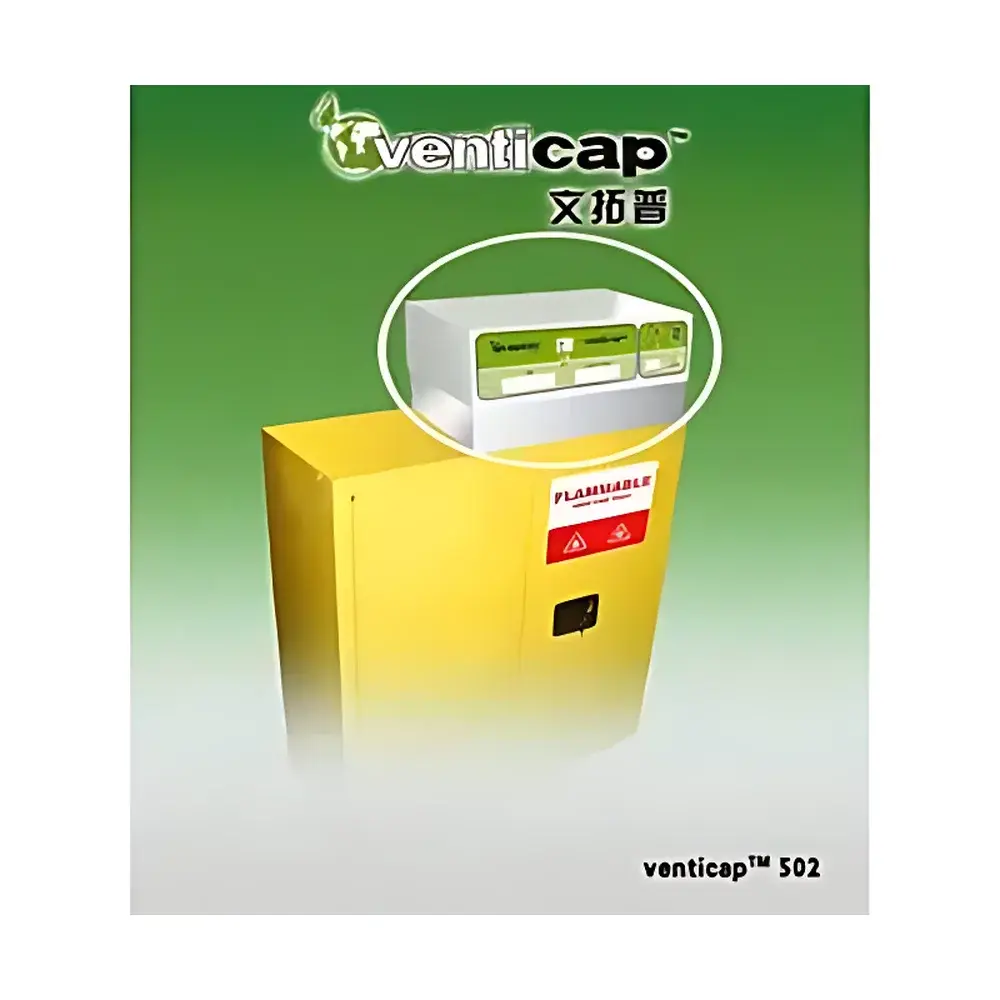
Erlab Chemtrap V 201 Molecular Filtration Unit for Flammable Storage Cabinets
| Brand | Erlab |
|---|---|
| Origin | France |
| Model | Chemtrap V 201 |
| Dimensions (L×W×H) | 200 × 537 × 605 mm |
| Sound Level | 55 dBA |
| Airflow Capacity | 75 m³/h |
| Power Supply | 220 V / 50 Hz |
| Power Consumption | 19 W |
| Current Draw | 0.1 A |
| Telescopic Duct Length | 1 m (Ø80 mm) |
| Flange Diameter Range | Ø75–110 mm |
| Filtration Standard | NFX 15-211 Class 2 (organic vapors) |
| Filter Lifetime | ~12 months (typical, dependent on VOC load and exposure profile) |
Overview
The Erlab Chemtrap V 201 is an engineered molecular filtration unit designed specifically for integration with flammable liquid storage cabinets in research laboratories, pharmaceutical QC facilities, and industrial R&D environments. Unlike passive ventilation or simple carbon filters, the Chemtrap V 201 employs active air recirculation—drawing cabinet interior air through a high-surface-area, impregnated activated carbon molecular filter—and returning purified air to the laboratory space. Its operation is grounded in adsorption kinetics: volatile organic compounds (VOCs), including acetone, ethanol, toluene, xylene, and other common solvents, are retained within the microporous structure of the filter media via van der Waals forces and chemical affinity. This closed-loop system eliminates the need for ducted exhaust, thereby preserving conditioned air, reducing HVAC energy demand, and complying with modern sustainability mandates without compromising occupational safety.
Key Features
- Integrated axial fan delivering consistent 75 m³/h airflow at low acoustic emission (55 dBA), suitable for continuous 24/7 operation in shared lab spaces.
- Molecular filter cartridge with extended service life (~12 months under typical usage), validated per French standard NFX 15-211 Class 2 for organic vapor retention efficiency (residual emissions ≤50% of applicable TLV-TWA).
- Dual-stage monitoring system: visual/audible saturation alarm for organic vapor breakthrough and independent fan failure detection—both compliant with ISO 17025 traceability requirements for preventive maintenance logging.
- Modular telescopic duct (1 m, Ø80 mm) with adjustable flange interface (Ø75–110 mm) enabling rapid retrofit onto most commercially available flammable storage cabinets—including those certified to EN 14470-1 and NFPA 30.
- Low-power electronics (19 W, 0.1 A @ 220 V/50 Hz) with internal thermal protection and EMI-filtered power input, ensuring electromagnetic compatibility in sensitive instrumentation zones.
Sample Compatibility & Compliance
The Chemtrap V 201 is compatible with storage of Class I and II flammable liquids (flash point < 60°C), including alcohols, ketones, esters, and aromatic hydrocarbons. It does not support highly reactive substances (e.g., alkali metals, phosphorus chlorides) or acidic gases (e.g., HCl, HF), which require chemisorptive media beyond standard impregnated carbon. The unit conforms to French occupational hygiene regulation NFX 15-211 (Class 2), aligning with international TLV-TWA (Threshold Limit Value – Time-Weighted Average) benchmarks established by ACGIH®. While not a replacement for local exhaust ventilation (LEV) in high-emission scenarios, it meets GLP-compliant storage prerequisites when used as a secondary containment safeguard. No external ductwork or roof penetration is required, simplifying installation in leased or historic buildings where structural modifications are restricted.
Software & Data Management
The Chemtrap V 201 operates as a standalone hardware device with no embedded firmware, cloud connectivity, or proprietary software. All operational status indicators (fan run, filter saturation) are conveyed via front-panel LED and audible alerts—ensuring deterministic behavior, audit readiness, and full compliance with FDA 21 CFR Part 11 Annex 11 principles for non-software-based safety-critical systems. Maintenance logs—including filter installation date, saturation test results (using optional ChemCheck detection kit), and fan performance verification—can be recorded manually in laboratory logbooks or integrated into existing CMMS platforms (e.g., IBM Maximo, SAP PM) using standardized work order templates. Erlab provides calibration-free verification protocols aligned with ISO/IEC 17025 Clause 6.4.2 for in-house validation.
Applications
- Pharmaceutical stability chambers and solvent storage rooms requiring VOC containment without heat loss.
- Academic chemistry labs seeking LEED-certified infrastructure upgrades while maintaining budgetary constraints.
- Contract manufacturing organizations (CMOs) performing GMP-compliant raw material handling where environmental monitoring reports must demonstrate continuous airborne contaminant control.
- Microelectronics fabrication support areas storing photoresist thinners and developer solvents near cleanroom perimeters.
- University teaching labs deploying student-accessible flammable cabinets with built-in engineering controls satisfying OSHA Lab Standard 29 CFR 1910.1450.
FAQ
How is filter saturation determined?
Saturation is verified using the optional ChemCheck detection kit (sold separately), comprising a calibrated sampling pump and colorimetric detection rods specific to target VOC families. Results are interpreted visually against reference charts—no instrumentation or software required.
Can the Chemtrap V 201 be installed on cabinets without pre-drilled ventilation ports?
Yes—Erlab supplies universal mounting kits with silicone gaskets and clamping flanges for field adaptation to non-vented cabinets, provided structural integrity and fire-rating compliance (EN 14470-1) are preserved.
Does this unit meet requirements for ISO 14001 environmental management systems?
Yes—the closed-loop design reduces total HVAC energy consumption by eliminating conditioned air exhaust, directly supporting Clause 6.1.2 (actions to address risks and opportunities) and contributing to measurable Scope 1 & 2 emissions reduction targets.
Is routine filter replacement mandatory after 12 months regardless of usage?
No—lifetime is usage-dependent. Erlab recommends quarterly saturation checks in high-throughput environments; replacement is triggered only upon confirmed breakthrough or alarm activation—not calendar time.
What documentation is provided for regulatory audits?
Erlab supplies EU Declaration of Conformity (CE), NFX 15-211 test report excerpts, dimensional drawings, electrical safety certification (IEC 61000-6-3), and installation/maintenance manuals—all available in English and traceable to batch-specific serial numbers.



