
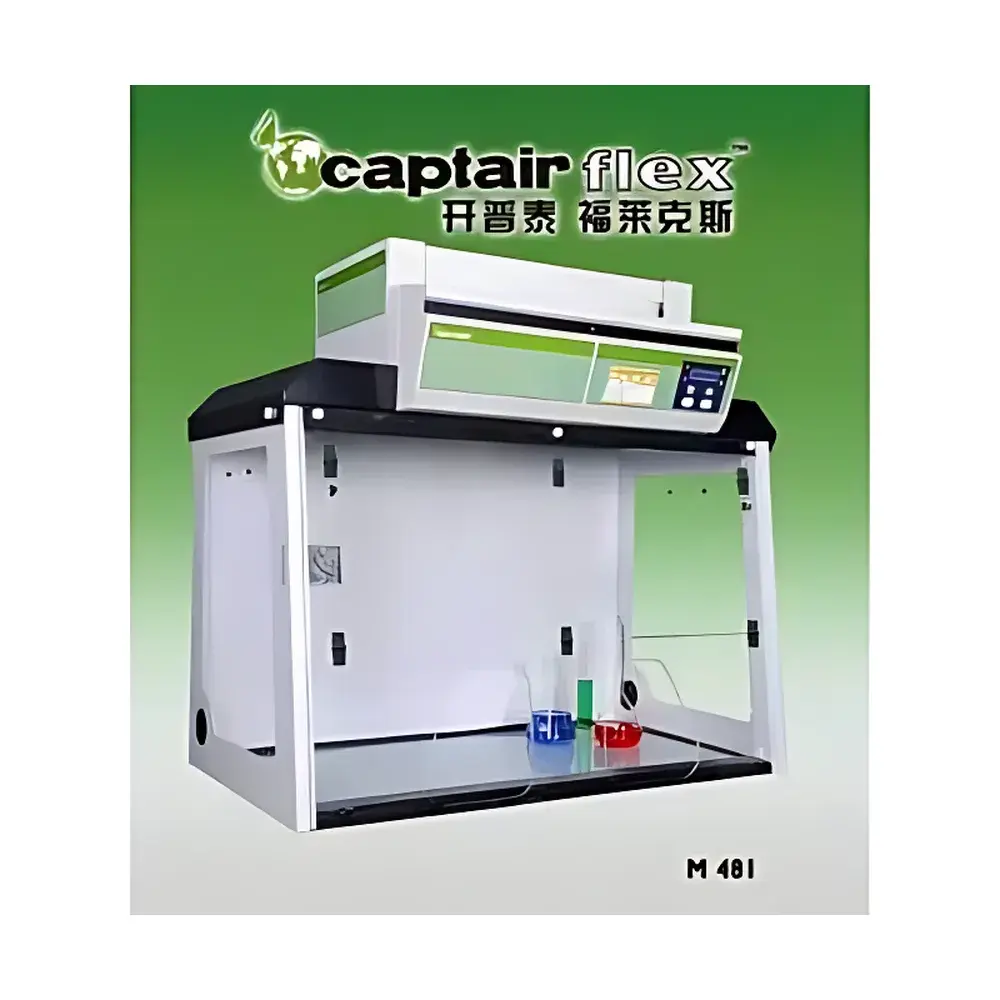
Erlab M481 Ductless Fume Hood
| Brand | Erlab |
|---|---|
| Origin | France |
| Model | M481 |
| Construction | Fully Steel Enclosure |
| Configuration | Double-Sided Operation |
| Airflow Capacity | 230 m³/h |
| Face Velocity Range | 0.4–0.6 m/s (compliant with AFNOR NF X 15-211:2009) |
| Filtration Class | Class 1 (dual-layer molecular filter configuration) |
| Power Consumption | 85 W |
| Input Voltage | 100–240 V AC, 50–60 Hz |
| Internal DC Voltage | 24 V DC |
| Sound Pressure Level | 52 dB(A) |
| Dimensions (L×W×H, mm) | External 1275 × 620 × 1161–1345 |
| Operating Aperture | Elliptical |
| Lighting | 18 W fluorescent lamp(s), 500 lux, IP67 rated |
| Filter Monitoring | Integrated saturation timer (0–250 h), optional Melecode™ S organic vapor alarm, and physical sampling port for breakthrough verification |
Overview
The Erlab M481 Ductless Fume Hood is a CE-marked, Class 1 certified containment system engineered for precision chemical handling in laboratories where ducted exhaust infrastructure is unavailable, impractical, or energy-prohibitive. Unlike conventional canopy or ducted hoods that expel conditioned air outdoors—requiring costly makeup air systems—the M481 employs a closed-loop recirculation principle based on active airflow management and multi-stage molecular filtration. Air is drawn inward across the work surface at a controlled face velocity of 0.4–0.6 m/s (validated per AFNOR NF X 15-211:2009), passes through dual-layer, application-specific molecular filters housed vertically in parallel columns—one upstream and one downstream of the centrifugal blower—and returns purified air directly into the laboratory environment. This architecture eliminates external venting while maintaining operator safety, thermal stability, and ambient air quality. The unit operates on low-voltage 24 V DC internal circuitry, enhancing electrical safety during routine maintenance or accidental contact.
Key Features
- Dual-layer molecular filtration system: Two identical, replaceable filter cartridges per column ensure continuous protection—even if the lower filter reaches saturation, the upper cartridge remains fully active, preventing any breakthrough of hazardous vapors.
- Integrated digital control panel (Kaptair Flex™ interface): Centralized monitoring of blower status, real-time airflow balance, audible/visual alarms for velocity deviation, programmable service timers (0–250 operating hours), and configurable maintenance protocols.
- Filter saturation verification port: Enables qualitative or semi-quantitative assessment using colorimetric detection tubes (e.g., Dräger or equivalent) to confirm adsorbent exhaustion prior to scheduled replacement.
- Ergonomic workstation design: Tilted front sash (15°), elliptical access aperture, central splash guard, and radius-edged work surface optimize posture, dexterity, and splash containment during liquid handling or powder weighing.
- Energy-efficient operation: Consumes only 85 W under nominal load; eliminates HVAC load associated with 100% outside-air replacement—yielding up to 85% reduction in annual climate-control energy expenditure versus traditional ducted systems.
- Modular mobility option: Optional castor-mounted trolley enables repositioning without structural modification—ideal for shared labs, teaching facilities, or temporary setups requiring flexible workflow alignment.
Sample Compatibility & Compliance
The M481 is validated for use with low-to-moderate volatility organic solvents (e.g., acetone, ethanol, hexane, chloroform), aqueous acids/bases (pH 2–12), and particulate-generating operations including powder weighing and solvent evaporation. It is not intended for perchloric acid, hydrofluoric acid, radioactive isotopes, or uncharacterized high-boiling-point compounds (>200 °C). Compliance includes full adherence to AFNOR NF X 15-211:2009 (Class 1 performance standard), SGS-certified filtration efficiency testing per EN 14175-3, and conformity with IEC 61000-6-3 (EMC) and IEC 61000-6-2 (immunity). All electrical components meet UL/CSA 61010-1 requirements for laboratory equipment safety.
Software & Data Management
The Kaptair Flex™ control interface supports audit-ready operational logging—including date/time-stamped airflow events, filter runtime accumulation, alarm triggers, and manual override actions. While the base unit does not include network connectivity, optional RS-485 or Modbus RTU interfaces enable integration into centralized lab monitoring platforms compliant with ISO/IEC 17025 or GLP environments. Data logs are exportable via USB for inclusion in SOP documentation, preventive maintenance records, or regulatory submissions (e.g., FDA 21 CFR Part 11–aligned workflows when paired with validated third-party LIMS).
Applications
- Routine analytical chemistry: Titration, sample preparation, solvent transfers, and reagent dispensing in QC/QA labs.
- Pharmaceutical R&D: Stability testing sample handling, excipient blending, and low-risk API manipulation under GMP-aligned conditions.
- Academic teaching labs: Safe demonstration of volatile reagent use without building-level ductwork retrofits.
- Environmental testing labs: Preparation of VOC standards, extraction procedures, and field-sample preservation.
- Cleanroom-adjacent workflows: Dust-sensitive weighing and low-emission packaging operations where particle ingress must be minimized.
FAQ
What types of chemicals can be safely handled in the M481?
The hood is validated for common organic solvents, dilute inorganic acids and bases, and non-toxic particulates. It is not approved for perchloric acid, HF, cyanides, or unknown high-boiling compounds.
How often must the filters be replaced?
Replacement frequency depends on usage intensity and chemical profile; the integrated timer alerts every 250 operating hours, but actual saturation should be confirmed via breakthrough testing at the sampling port.
Does the M481 require external ductwork or make-up air systems?
No—its ductless design recirculates filtered air internally, eliminating dependency on building HVAC infrastructure.
Is the unit compatible with GLP or ISO/IEC 17025 compliance requirements?
Yes—when deployed with documented filter change logs, calibration records for the anemometer, and timestamped alarm history, it supports auditable safety and maintenance traceability.
Can multiple M481 units operate simultaneously in one room?
Yes—each unit functions independently with no cross-contamination risk; total room air exchange remains unaffected due to zero net air loss.



