
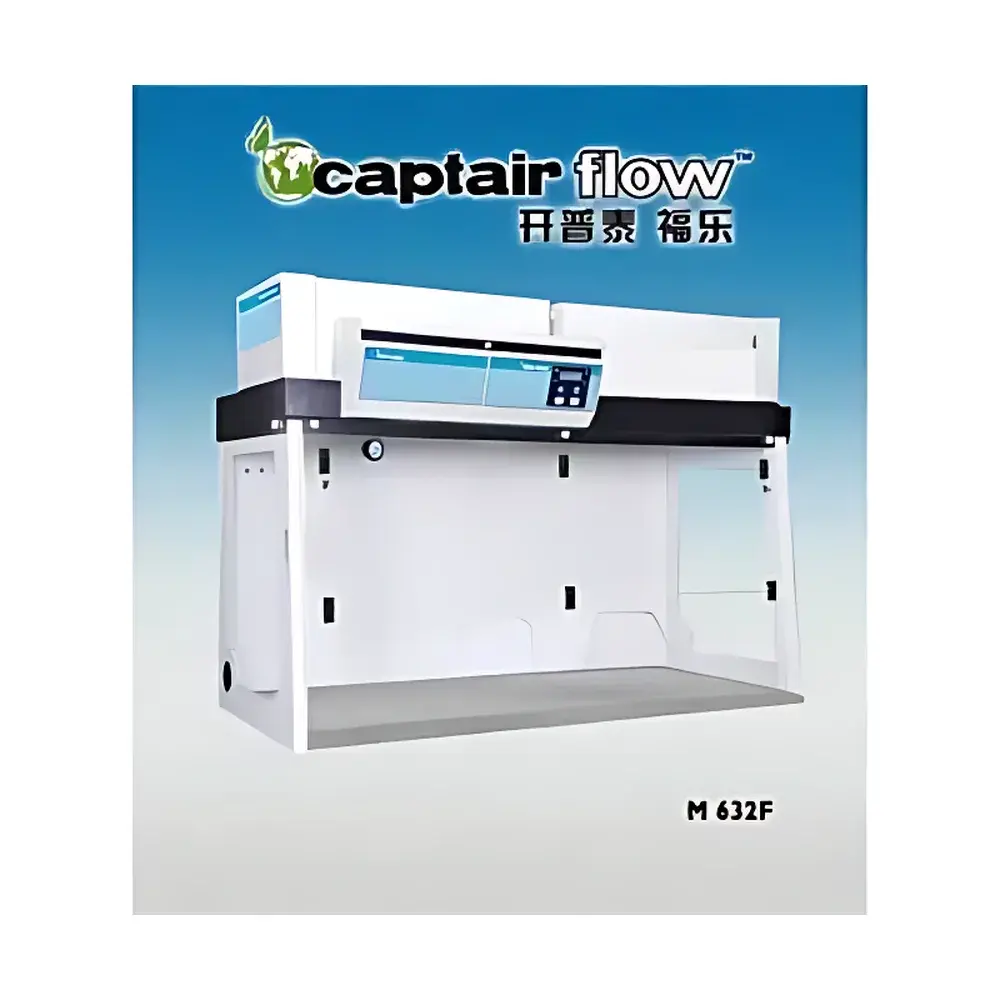
Erlab M632 F Vertical Laminar Flow Clean Bench
| Brand | Erlab |
|---|---|
| Origin | France |
| Model | M632 F |
| Airflow Type | Vertical Laminar Flow |
| Filter Class | H14 (EN 1822-1, MPPS ≥ 0.3 µm, 99.995% efficiency) |
| Cleanroom Classification | ISO Class 5 (EN ISO 14644-1) / US Federal Standard 209E Class 100 |
| Operating Face Velocity | > 0.3 m/s |
| Air Volume Flow | 460 m³/h |
| Sound Pressure Level | 55 dB(A) |
| Power Supply | 100–240 V, 50–60 Hz |
| Total Power Consumption | 125 W |
| Dimensions (L × W × H, mm) | External 1600 × 620 × 1161–1246 |
| Internal Work Area (L × W × H, mm) | 1497 × 522 × 866 |
| Fan Configuration | Dual LP44 Fans |
| Pre-filter & HEPA Monitoring | Integrated differential pressure gauge and audible/visual alarm for fan failure |
Overview
The Erlab M632 F Vertical Laminar Flow Clean Bench is an ISO Class 5-certified containment workstation engineered for applications requiring particle-free air delivery across the operator-facing work surface. Unlike horizontal flow units, the M632 F directs unidirectional airflow vertically downward—from ceiling-mounted H14 high-efficiency particulate air (HEPA) filters—through a precisely calibrated plenum into the work area and then out through the front grille or base exhaust. This vertical laminar architecture minimizes turbulence-induced cross-contamination and ensures consistent velocity (>0.3 m/s) across the entire 1497 mm × 522 mm working plane. Designed and manufactured in France under strict EN ISO 9001 quality management protocols, the unit complies with EN ISO 14644-1 (2015), EN 1822-1 (2019), and EU GMP Annex 1 (Class A/B environments), making it suitable for critical non-sterile aseptic operations where ambient particulate ingress must be reduced to ≤100 particles ≥0.3 µm per cubic foot.
Key Features
- Dual LP44 centrifugal fans providing redundant airflow control and stable pressure differential across the H14 filter bank
- H14-grade HEPA filter certified per EN 1822-1 at Most Penetrating Particle Size (MPPS ≥ 0.3 µm) with ≥99.995% filtration efficiency
- Integrated real-time differential pressure monitoring system with visual LED indicators and audible alarm for pre-filter or HEPA saturation
- Fan failure detection circuit triggering simultaneous audio-visual alerts to prevent undetected loss of laminar integrity
- Modular filter access design enabling rapid, tool-free replacement of both pre-filters and H14 HEPA modules without disassembly
- Adjustable height range (1161–1246 mm) accommodating ergonomic operator positioning and integration with adjacent lab furniture
- Front grille optimized for uniform velocity distribution and low turbulence—validated via ISO 14644-3 airflow visualization testing
Sample Compatibility & Compliance
The M632 F supports non-hazardous, non-volatile sample handling in disciplines including cell culture (non-pathogenic lines), microbiological assay preparation, pharmaceutical formulation staging, optical component assembly, and precision electronics benchwork. It is not designed for biosafety-level containment or volatile organic compound (VOC) generation; however, optional GF4BE+ activated carbon filtration modules can be integrated upstream of the HEPA stage to adsorb low-concentration inorganic and organic vapors—enabling safe handling of solvents such as ethanol, acetone, or isopropanol within defined exposure limits. The unit meets structural and performance requirements of ISO 14644-1:2015 (Class 5), USP environmental monitoring thresholds for low-risk compounding, and EU GMP Annex 1 (2022) criteria for Grade A local protection zones when operated in controlled background environments (Grade B).
Software & Data Management
The M632 F operates via a dedicated microprocessor-based control panel with no embedded software stack or network interface. All operational parameters—including fan status, filter delta-P, and alarm history—are displayed locally via tactile buttons and dual-color LEDs. While the unit does not feature digital data logging or remote connectivity, its analog alarm outputs (dry contact relays) support integration into centralized laboratory building management systems (BMS) for audit-ready event tracking. For GLP/GMP-regulated laboratories, users may document filter change dates, pressure readings, and alarm events manually in logbooks compliant with FDA 21 CFR Part 11 (electronic records) when paired with validated paper-based SOPs and signature protocols.
Applications
- Aseptic transfer of mammalian and insect cell lines in non-BSL facilities
- Preparation of media, reagents, and master mixes for PCR and sequencing workflows
- Assembly and inspection of micro-optical components sensitive to sub-micron particulates
- Weighing and dispensing of active pharmaceutical ingredients (APIs) under ISO Class 5 conditions
- Quality control sampling in cosmetic and nutraceutical manufacturing cleanrooms
- Electronics prototyping involving bare PCB handling and solder paste application
- Botanical tissue culture initiation under low-bioburden conditions
FAQ
What ISO class does the M632 F achieve, and how is it verified?
The M632 F delivers ISO Class 5 (formerly Class 100) air quality at the work surface, verified per EN ISO 14644-1:2015 using calibrated particle counters measuring ≥0.3 µm particles in cubic feet per minute. Certification requires annual third-party validation including airflow velocity mapping, particle count testing, and filter integrity checks.
Can the M632 F be used for chemical fume containment?
No—it is not a fume hood and provides no vapor containment. However, optional GF4BE+ activated carbon modules mitigate low-level VOC exposure by adsorption upstream of the HEPA filter; this configuration does not replace dedicated chemical fume hoods for high-volatility or toxic substances.
What maintenance intervals are recommended for the H14 filter?
Under typical ISO Class 7–8 ambient lab conditions, the H14 filter maintains rated efficiency for up to 4 years. Replacement timing must be determined empirically using the built-in differential pressure gauge: service is required when delta-P exceeds 500 Pa across the HEPA stage.
Is the M632 F compatible with GMP documentation requirements?
Yes—the unit’s alarm outputs, pressure monitoring, and mechanical interlocks support traceable operational records. When combined with site-specific SOPs and manual log entries, it satisfies baseline Annex 1 and FDA 21 CFR Part 11 expectations for equipment qualification and ongoing performance verification.



