
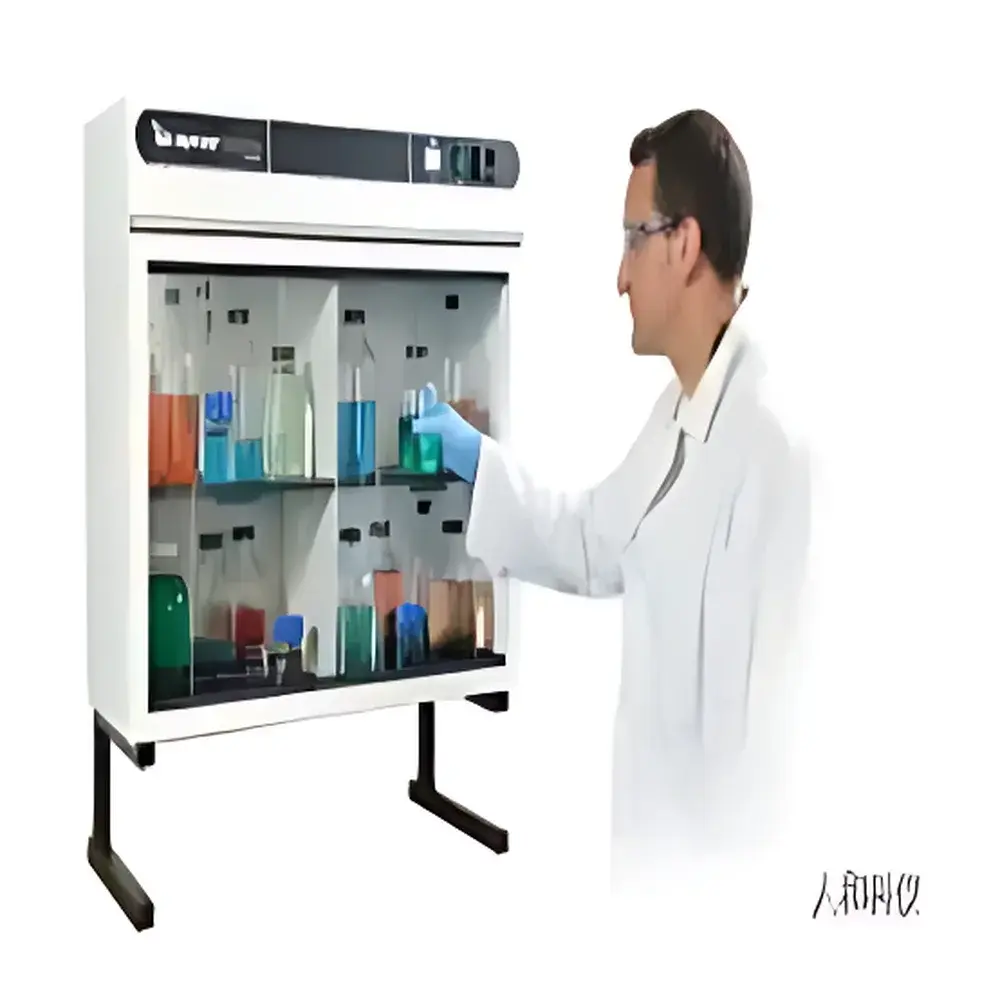
Erlab Ministore 822 Series Plug-and-Play Molecular Filtration Medicine Cabinet
| Brand | Erlab |
|---|---|
| Origin | France |
| Model | Ministore 822A / 822B / 822C / 822D |
| Dimensions (W×D×H) | 819×354×725 mm (822A/822D), 819×435×911 mm (822B), 819×372×705 mm (822C) |
| Internal Volume | 753×322×519 mm |
| Airflow Rate | 75 m³/h |
| Air Changes per Minute | 9.9 |
| Noise Level | 45 dBA |
| Power Supply | 220 V / 50 Hz |
| Power Consumption | 20 W |
| Current Draw | 0.17 A |
| Filtration Standard | NFX 15-211 Class 2 |
| Filter Type | Activated Carbon-Based Molecular Filter |
| Door Type | Dual Acrylic Sliding Doors with Lock |
| Shelving | Two Adjustable Polypropylene Shelves |
| Compartments | Two Segregated Storage Zones |
| Installation Options | Benchtop, Floor-Standing (with optional base), Wall-Mounted, Under-Counter |
Overview
The Erlab Ministore 822 Series is a compact, self-contained molecular filtration cabinet engineered for safe, localized storage of hazardous chemicals and pharmaceutical compounds in laboratories where space, flexibility, and continuous air quality management are critical. Unlike conventional ventilated cabinets that exhaust to the outside environment, the Ministore 822 operates on a closed-loop recirculation principle: ambient laboratory air is drawn inward by a low-noise centrifugal blower, passed through a certified multi-stage molecular filter—primarily composed of impregnated activated carbon and specialized chemisorbent media—and returned as purified air directly into the room. This design eliminates ductwork requirements and enables immediate deployment without facility modification. Its core functionality aligns with occupational hygiene best practices defined in ISO 10993-1 (biocompatibility), EN 14175-3 (fume hood performance), and supports compliance with OSHA 29 CFR 1910.1200 (Hazard Communication Standard) and EU CLP Regulation (EC No. 1272/2008) for chemical segregation and exposure control.
Key Features
- Plug-and-play operation: Requires only a standard 220 V / 50 Hz power outlet—no external ducting, civil works, or HVAC integration needed.
- Ultra-quiet performance: Integrated EC motor-driven blower maintains consistent airflow at ≤45 dBA, suitable for open-plan labs and quiet environments such as QC/QA suites and analytical support areas.
- NFX 15-211 Class 2 certified filtration: Validates removal efficiency for organic vapors (e.g., acetone, methanol, chloroform, ethyl acetate), acidic gases (e.g., HCl, HF), and basic compounds (e.g., ammonia), ensuring long-term operator safety under typical storage conditions.
- Modular configuration system: Four standardized variants—822A (benchtop), 822B (floor-standing with integrated base), 822C (wall-mounted), and 822D (under-bench)—allow seamless adaptation to diverse lab layouts and workflow constraints.
- Dual segregated compartments with independent access: Physically isolates incompatible chemical classes (e.g., oxidizers from organics, acids from bases), reducing cross-contamination risk and supporting NFPA 45-compliant storage protocols.
- Acrylic sliding doors with mechanical lock: Provide unobstructed visibility, rapid access, and tamper-resistant containment; door position sensors can be integrated into building BMS for status monitoring (optional).
Sample Compatibility & Compliance
The Ministore 822 is validated for storage of volatile organic compounds (VOCs), halogenated solvents, low-boiling-point reagents, and select pharmaceutical intermediates. It is not intended for flammable liquids exceeding flashpoint thresholds governed by NFPA 30 or for pyrophoric, peroxide-forming, or highly reactive substances requiring inert atmosphere handling. All models comply with CE marking requirements under the EU Machinery Directive 2006/42/EC and Electromagnetic Compatibility Directive 2014/30/EU. Filter replacement intervals are determined by real-time saturation indicators (optional) or scheduled maintenance based on cumulative runtime and known chemical loading profiles—fully traceable per GLP Annex 13 and ISO/IEC 17025:2017 clause 6.4.6.
Software & Data Management
While the base Ministore 822 operates as a standalone unit, optional digital modules enable connectivity via RS-485 or Modbus RTU to centralized lab infrastructure. The Erlab SmartLink™ interface (sold separately) provides remote monitoring of blower status, filter saturation alerts, runtime logging, and audit-trail generation compliant with FDA 21 CFR Part 11 requirements. All event logs—including door openings, power cycles, and filter change timestamps—are time-stamped and stored locally for ≥12 months, supporting internal audits and regulatory inspections.
Applications
- Pharmaceutical R&D labs: Secure storage of reference standards, cytotoxic agents, and controlled substances in ISO Class 5–7 cleanrooms or adjacent preparation zones.
- Academic teaching laboratories: Safe, visible containment for undergraduate chemistry experiments involving common solvents and reagents.
- Quality control environments: Dedicated storage for HPLC mobile phase components, calibration standards, and stability study samples requiring vapor-phase isolation.
- Hospital pharmacy satellite units: Localized, low-footprint storage of high-alert medications and compounded sterile preparations in accordance with USP environmental controls.
- Contract manufacturing organizations (CMOs): Modular deployment across multiple production suites to maintain segregation integrity during campaign-based manufacturing.
FAQ
What types of chemicals can be safely stored in the Ministore 822?
It is designed for low-to-moderate volatility organic solvents, weak acids/bases, and non-reactive pharmaceutical compounds. Flammables, peroxides, strong oxidizers, and water-reactive materials require alternative containment solutions.
How often must the molecular filter be replaced?
Filter life depends on chemical load, concentration, and usage frequency. Under typical academic or QC use, replacement is recommended every 6–12 months; Erlab provides a Filter Life Calculator tool based on compound-specific adsorption isotherms.
Does the cabinet require annual certification or third-party validation?
While not mandated by regulation for recirculating cabinets, Erlab recommends annual performance verification using tracer gas (e.g., isopropanol) and airflow measurement per EN 14175-3 Annex E to ensure continued compliance with NFX 15-211 Class 2 claims.
Can multiple Ministore units be networked for centralized monitoring?
Yes—when equipped with SmartLink™ modules, up to 32 units can be daisy-chained and managed via a single web-based dashboard with configurable email/SMS alerts.
Is wall-mounting structurally certified for seismic zones?
The 822C variant includes reinforced mounting brackets tested to IBC 2018 Seismic Design Category C (SDC-C) requirements; installation must follow local structural engineering guidelines and anchor into load-bearing substrates.
Related Products



