
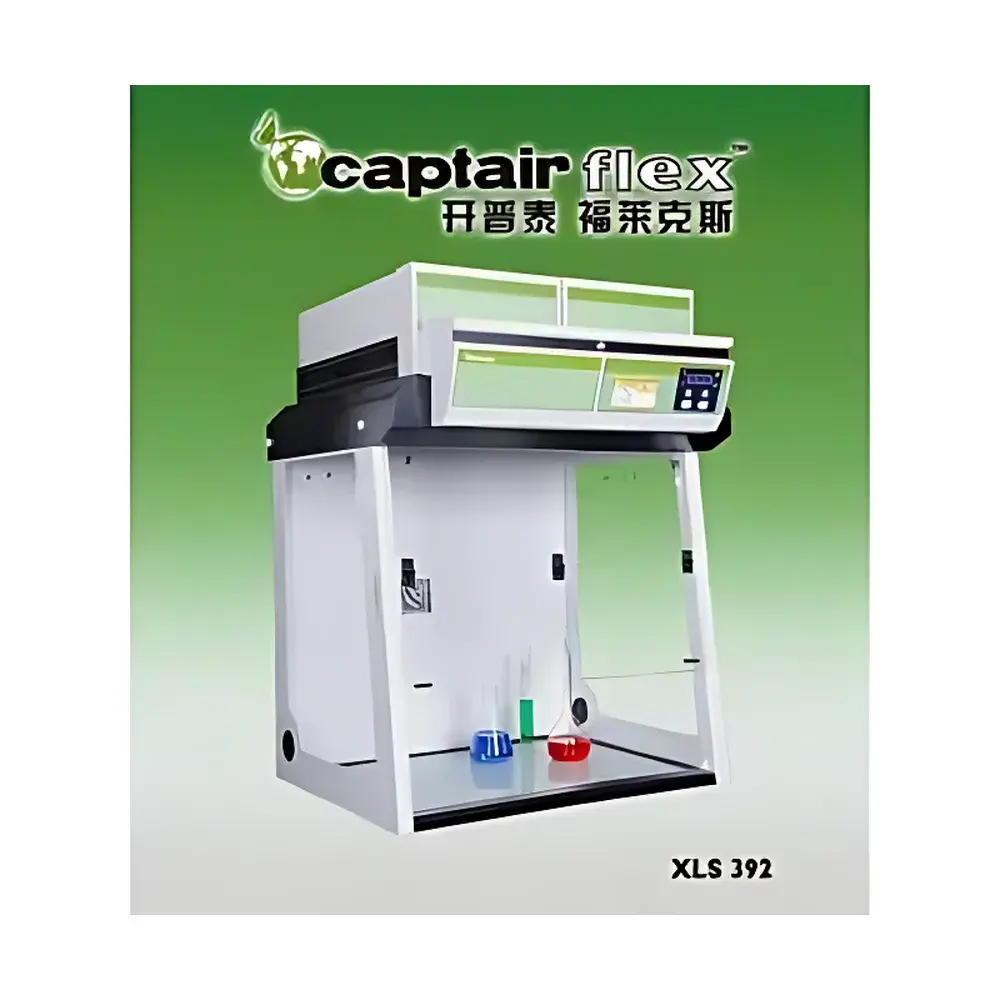
Erlab XLS392 Plug-and-Play Ductless Fume Hood
| Brand | Erlab |
|---|---|
| Origin | France |
| Model | XLS392 |
| Construction | All-Steel Enclosure |
| Configuration | Double-Faced Operation |
| Airflow Capacity | 460 m³/h |
| Face Velocity Range | 0.4–0.6 m/s (compliant with AFNOR NF X 15-211:2009) |
| Power Consumption | 105 W |
| Input Voltage | 100–240 V AC, 50–60 Hz |
| Internal DC Voltage | 24 V DC |
| Sound Pressure Level | 55 dB(A) |
| Filter Configuration | Dual-Layer Molecular Filtration System (Class 1 per NFX 15-211) |
| External Dimensions (L×W×H) | 1000 × 790 × 1316–1500 mm |
| Internal Work Area (L×W×H) | 897 × 692 × 1014 mm |
| Lighting | IP67-rated fluorescent lamp(s), 18 W, ≥500 lux |
| Certifications | Compliant with NFX 15-211:2009 Class 1 |
Overview
The Erlab XLS392 is a CE-marked, plug-and-play ductless fume hood engineered for precision chemical containment in modern laboratories where infrastructure flexibility, energy efficiency, and regulatory compliance are critical. Unlike conventional ducted hoods that exhaust conditioned air to the exterior—requiring costly HVAC make-up air—the XLS392 operates on a closed-loop recirculation principle. It draws ambient laboratory air through the work surface, passes it sequentially through two vertically staged molecular filter cartridges (top and bottom), and returns purified air directly into the room. This process relies on adsorption-based capture of volatile organic compounds (VOCs), acids, bases, aldehydes, and other low-molecular-weight hazardous vapors—validated per the stringent performance criteria defined in AFNOR NF X 15-211:2009 and classified as Class 1 under NFX 15-211. The system maintains a dynamically stable face velocity between 0.4 and 0.6 m/s across its full-width open-face aperture, ensuring consistent inward airflow integrity without reliance on building ductwork or external exhaust fans.
Key Features
- Dual-stage molecular filtration architecture: Two identical, independently replaceable filter modules—mounted above and below the centrifugal blower—provide redundant adsorption capacity. When the lower filter reaches saturation, the upper unit continues active vapor capture without interruption or breakthrough risk.
- Capteur™ Flex digital control panel: Integrates real-time monitoring of airflow velocity, cumulative operational hours (0–250 h counter), audible/visual alarms for flow deviation, and programmable maintenance scheduling. Optional Melecode™ S sensor enables automated organic vapor saturation detection.
- In-situ filter saturation verification port: Enables non-invasive sampling of post-filter effluent using colorimetric indicator tubes (e.g., Dräger or similar), allowing quantitative assessment of residual VOC concentration prior to scheduled replacement.
- Ergonomic front panel design: 15° forward tilt improves operator posture and visual access; elliptical and trapezoidal arm openings optimize limb mobility; curved work surface edge provides forearm support during extended procedures.
- Low-voltage internal architecture: 24 V DC operation enhances electrical safety in wet or corrosive environments; meets IEC 61000-6-3 EMC standards for electromagnetic compatibility.
- Modular mobility option: Compatible with optional castor-mounted trolleys (sold separately) for repositioning across shared lab spaces without structural modification.
Sample Compatibility & Compliance
The XLS392 is validated for use with liquid-phase reagents, low-dust solid handling (e.g., weighing powders), and controlled solvent evaporation protocols. It is not intended for perchloric acid, hydrogen fluoride, radioactive isotopes, or nanoparticle aerosol generation. Its dual-filter configuration satisfies Class 1 containment requirements per NFX 15-211:2009, verified by independent third-party testing (SGS and Intertek reports available upon request). While not inherently GLP/GMP-certified, the Capteur™ Flex panel supports audit-ready documentation when integrated with laboratory information management systems (LIMS) via RS-485 or optional Ethernet interface. The unit complies with EN 61000-3-2 (harmonic current emissions) and EN 61000-4-3 (radiated RF immunity), and its 55 dB(A) acoustic output meets ISO 7779 noise emission guidelines for occupied laboratory zones.
Software & Data Management
The embedded Capteur™ Flex controller stores up to 30 days of timestamped operational logs—including face velocity readings, total runtime, alarm events, and filter usage duration—in non-volatile memory. Data export is supported via USB-C or serial interface (RS-232/RS-485), enabling integration into centralized facility monitoring platforms. Optional firmware upgrades maintain alignment with evolving international standards (e.g., updates reflecting revisions to ISO 10993-17 or ASTM D5466). Audit trail functionality—including user login timestamps and parameter change history—is available when paired with Erlab’s CloudLink™ gateway (accessory), satisfying traceability expectations under FDA 21 CFR Part 11 for regulated QC/QA environments.
Applications
- Routine analytical chemistry workflows involving solvents (acetone, methanol, chloroform), weak acids/bases, and amine derivatives.
- Pharmaceutical formulation development where solvent recovery and indoor air quality preservation are prioritized.
- University teaching labs requiring flexible, relocatable containment without HVAC retrofitting.
- Quality control laboratories performing raw material inspection, stability testing, or reference standard preparation under ISO/IEC 17025-accredited conditions.
- Cleanroom-adjacent applications where particle-free recirculated air must meet ISO 14644-1 Class 8 specifications (achieved via HEPA pre-filtration upstream of molecular media).
FAQ
What types of chemicals can be safely handled in the XLS392?
The hood is validated for organic solvents, aliphatic/aromatic hydrocarbons, ketones, esters, and low-concentration inorganic vapors (e.g., HCl, NH₃). It is not approved for oxidizers (e.g., perchloric acid), fluorinated compounds (HF), or unfiltered particulates.
How often must the filters be replaced?
Replacement frequency depends on usage intensity and chemical profile. The built-in 250-hour timer provides a conservative baseline; actual service life ranges from 6–18 months. Saturation verification via colorimetric tube sampling is recommended every 100 operational hours.
Does the XLS392 require external ductwork or make-up air systems?
No. It operates as a self-contained unit requiring only a standard 100–240 V AC outlet. No wall penetrations, roof vents, or HVAC coordination are necessary.
Can the XLS392 be used in a GMP-regulated environment?
Yes—when deployed with CloudLink™ gateway and configured for electronic log export, it supports ALCOA+ data integrity principles and satisfies documentation requirements for Annex 11 and USP analytical instrument qualification.
Is installation performed by the end user?
Yes. Mechanical assembly requires no tools and takes approximately 30 minutes. Electrical connection uses a standard IEC C13 inlet; no licensed electrician is required due to its SELV (Safety Extra-Low Voltage) internal architecture.



