
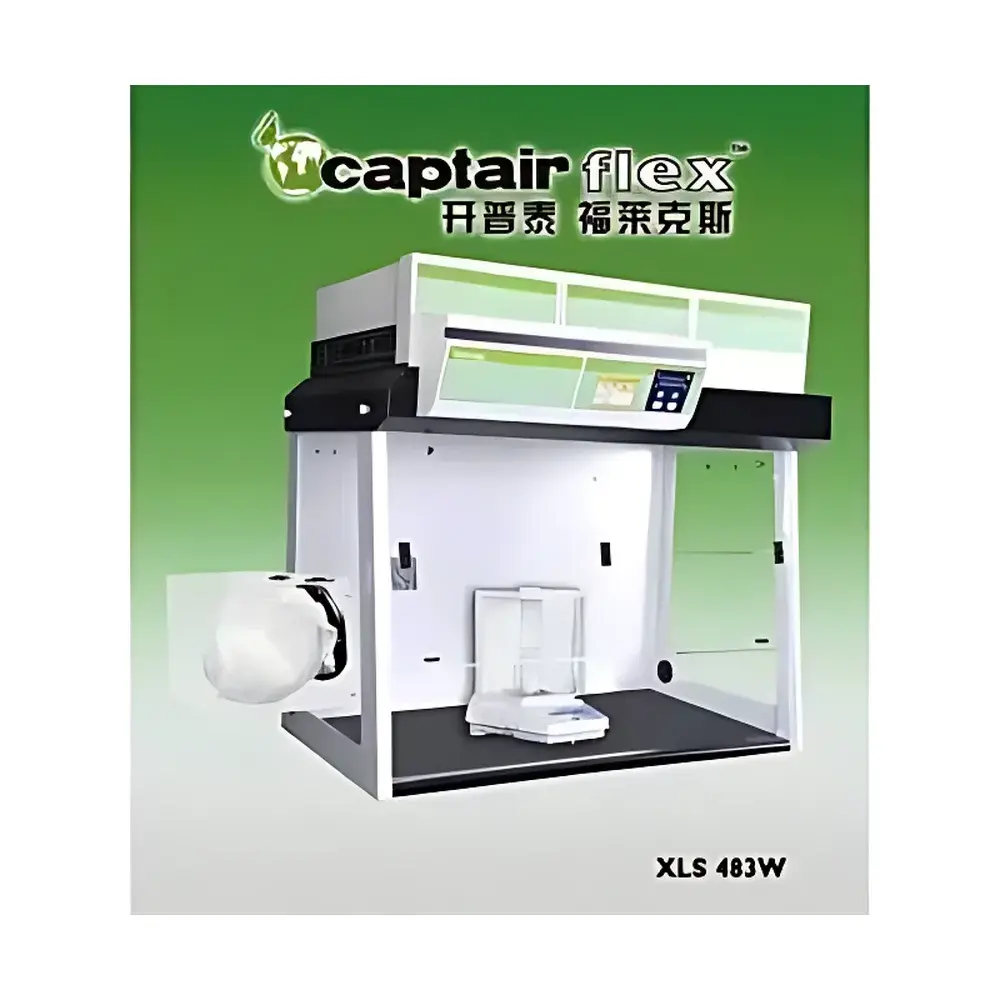
Erlab XLS483W Safe Weighing Workstation (Recirculating Ductless Fume Hood)
| Brand | Erlab |
|---|---|
| Origin | Germany |
| Model | XLS483W |
| Construction | Fully Steel Enclosure |
| Configuration | Double-Faced Operation |
| Airflow Capacity | 690 m³/h |
| Face Velocity Range | 0.4–0.6 m/s (compliant with AFNOR NF X 15-211:2009 Class 1) |
| Filtration System | Dual-layer molecular filter columns (3 filter frames total) |
| Power Input | 100–240 V AC, 50–60 Hz |
| Power Consumption | 175 W |
| Noise Level | 58 dB(A) |
| Illumination | 18 W IP67 fluorescent lamp(s), ≥500 lux at work surface |
| Safety Certification | Compliant with NF X 15-211:2009 Class 1 |
| Operating Modes | Liquid handling, liquid + particulate, powder weighing, cleanroom-compatible applications |
| Enclosure Dimensions (L×D×H, mm) | External 1275 × 790 × 1316–1500 |
| Voltage Output | 24 V DC (low-voltage control circuitry) |
| Current Draw | 1.75 A |
| Access Opening | Full-height open-face design |
| Optional Mobility | Castor-mounted trolley kit available |
Overview
The Erlab XLS483W Safe Weighing Workstation is a Class 1 recirculating ductless fume hood engineered for precision chemical weighing and low-emission laboratory operations. Unlike conventional exhaust hoods that vent conditioned air outdoors, the XLS483W employs a closed-loop air purification system based on active molecular adsorption—primarily utilizing impregnated activated carbon and specialty media tailored for volatile organic compounds (VOCs), acids, bases, and aldehydes. Air is drawn across the work surface at a controlled face velocity of 0.4–0.6 m/s (validated per AFNOR NF X 15-211:2009), then passed through a dual-stage filtration architecture: two identical molecular filter columns are arranged in vertical series—one upstream and one downstream of the centrifugal blower—ensuring continuous containment integrity even during progressive saturation of the primary filter. This redundancy eliminates breakthrough risk and supports uninterrupted operation in GMP-aligned QC labs, analytical chemistry suites, and cleanroom-adjacent environments where particulate and vapor control are critical.
Key Features
- Dual-layer molecular filtration system with three filter frames—configured to meet NF X 15-211:2009 Class 1 performance requirements for high-risk chemical weighing tasks.
- Integrated FlexControl™ digital panel (Capteur Flex™ platform) providing real-time monitoring of airflow balance, blower status, cumulative operating hours (0–250 h timer), and maintenance alerts.
- Optional Melecode™ S sensor module for automated VOC saturation detection—particularly suited for organic solvent-intensive workflows such as API synthesis or reference standard preparation.
- Dedicated filter saturation test port compatible with colorimetric tube sampling (e.g., Dräger or Sensidyne kits) for quantitative verification of breakthrough thresholds without filter disassembly.
- Ergonomic front panel with 15° forward tilt, elliptical and trapezoidal arm openings, central splash guard, and radius-edged work surface—optimized for prolonged operator comfort and containment fidelity during manual weighing procedures.
- IP67-rated 18 W fluorescent lighting delivering ≥500 lux uniform illumination across the entire internal work zone—certified for use in non-explosive atmospheres per IEC 60529.
- Low-voltage (24 V DC) internal control architecture enhancing electrical safety and simplifying integration into centralized lab infrastructure management systems.
Sample Compatibility & Compliance
The XLS483W is validated for use with liquid reagents, liquid–particulate mixtures, dry powders, and low-volatility standards under ISO 14644-1 Class 5–8 cleanroom-adjacent conditions. Its filtration configuration supports safe handling of common laboratory chemicals including acetone, methanol, hexane, hydrochloric acid (dilute), ammonia solution, and formaldehyde (<5 ppm). The unit complies with European ventilation safety standards NF X 15-211:2009 (Class 1), carries SGS and Intertek third-party verification reports, and meets CE marking requirements under Directive 2006/42/EC (Machinery) and 2014/30/EU (EMC). While not intrinsically rated for ATEX Zone 1/2, its 24 V DC control system and absence of ignition sources permit deployment in non-hazardous classified areas per IEC 60079-0.
Software & Data Management
The FlexControl™ interface logs operational parameters—including runtime hours, airflow deviation events, and user-initiated service cycles—in non-volatile memory. Audit trails are exportable via USB for GLP/GMP documentation compliance. Optional integration with LabVantage or Thermo Fisher SampleManager LIMS is supported through Modbus RTU protocol over RS-485. All alarm states (e.g., airflow loss >15%, filter saturation warning, door position fault) trigger both audible (85 dB buzzer) and visual (LED matrix) indicators—fully traceable in event history with timestamp resolution to ±1 second. No cloud connectivity or proprietary firmware updates are required; configuration remains local and deterministic.
Applications
- High-accuracy mass measurement of reference standards, pharmaceutical intermediates, and catalysts in ISO/IEC 17025-accredited testing laboratories.
- Weighing of hygroscopic, oxidizing, or light-sensitive compounds where ambient humidity or airborne contaminants must be excluded.
- Preparation of cytotoxic drug formulations under containment conditions aligned with USP hazardous drug handling guidelines.
- QC release testing involving solvent-based sample dissolution prior to HPLC or GC analysis.
- Environmental monitoring lab workflows requiring trace-level particulate exclusion during gravimetric filter weighing (e.g., PM2.5, TSP).
- Teaching laboratories conducting undergraduate organic chemistry experiments with reduced HVAC load and zero external ducting.
FAQ
What filtration media types are used in the XLS483W, and can they be customized for specific chemical classes?
The standard configuration employs dual-bed molecular filters: a first stage with acid gas–targeted impregnated alumina and a second stage with broad-spectrum coconut-shell activated carbon. Custom media packs—including amine-functionalized carbon for aldehydes or potassium permanganate–impregnated zeolite for formaldehyde—are available upon request and subject to compatibility validation per ASTM D5225 and EN 1540.
Does the XLS483W require external ductwork or make-up air systems?
No. As a recirculating ductless hood, it operates independently of building HVAC infrastructure. It draws ambient lab air, purifies it, and returns it—eliminating the need for dedicated exhaust stacks, roof penetrations, or air replacement systems.
How frequently must filters be replaced, and what indicators confirm saturation?
Under typical academic lab usage (4–6 hrs/day, moderate solvent load), filter service intervals range from 6–12 months. Saturation is indicated by the FlexControl™ panel’s hour-based timer, optional Melecode™ S sensor output, or manual colorimetric tube testing at the designated port. Replacement is performed field-serviceable without tools.
Is the XLS483W suitable for use with radioactive materials or nanomaterials?
No. It is not designed for alpha/beta emitters or aerosolized nanoparticles requiring HEPA + ULPA-grade particulate retention. For such applications, Erlab recommends the NanoFlow™ or Radiflow™ series with certified 99.995% @ 0.3 µm filtration and negative-pressure containment verification.
Can multiple XLS483W units operate simultaneously in the same room without compromising air quality?
Yes. Because each unit recirculates and purifies only its own intake volume, installation density is limited solely by floor space and electrical circuit capacity—not by room air exchange rates. This enables scalable deployment in modular lab designs without HVAC recalibration.
Related Products



