
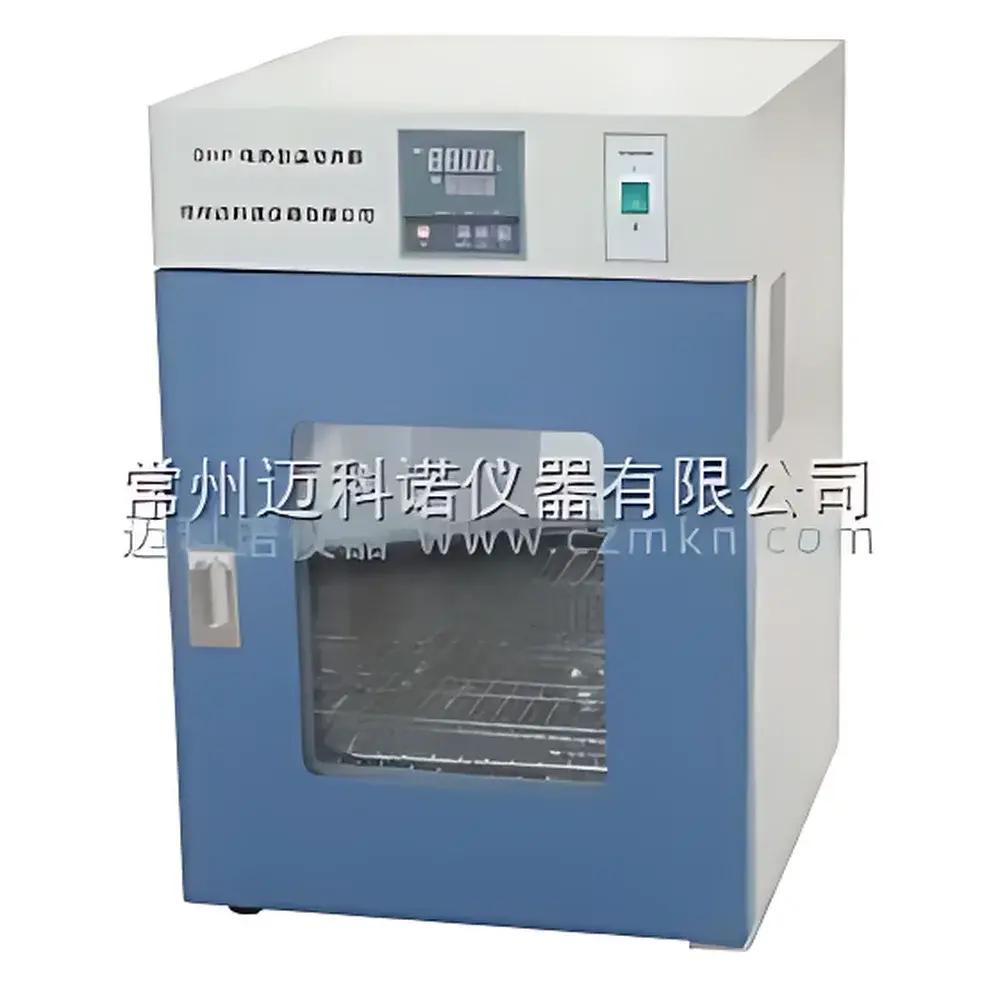
MKN DHP-160 Temperature-Controlled Incubator
| Brand | MKN |
|---|---|
| Model | DHP-160 |
| Type | Benchtop Forced-Air Dry Incubator |
| Temperature Range | Ambient +5°C to 80°C |
| Temperature Uniformity | ±0.5°C at 37°C (per ISO 1539-1) |
| Temperature Stability | ±0.2°C at setpoint |
| Chamber Volume | 160 L |
| Heating Method | External Sheathed Heater with PID Control |
| Display | 4-digit LED Digital Controller with Setpoint/Actual Dual Display |
| Door | Double-layer Tempered Glass Door with Sealed Gasket |
| Power Supply | 220 VAC, 50 Hz |
| Safety Features | Over-temperature Protection, Auto Cut-off, Ground Fault Circuit Interrupter (GFCI) |
Overview
The MKN DHP-160 Temperature-Controlled Incubator is a benchtop forced-air dry incubator engineered for precise, stable thermal environments in life science laboratories. Unlike humidity-controlled or CO₂ incubators, the DHP-160 is purpose-built for applications requiring strictly regulated dry heat—such as microbial culture storage, enzyme inactivation studies, cell line passaging pre-conditioning, desiccation protocols, and stability testing of pharmaceutical excipients. Its operational principle relies on a convection-driven airflow system with an externally mounted sheathed heating element, minimizing thermal overshoot and eliminating localized hot spots near samples. The chamber’s uniform air circulation—validated per ISO 1539-1 methodology—ensures reproducible thermal exposure across the full 160 L working volume. Designed for routine use in GLP-compliant QC labs, academic research facilities, and clinical microbiology units, the DHP-160 delivers traceable temperature performance without integrated humidification or gas control subsystems.
Key Features
- PID-controlled digital temperature regulation with dual-display LED interface (setpoint and real-time chamber temperature)
- External sheathed heating assembly—prevents radiant heat transfer and eliminates sample surface overheating or thermal shock
- Double-layer tempered glass observation door with silicone gasket sealing, maintaining thermal integrity during visual monitoring
- Forced-air convection system with adjustable rear-mounted fan speed for optimized uniformity across shelf levels
- Independent over-temperature safety cutoff (mechanical backup) plus electronic high-limit alarm with audible/visual alert
- CE-marked power supply (220 VAC, 50 Hz) with integrated GFCI protection and grounded chassis design
- Stainless steel interior chamber (304 grade) with rounded corners and removable perforated stainless steel shelves (3 standard positions)
Sample Compatibility & Compliance
The DHP-160 accommodates standard laboratory vessels including Petri dishes (up to 150 mm), multi-well plates (6–96-well), test tubes (13 × 100 mm and 16 × 150 mm), and Erlenmeyer flasks (up to 2 L). Its dry-heat configuration avoids condensation-related contamination risks common in humidified systems—making it especially suitable for mycological culture maintenance, spore germination assays, and lyophilized reagent storage conditioning. The unit complies with IEC 61010-1:2010 for electrical safety in laboratory equipment and meets mechanical design requirements outlined in ISO 1539-1 for thermal uniformity validation in dry incubators. While not certified for GMP manufacturing environments, its temperature logging capability (via optional RS-232 output) supports 21 CFR Part 11–aligned audit trails when paired with validated third-party data acquisition software.
Software & Data Management
The DHP-160 operates via embedded firmware with no proprietary PC software dependency. All calibration, alarm thresholds, and operational parameters are configured directly through the front-panel keypad. Optional RS-232 serial interface enables connection to external data loggers or SCADA systems for continuous temperature recording—supporting CSV export and time-stamped event logging (e.g., door open/close, alarm activation, setpoint changes). Firmware supports user-defined calibration offset adjustment (±5.0°C range) traceable to NIST-traceable reference thermometers. No cloud connectivity, mobile app, or remote access functionality is included—consistent with institutional IT security policies governing standalone lab instrumentation.
Applications
- Maintenance of bacterial and fungal stock cultures at defined sub-optimal temperatures (e.g., 4°C for short-term preservation, 30–37°C for active propagation)
- Thermal inactivation validation of biological indicators (e.g., Bacillus stearothermophilus spores) per ISO 11138-3
- Dry-heat depyrogenation trials for glassware and metal instruments (validated at ≥160°C for ≥2 hours; note: DHP-160 max = 80°C—requires higher-temp models for depyrogenation)
- Accelerated stability testing of solid-dose pharmaceuticals under ICH Q1A(R2) dry-heat stress conditions
- Pre-incubation equilibration of agar media, ELISA plates, and immunoblot membranes prior to assay execution
- Environmental simulation for entomological or seed germination studies requiring consistent dry thermal regimes
FAQ
Is the DHP-160 suitable for cell culture applications requiring CO₂ or humidity control?
No. It is a dry-heat, ambient-humidity incubator. Cell monolayer maintenance requires CO₂-regulated, humidified environments—use a dedicated CO₂ incubator instead.
Does the unit include factory calibration documentation?
Yes—each unit ships with a Certificate of Conformance listing initial temperature uniformity verification at 37°C and 60°C, performed using calibrated PT100 probes per ISO 1539-1 Annex B.
Can the internal shelves be repositioned during operation?
Shelves may be adjusted only when the chamber is powered off and cooled below 40°C to prevent thermal deformation of support rails.
What is the recommended recalibration interval?
Annual verification against a NIST-traceable reference thermometer is advised for GLP-regulated workflows; biannual checks suffice for non-regulated academic use.
Is the exterior casing insulated to reduce surface temperature during extended operation?
Yes—the outer shell incorporates 25 mm mineral wool insulation, limiting external surface temperature rise to ≤32°C above ambient at maximum setpoint.





