
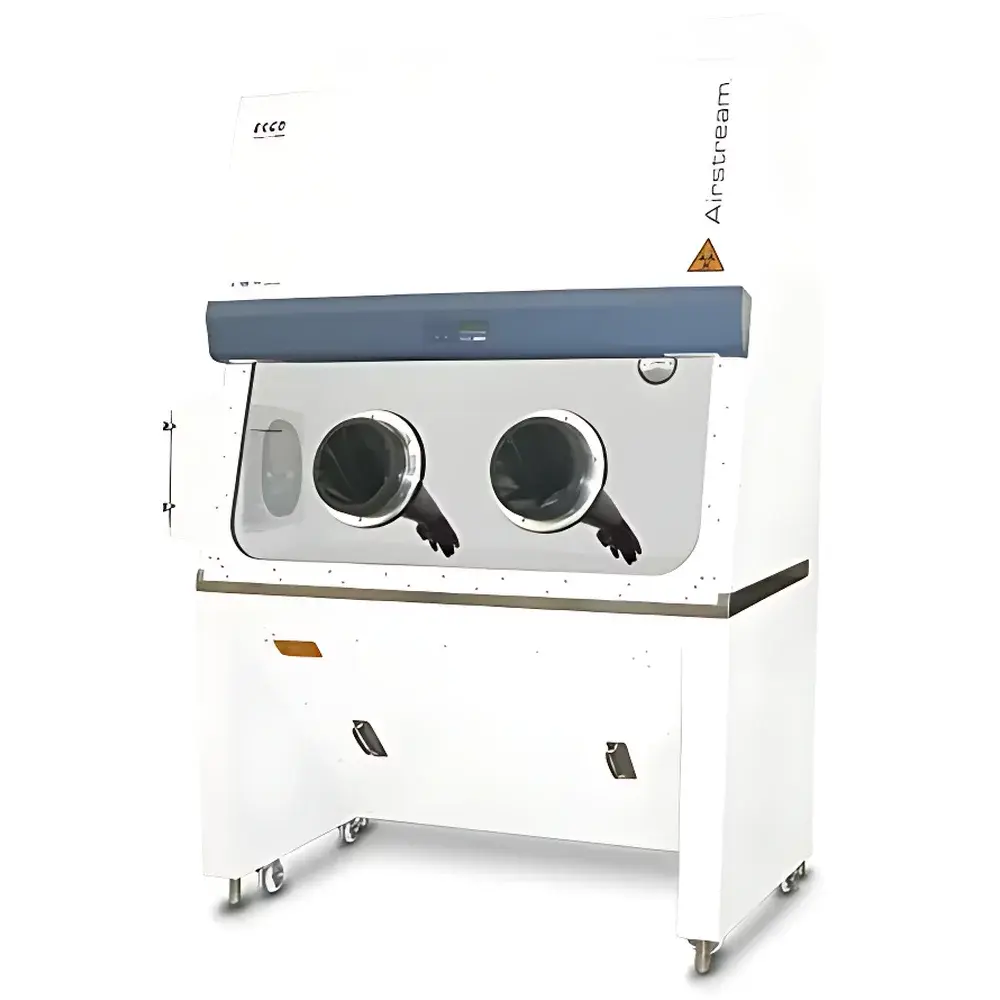
Esco Airstream AC3-B Class III Biological Safety Cabinet
| Brand | Esco |
|---|---|
| Origin | Singapore |
| Manufacturer Type | Original Equipment Manufacturer (OEM) |
| Product Origin | Imported |
| Cabinet Class | Class III |
| External Dimensions (L×W×H) | Refer to model-specific specifications |
| Internal Dimensions (L×W×H) | Refer to model-specific specifications |
| Filter Efficiency | ≥99.999% for particles ≥0.1–0.3 µm |
Overview
The Esco Airstream AC3-B Class III Biological Safety Cabinet is a fully enclosed, gas-tight containment system engineered for maximum personnel, product, and environmental protection during high-containment microbiological operations. Designed in strict accordance with the European standard EN 12469:2000 and exceeding its performance requirements, this cabinet operates under continuous negative pressure relative to the laboratory environment—ensuring zero unfiltered exhaust to the room. It employs a dual-ULPA filtration architecture with airflow recirculation and dedicated exhaust pathways, making it suitable for work involving Risk Group 4 (RG4) pathogens, including highly virulent viruses (e.g., Ebola, Marburg), prions, and other agents requiring Biosafety Level 4 (BSL-4) containment. Unlike Class II cabinets, the AC3-B eliminates operator exposure via rigid, leak-tested Neoprene gloves integrated into the front wall, eliminating reliance on laminar inflow velocity alone for protection.
Key Features
- Dual ULPA filtration system compliant with IEST-RP-CC001.3, delivering ≥99.999% particle capture efficiency for airborne contaminants sized 0.1–0.3 µm—exceeding HEPA performance by three orders of magnitude.
- Gas-tight construction certified per EN 12469:2000, validated through helium leak testing of all seams, glove ports, and transfer hatch interfaces.
- Esco Sentinel Silver microprocessor controller providing real-time visual and audible alarms for airflow deviation, filter saturation, pressure loss, and power interruption.
- Magnehelic® differential pressure gauge (registered trademark of Dwyer Instruments, Inc.) mounted on the rear wall for continuous monitoring of chamber static pressure and integrity verification.
- Integrated interlocked pass-through chamber enabling safe, contamination-free sample and material transfer without compromising primary containment.
- ISOCIDE™ antimicrobial coating applied to all exposed interior and exterior surfaces, inhibiting microbial colonization per ISO 22196:2011 test methodology.
- Ergonomically optimized front sash angle (15° tilt) reducing operator fatigue during extended procedures.
- Full negative-pressure operation: work area maintained at −275 Pa (−1.1 W.G.) relative to ambient lab air, preventing pathogen escape under normal and fault conditions.
Sample Compatibility & Compliance
The AC3-B accommodates a wide range of biological samples—including liquid cultures, lyophilized agents, aerosol-generating procedures, and solid tissue specimens—without compromising containment integrity. Its design supports compliance with international biosafety frameworks, including WHO Laboratory Biosafety Manual (4th ed.), CDC/NIH Biosafety in Microbiological and Biomedical Laboratories (BMBL, 6th ed.), and EU Directive 2000/54/EC. All electrical components meet IEC 61010-1 safety standards; UV germicidal lamps operate at 253.7 nm and are controlled via timed auto-shutoff to prevent ozone generation and ensure operator safety during maintenance.
Software & Data Management
The Sentinel Silver controller logs critical operational parameters—including static pressure differentials, fan speed, filter delta-P, and alarm events—with timestamped records stored onboard for ≥30 days. Optional RS-485 or Ethernet connectivity enables integration into centralized facility monitoring systems compliant with 21 CFR Part 11 for audit trail generation, electronic signature support, and secure data export. All firmware updates are digitally signed and validated prior to installation to maintain regulatory traceability.
Applications
- BSL-4 research laboratories handling RG4 pathogens under national regulatory authorization.
- Vaccine development and antiviral drug screening involving live, highly pathogenic viruses.
- Diagnostic reference labs performing confirmatory testing for select agents listed under APHIS/CDC Federal Select Agent Program.
- Biodefense R&D requiring full physical containment for aerosol challenge studies.
- Production of high-potency biologics where operator exposure must be reduced to ALARA (As Low As Reasonably Achievable) levels.
- Decontamination validation studies using formaldehyde vapor (via optional evaporator module) per ISO 14644-3 Annex B protocols.
FAQ
What biosafety level does the AC3-B support?
The AC3-B is certified for Class III operation and is routinely deployed in BSL-4 facilities. It meets—and exceeds—the engineering controls required for RG4 agent manipulation.
How is glove integrity verified?
Each Neoprene glove undergoes individual helium leak testing at 10⁻⁶ mbar·L/s sensitivity prior to installation and is retested after replacement per institutional biosafety SOPs.
Can the cabinet be integrated into building management systems (BMS)?
Yes—via optional Modbus RTU or BACnet MS/TP protocol modules, enabling remote status monitoring, alarm forwarding, and HVAC interlock signaling.
Is UV decontamination automated and validated?
UV lamp operation is programmable via the Sentinel Silver interface, with cycle duration, intensity ramp-up, and post-cycle cooldown configurable. Validation reports for UV dose mapping (per ISO 15714) are available upon request.
What materials are used in construction to resist chemical decontamination?
Stainless steel 304 body with electropolished finish; polyvinyl chloride (PVC)-clad work surface resistant to 70% ethanol, 10% bleach, and VHP—validated per ASTM D543 and ISO 10993-5 cytotoxicity testing.



