
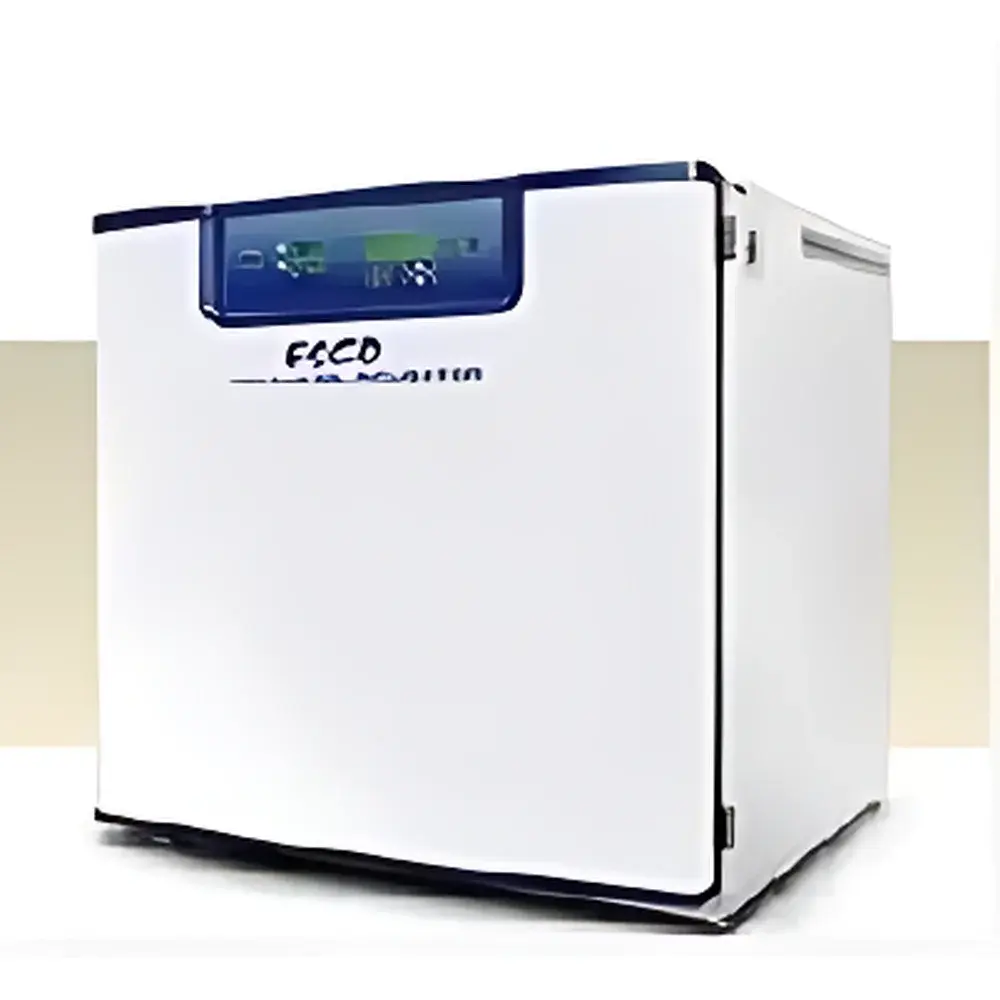
ESCO CelCulture® CCL-170B-8 Direct-Heat CO₂ Incubator
| Brand | ESCO |
|---|---|
| Origin | Singapore |
| Model | CCL-170B-8 |
| Heating Method | Direct-heat air-jacketed |
| Temperature Range | Ambient +3 to 60 °C |
| Temp. Uniformity | <±0.2 °C |
| Temp. Accuracy | <±0.1 °C |
| Temp. Recovery (after 1-min door opening) | 6 min |
| CO₂ Range | 0–20% |
| CO₂ Accuracy | ±0.1% |
| CO₂ Sensor | NDIR single-beam dual-wavelength infrared |
| CO₂ Recovery | 4 min |
| Humidity Range | Ambient to 97% RH |
| Humidity Recovery (±5% from setpoint) | 15 min |
| Chamber Volume | 170 L |
| Internal Dimensions (W×D×H) | 505 × 530 × 635 mm |
| External Dimensions (W×D×H) | 660 × 660 × 900 mm |
| Power Supply | 230 V, 50/60 Hz, 3.4 A |
| Max. Power Consumption | 800 W |
| Steady-State Power @ 37 °C | 80 W |
| Net Weight | 120 kg |
| Chamber Material | 304 stainless steel, seamless one-piece construction with large-radius internal corners |
| Exterior Coating | ISOCIDE™ antimicrobial-coated galvanized steel |
| Air Filtration | ULPA filter (≥99.999% @ 0.12 µm), ISO 5 (Class 100) cleanroom-grade chamber air |
| Gas Inlet Filtration | 0.2 µm inline sterilizing filter |
| Sterilization | SwiftCon™ 90 °C wet-heat cycle with automated drying and cooling phases |
| Control System | Smartsense™ microprocessor-based PID controller with 16 MB embedded flash memory |
| Data Logging | Full-parameter event logging with timestamped records accessible via LCD interface |
| Interface | RS-485 standard output |
| Compliance | Designed for GLP/GMP environments |
Overview
The ESCO CelCulture® CCL-170B-8 is a direct-heat, air-jacketed CO₂ incubator engineered for high-fidelity mammalian cell culture under rigorously controlled environmental conditions. Unlike conventional water-jacketed or convection-heated units, its proprietary direct-heat architecture employs eight independently modulated heating elements distributed across six chamber surfaces—managed through three thermally isolated control zones—to deliver exceptional spatial temperature uniformity (<±0.2 °C) and rapid thermal recovery (≤6 minutes after a 60-second door opening). The system integrates a dual-wavelength non-dispersive infrared (NDIR) CO₂ sensor, offering superior long-term stability, minimal drift, and immunity to cross-sensitivity from water vapor or ambient contaminants—critical for extended-duration experiments in regenerative medicine, IVF labs, and oncology research. Relative humidity is maintained up to 97% RH via a passive humidification tray, with airflow optimized by VentiFlow™ forced convection to ensure rapid re-equilibration without turbulence-induced shear stress on adherent monolayers.
Key Features
- VivoCell™ precision environmental control architecture: Simultaneous regulation of CO₂ concentration (0–20%), temperature (ambient +3 to 60 °C), and relative humidity (ambient to 97% RH) with zero overshoot during recovery cycles.
- SteriSafe™ contamination mitigation suite: ULPA filtration (≥99.999% efficiency at 0.12 µm) maintains ISO 5 (Class 100) air quality inside the chamber; all incoming gases pass through a certified 0.2 µm sterilizing filter.
- SwiftCon™ wet-heat decontamination: Fully automated 90 °C sterilization cycle—including pre-heat, hold, drying, and cooldown phases—eliminates bacterial endospores, mycoplasma, and fungi without operator intervention or chemical residuals.
- Smartsense™ PID microcontroller: Features real-time parameter logging to 16 MB onboard flash memory, time-stamped event history (alarms, door openings, sensor calibrations), and configurable alert thresholds for temperature deviation, CO₂ drift, or humidity loss.
- Ergonomic and service-oriented design: 10° inclined front panel reduces operator fatigue; tool-free removal of glass inner door, perforated stainless steel shelves (470 × 470 mm, 11 kg capacity each), and modular airflow ducts simplifies routine cleaning and validation.
Sample Compatibility & Compliance
The CCL-170B-8 accommodates standard T-75, T-175, and multi-well plates across up to seven adjustable shelves (standard configuration: four). Its seamless 304 stainless steel chamber—fabricated as a single unit with radius ≥15 mm at all internal corners—prevents microbial entrapment and enables reproducible cleaning validation per ISO 14644-1 and EU GMP Annex 1. The ISOCIDE™ antimicrobial coating on exterior panels inhibits surface biofilm formation in shared lab environments. Regulatory alignment includes support for FDA 21 CFR Part 11-compliant data integrity workflows when interfaced with validated laboratory information management systems (LIMS); full audit-trail generation, electronic signature capability, and user-access-level controls are implemented via optional software modules. The unit meets IEC 61010-1 safety standards and is CE-marked for use in clinical and research laboratories operating under GLP or GMP frameworks.
Software & Data Management
All operational parameters—including chamber temperature, CO₂ partial pressure, relative humidity, door status, alarm events, and sterilization cycle logs—are continuously recorded with millisecond-resolution timestamps. Data is stored locally in non-volatile flash memory and retrievable directly via the intuitive LCD interface using password-protected navigation menus. Export is supported via RS-485 serial communication for integration into centralized monitoring platforms compliant with ASTM E2500 or ISO/IEC 17025 requirements. Diagnostic mode provides real-time sensor diagnostics, calibration status flags, and predictive maintenance alerts (e.g., filter saturation indicators, heater performance degradation trends). No cloud connectivity or proprietary drivers are required—ensuring compatibility with air-gapped infrastructure common in biosafety level 2+ facilities.
Applications
This incubator serves as a foundational platform for applications demanding stringent environmental fidelity: primary human neuronal cultures requiring stable pH and low O₂ variability; stem cell expansion protocols sensitive to transient CO₂ fluctuations; co-culture models involving immune cells and tumor spheroids; and assisted reproductive technology (ART) workflows where embryo viability correlates directly with humidity stability and airborne particulate load. Its ISO 5 chamber environment and validated SwiftCon™ sterilization make it suitable for ISO/IEC 17025-accredited reference labs performing cell line authentication or biobanking. The absence of condensation-prone water jackets also eliminates risk of microbial ingress during prolonged operation—a key consideration for continuous bioprocess monitoring in academic core facilities.
FAQ
What CO₂ sensing technology does the CCL-170B-8 employ, and how does it differ from thermal conductivity (TC) sensors?
It uses an NDIR (non-dispersive infrared) single-beam dual-wavelength sensor, which offers higher specificity, longer calibration intervals, and immunity to humidity interference compared to TC sensors.
Is the SwiftCon™ sterilization cycle validated against ISO 14644-1 or EN 17141 standards?
While the cycle achieves >6-log reduction of Geobacillus stearothermophilus spores, formal validation against specific ISO/EN standards requires site-specific protocol execution per ISO 14644-3 and ISO/IEC 17025 accreditation scope.
Can the incubator be integrated into a building management system (BMS)?
Yes—via RS-485 Modbus RTU protocol, enabling remote status monitoring and alarm forwarding to central facility dashboards.
Does the ULPA filter require replacement, and what is its rated service life?
Filter replacement interval depends on usage frequency and ambient lab air quality; typical service life is 12–24 months, with status indicated via the Smartsense™ interface.
How is temperature uniformity verified during factory qualification?
Performed using 9-point thermocouple mapping per ISO 14644-3 Annex B, with results documented in the Certificate of Conformance shipped with each unit.
Related Products




