
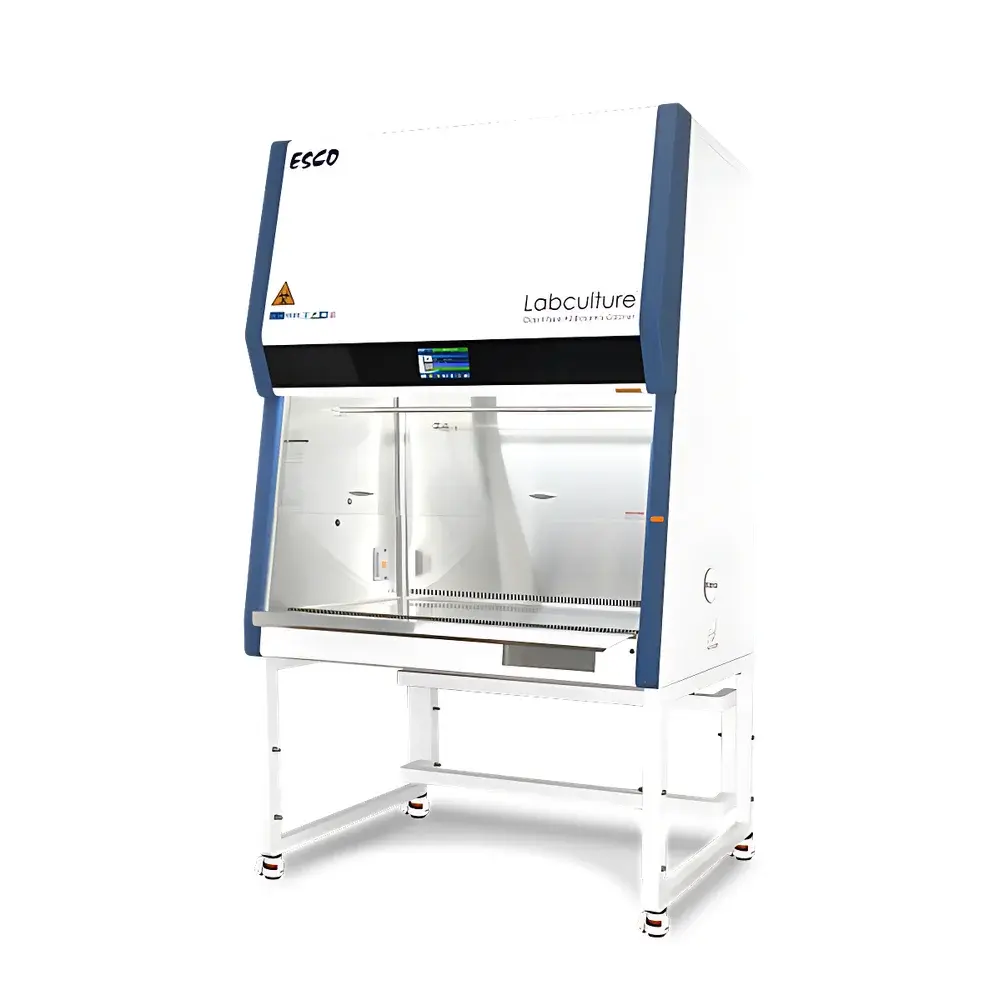
Esco Labculture G4 A2 Class II Biological Safety Cabinet
| Brand | Esco |
|---|---|
| Origin | Singapore |
| Manufacturer | Esco Micro Pte Ltd |
| Type | Class II, Type A2 Biosafety Cabinet |
| Model | LA2-G4 |
| Filter Efficiency | ≥99.999% (ULPA) |
| Inflow Velocity | 0.30–0.53 m/s |
| Downflow Velocity | 0.30–0.33 m/s |
| Noise Level | ≤56 dBA |
| Power Supply | 220–240 VAC, 50/60 Hz |
| Compliance | NSF/ANSI 49-2022, EN 12469:2000, AS/NZS 2252.2:2013 |
Overview
The Esco Labculture G4 A2 Class II Biological Safety Cabinet is an engineered solution for containment of low-to-moderate risk biological agents (BSL-1 to BSL-2), designed in strict accordance with NSF/ANSI 49-2022 and EN 12469:2000 standards. It operates on the principle of laminar airflow management—drawing ambient room air through a front intake grille (inflow), passing it over the work surface, and recirculating ~70% of the total volume through a ULPA filter after passing through a dedicated plenum; the remaining ~30% is exhausted externally via a dedicated ducted connection or thimble. This dual-path airflow architecture ensures personnel protection (via inward inflow velocity control), product protection (via downward ISO Class 3–certified laminar flow), and environmental protection (via exhaust filtration and negative-pressure containment). The cabinet’s structural integrity relies on a negative-pressure envelope surrounding all positive-pressure zones—including the work chamber and supply plenum—to prevent unfiltered leakage under operational or transient failure conditions.
Key Features
- Centurion™ Touchscreen Controller: Real-time monitoring and adjustment of inflow/downflow velocities, alarm status, filter life estimation, and system diagnostics; supports multi-language UI and audit-trail-capable event logging.
- Energy-Efficient DC-ECM Blower System: Delivers up to 70% lower power consumption versus conventional AC motors while maintaining stable, pulse-free airflow profiles across variable load conditions.
- ULPA Filtration: Certified ≥99.999% particle capture efficiency at 0.12 µm (DOP/NaCl test aerosol), ensuring ISO Class 3 (Class 10) clean air delivery to the work area.
- Ergonomic Stainless Steel Work Surface: Seamless, shallow-dish design minimizes fluid pooling and facilitates decontamination; integrated support columns provide uniform load distribution across full-width trays.
- ISOCIDE® Antimicrobial Coating: Applied to all exposed interior stainless steel surfaces to inhibit microbial colonization between routine disinfection cycles.
- Adjustable LED Task Lighting: Dimmable, flicker-free illumination with color temperature optimized for visual acuity and reduced operator fatigue during extended procedures.
- USB-C Interface: Enables secure export of operational logs (start/stop timestamps, alarm events, filter usage metrics) to Building Management Systems (BMS) or centralized laboratory informatics platforms.
Sample Compatibility & Compliance
The Labculture G4 A2 accommodates standard microbiological workflows involving cell culture, sterile tissue handling, recombinant DNA manipulation, and antibiotic susceptibility testing. Its internal dimensions—ranging from 915 × 625 × 720 mm (LA2-3S8 G4) to 1830 × 625 × 720 mm (LA2-6S8 G4)—support multi-user benchtop configurations and integration with centrifuges, pipette stations, and CO₂ incubators. All models comply with GLP-relevant documentation requirements and support 21 CFR Part 11–compliant electronic records when paired with validated LIMS/BMS interfaces. Certification documentation includes third-party verification of airflow uniformity (±10% tolerance), sash velocity stability (±5% over 100-hour continuous operation), and containment integrity (smoke visualization per NSF 49 Annex D).
Software & Data Management
The Centurion controller firmware includes embedded data logging with timestamped entries for fan runtime, filter differential pressure, door position status, and alarm triggers (e.g., high-velocity deviation, UV lamp fault, sash height out-of-range). Logs are exportable in CSV format via USB port without requiring proprietary software. Optional Esco CloudLink module enables remote monitoring, predictive maintenance alerts, and integration with enterprise asset management systems. Audit trails meet ALCOA+ principles (Attributable, Legible, Contemporaneous, Original, Accurate, Complete, Consistent, Enduring, Available) for regulated environments.
Applications
This cabinet is routinely deployed in academic core facilities, pharmaceutical QC labs, clinical diagnostics centers, and biotech R&D suites performing tasks including: primary human cell isolation and expansion; lentiviral vector production under BSL-2+ containment; mycoplasma testing using selective media; aseptic filling of diagnostic reagents; and preparation of CRISPR-Cas9 editing complexes. Its consistent downflow velocity profile (<0.33 m/s) and low turbulence design minimize cross-contamination risk during open-vessel manipulations, while the robust negative-pressure chassis ensures containment integrity during accidental spills or procedural breaches.
FAQ
What safety certifications does the Labculture G4 A2 hold?
NSF/ANSI 49-2022 (USA), EN 12469:2000 (EU), AS/NZS 2252.2:2013 (Australia/New Zealand), and CE-marked under the EU Medical Device Regulation (MDR) Annex I essential requirements.
Is external ducting mandatory for A2 cabinet operation?
Yes—A2 cabinets require either hard-ducted exhaust to the outdoors or connection to a thimble system with dedicated makeup air supply. Recirculation-only mode is not permitted per NSF 49.
How often should the ULPA filters be replaced?
Filter service life is application-dependent but typically ranges from 3 to 5 years under normal use; the Centurion controller estimates remaining filter life based on cumulative runtime and pressure drop trends.
Can the cabinet be validated for GMP compliance?
Yes—Esco provides IQ/OQ documentation packages, and the unit supports qualification protocols aligned with ISO 14644-3 and EU GMP Annex 1 (2022) for cleanroom-associated equipment.
Does the ISOCIDE coating require special cleaning agents?
No—standard hospital-grade disinfectants (e.g., 70% ethanol, sodium hypochlorite ≤0.5%) are compatible; abrasive cleaners or chlorine-based solutions above 1,000 ppm must be avoided to preserve coating integrity.






