
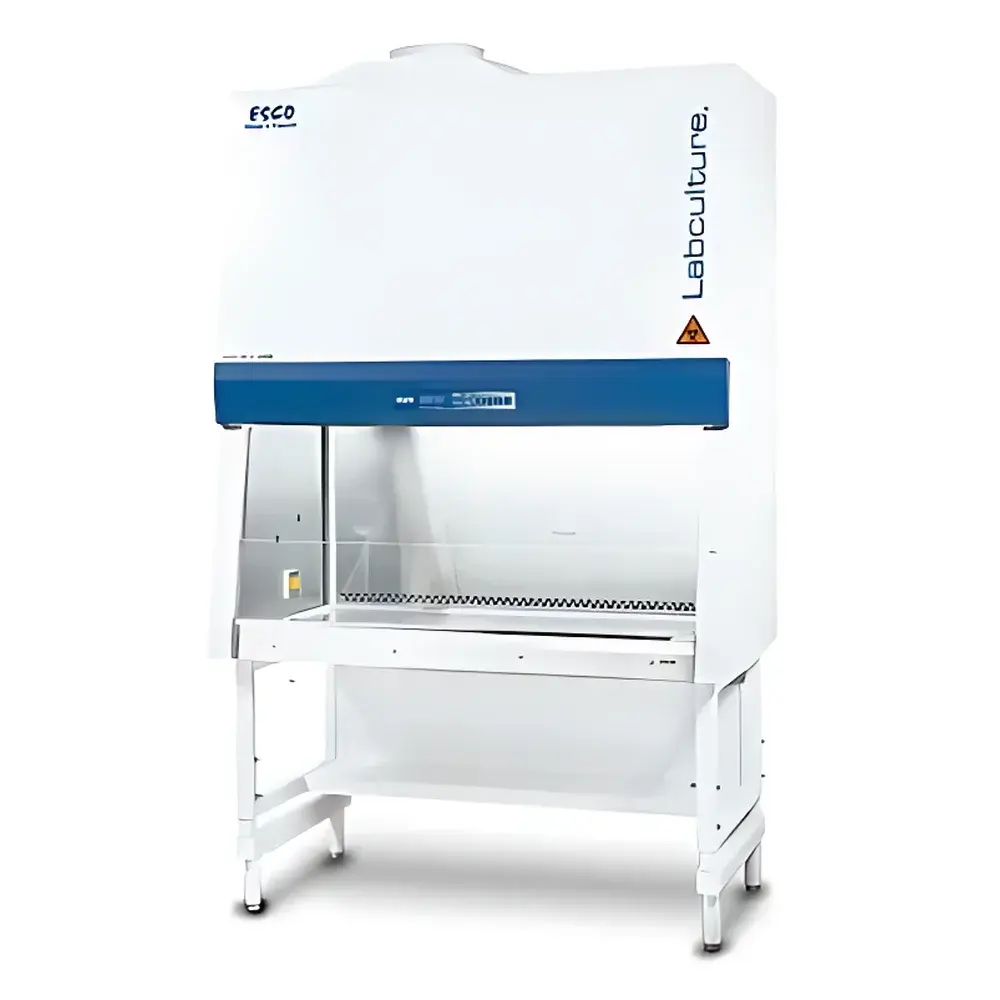
Esco Labculture LB2-B Series Class II Type B2 Biosafety Cabinet
| Brand | Esco |
|---|---|
| Origin | Singapore |
| Manufacturer | Esco Micro Pte Ltd |
| Product Category | Class II, Type B2 (Total Exhaust) Biosafety Cabinet |
| Certification | NSF/ANSI 49, YY0569 |
| Filter Efficiency | ≥99.999% for particles ≥0.1 µm (ULPA) |
| Airflow Velocity (Inflow) | 0.53 m/s (105 fpm) |
| Airflow Velocity (Downflow) | 0.31 m/s (60 fpm) |
| Power Supply | 220 VAC, 50 Hz |
| Construction | Seamless One-Piece Stainless Steel Work Chamber |
| Control System | Esco Sentinel Gold Microprocessor-Based Digital Display |
| Compliance | Meets ISO 14644-1 Class 5 (ISO Class 5), IEST-RP-CC001.3, ADA Accessibility Guidelines |
Overview
The Esco Labculture LB2-B Series Class II Type B2 Biosafety Cabinet is a total-exhaust, ducted biological safety cabinet engineered to provide simultaneous protection for personnel, products, and the external environment during procedures involving hazardous biological agents and volatile toxic chemicals. Unlike Class II Type A2 cabinets—which recirculate a portion of filtered air—Type B2 cabinets exhaust 100% of airflow externally via dedicated ductwork, eliminating any risk of chemical vapor re-entrainment into the laboratory space. This design adheres strictly to the fundamental principle of containment: unidirectional airflow dynamics governed by laminar downflow (≥0.31 m/s) and inward inflow (≥0.53 m/s), both conditioned through certified ULPA filters with ≥99.999% efficiency at 0.1–0.3 µm particle size. The cabinet’s structural integrity derives from a seamless, one-piece stainless steel work chamber—free of seams, welds, or fasteners—that ensures complete decontaminability and compliance with GLP and GMP facility requirements.
Key Features
- NSF/ANSI 49 and YY0569 certified—validated for Class II, Type B2 operational performance and containment integrity.
- ULPA filtration system meeting IEST-RP-CC001.3 standards, delivering ≥99.999% particle capture efficiency for airborne particulates ≥0.1 µm.
- Esco Sentinel Gold microprocessor control panel featuring a large-format backlit LCD display, real-time airflow monitoring, alarm logging, and user-accessible calibration diagnostics.
- Brushless DC motor-driven blower system offering precise speed regulation, energy efficiency, low acoustic emission (<65 dB(A)), and extended service life.
- Tilted supply air filter geometry optimized to ensure uniform downflow velocity distribution across the entire work surface—critical for ISO Class 5 (formerly Class 100) cleanroom-equivalent conditions.
- Ergonomic front sash angle (10° tilt) and recessed control/display module compliant with ADA accessibility guidelines for seated and standing operators.
- Esco ISOCIDE antimicrobial coating applied to all exposed painted surfaces, inhibiting microbial colonization per ASTM E2149-20 standard.
- Enhanced side-wall baffle perforation pattern improving containment at the operator interface zone, validated per NSF/ANSI 49 tracer gas containment tests.
- Frameless tempered glass sash for unrestricted visual access and simplified wipe-down protocols between operations.
- High-positioned front grille design minimizing obstruction risk from equipment placement while maintaining consistent inflow profile.
Sample Compatibility & Compliance
The LB2-B accommodates a broad range of life science workflows—including recombinant DNA manipulation, viral vector production, cytotoxic drug handling, and mycobacterial culture—where concurrent biosafety and chemical hazard mitigation are mandated. Its total-exhaust architecture is explicitly required under USP , USP , and EU GMP Annex 1 for sterile compounding involving hazardous pharmaceuticals. All models comply with ISO 14644-1 Class 5 (≤3,520 particles/m³ ≥0.5 µm) in the work area when operated within specified airflow parameters. Structural materials meet UL 61010-1 for electrical safety and NFPA 45 for laboratory ventilation system integration. Ducting interfaces conform to ASHRAE 110 containment verification protocols, supporting third-party commissioning and annual recertification per NSF/ANSI 49 Section 7.3.
Software & Data Management
The Sentinel Gold controller supports audit-ready data governance via built-in event logging (alarms, sash position, airflow deviations, filter lifetime estimates) with time/date stamping and non-volatile memory retention. RS-232 serial output enables integration with centralized building management systems (BMS) or LIMS for remote parameter monitoring and automated report generation. Optional Ethernet connectivity (via add-on module) facilitates secure, encrypted data transmission compliant with FDA 21 CFR Part 11 requirements—including electronic signatures, role-based access control, and immutable audit trails. Calibration records and maintenance logs are exportable in CSV format for regulatory submission during GLP/GMP inspections.
Applications
- Containment of BSL-2 and BSL-3 pathogens in academic, clinical, and contract research laboratories.
- Preparation of antineoplastic and hormonal therapeutics under USP hazardous drug handling guidelines.
- Cell therapy manufacturing environments requiring ISO Class 5 background conditions and chemical vapor exclusion.
- Environmental microbiology labs performing aerosol-generating procedures with environmental isolates.
- Vaccine development workflows involving live-attenuated or viral vector platforms.
- Quality control testing of sterile injectables where chemical cross-contamination must be eliminated.
FAQ
What distinguishes a Type B2 biosafety cabinet from a Type A2?
A Type B2 cabinet exhausts 100% of air externally and recirculates zero airflow; a Type A2 recirculates ~70% of filtered air internally. Type B2 is mandatory when working with volatile toxic chemicals that cannot be captured by carbon filtration.
Is ducted installation mandatory for the LB2-B series?
Yes. Type B2 cabinets require hard-ducted connection to an external exhaust system with dedicated fan capacity—no canopy or thimble configurations are permitted per NSF/ANSI 49.
Can the LB2-B be installed in a room without a dedicated exhaust system?
No. It must be integrated into a properly balanced laboratory ventilation infrastructure with static pressure compensation and fail-safe alarms for exhaust flow loss.
Does the ULPA filter require replacement after formaldehyde decontamination?
Formaldehyde sterilization does not degrade ULPA media integrity; however, post-decon integrity testing (e.g., DOP/PAO scan) is required before reuse per ISO 14644-3.
What validation documentation is provided with each unit?
Each cabinet ships with a Certificate of Conformance, Factory Performance Test Report (including airflow mapping, containment verification, and filter leak test results), and NSF/ANSI 49 certification seal documentation.




