
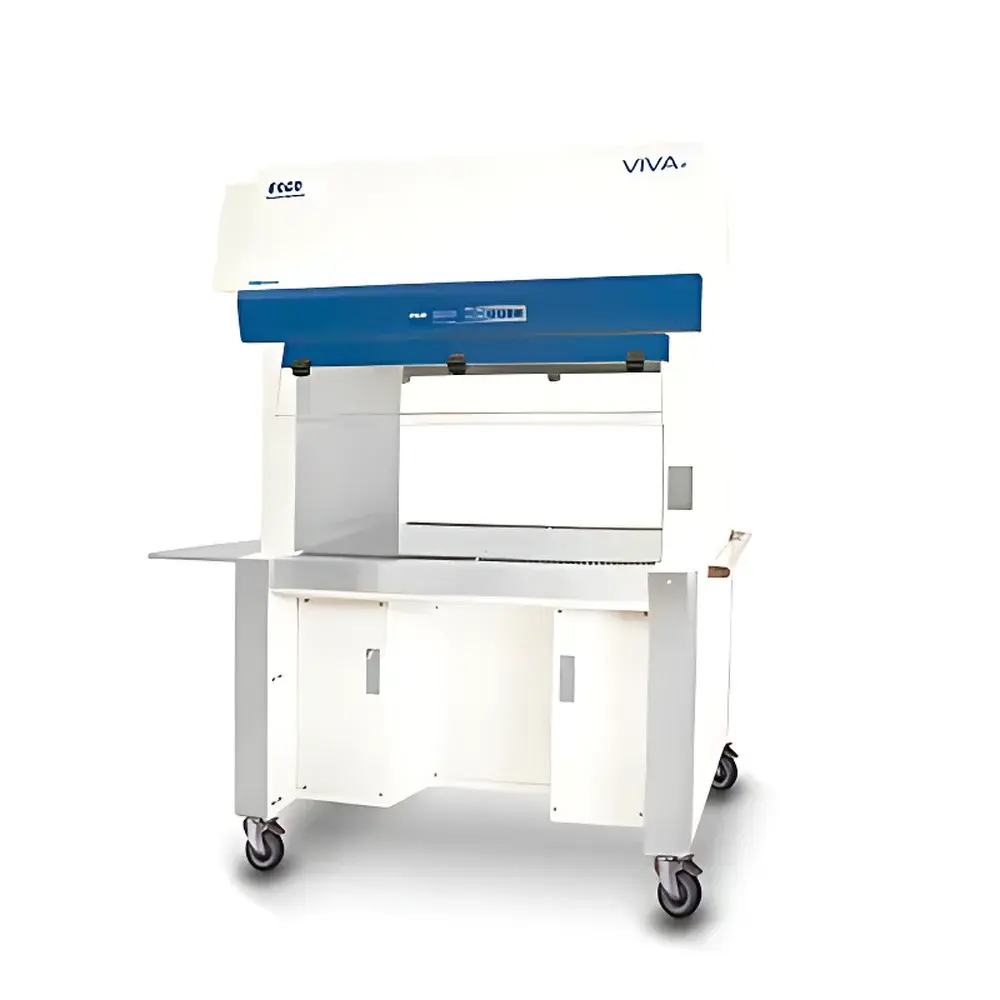
Esco VIVA Dual-Access Animal Cage Changing Station
| Brand | Esco |
|---|---|
| Origin | Singapore |
| Manufacturer Type | Original Equipment Manufacturer (OEM) |
| Product Category | Imported |
| Model | VDA-A |
| Instrument Class | Class II Biological Safety Cabinet |
| External Dimensions (L×W×H) | 1340 × 762 × 1961 mm / 1645 × 762 × 1961 mm |
| Internal Work Area Dimensions (L×W×H) | 1100 × 465 × 564 mm / 1405 × 465 × 564 mm |
| ULPA Filter Efficiency | ≥99.999% at MPPS (0.12 µm) |
Overview
The Esco VIVA Dual-Access Animal Cage Changing Station (Model VDA-A) is a purpose-engineered Class II biological safety cabinet designed specifically for humane, aseptic, and operator-safe rodent cage transfer in vivariums, preclinical research facilities, and GLP-compliant animal housing units. Unlike conventional biosafety cabinets optimized for microbiological work, the VIVA integrates dual-sided ergonomic access with laminar airflow architecture to support simultaneous two-operator workflows while maintaining strict separation between “dirty” (soiled cage removal) and “clean” (sterile cage placement) zones. Its core protection mechanism relies on a balanced, vertically downward unidirectional airflow—generated by an electronically commutated motor (ECM)—that passes through a certified ULPA filter (ISO 14644-1 Class 4 compliant) before entering the work area. This ensures continuous containment of allergens (e.g., dander, urine proteins), microorganisms, and particulate contaminants, while minimizing cross-contamination risk during routine cage changes. The system operates at a nominal downflow velocity of 0.24 m/s (47 fpm), calibrated to meet NSF/ANSI 49 and EN 12469 requirements for personnel, product, and environmental protection.
Key Features
- Dual-access configuration with symmetrical leg clearance enables two trained technicians to perform coordinated cage transfers without compromising airflow integrity or ergonomics.
- ULPA filtration (≥99.999% efficiency at MPPS 0.12 µm) delivers tenfold higher allergen retention than standard HEPA filters, critical for reducing occupational sensitization in animal facility staff.
- ECM-driven blower system maintains constant airflow velocity across ±10% input voltage fluctuations, ensuring stable containment performance under variable utility conditions.
- Noise emission limited to ≤53 dB(A) at 1 m—among the lowest in its class—minimizing acoustic stress on laboratory animals and supporting IACUC-compliant housing environments.
- Integrated Esco Sentinel microprocessor controller with LCD interface provides real-time monitoring of sash position, inflow/downflow velocity, filter life, and alarm status; supports audible and visual alerts for low airflow or sash mispositioning.
- ISOCIDE™ antimicrobial coating applied to all exposed stainless-steel surfaces inhibits bacterial colonization per ISO 22196, enhancing long-term hygiene and reducing bioburden accumulation.
- Recessed air grille design prevents obstruction from gloves, sleeves, or equipment, preserving uniform downflow distribution and preventing localized turbulence that could compromise containment.
Sample Compatibility & Compliance
The VIVA station accommodates standard IVC (individually ventilated cage) systems, static cages, and transport carriers up to 465 mm deep and 564 mm high. Its internal work surface is constructed from 304 stainless steel with seamless welded corners and coved edges for ease of decontamination. All airflow performance data are validated per NSF/ANSI 49–2022 Annex D (cage changing mode) and EN 12469:2000 Annex B. The unit complies with ISO 14644-1 Class 4 cleanroom specifications for the work area and meets ICH-GCP, AAALAC International, and EU Directive 2010/63/EU requirements for animal facility infrastructure. Optional validation documentation—including ELISA-based allergen challenge testing reports—is available upon request to support institutional biosafety committee (IBC) and veterinary oversight reviews.
Software & Data Management
The Esco Sentinel control system logs operational parameters—including daily runtime, filter usage hours, airflow deviations, and alarm events—in non-volatile memory. Audit trail functionality satisfies FDA 21 CFR Part 11 requirements when paired with Esco’s optional networked data export module (VIVA-Link). Data can be exported via USB or Ethernet to LIMS-compatible formats (CSV, XML), enabling integration into facility-wide QA/QC tracking systems. Firmware updates are performed offline via secure USB key, with version history and digital signature verification to ensure traceability and regulatory defensibility.
Applications
- Routine cage changing in SPF (specific pathogen-free) and germ-free rodent colonies.
- Transfer of immunocompromised or transgenic animals requiring enhanced allergen containment.
- Preparation of cages for behavioral assays, dosing studies, or imaging protocols where environmental consistency is critical.
- Support of GLP-regulated toxicology and pharmacokinetic studies requiring documented operator protection and sample integrity.
- Integration into modular vivarium designs where space-efficient, dual-operator workflow optimization is prioritized.
FAQ
What distinguishes the VIVA from standard Class II A2 cabinets?
The VIVA is engineered exclusively for cage changing—not general microbiological work—featuring dual-side access, optimized downflow-only airflow (no recirculation), and ULPA-grade allergen filtration validated for rodent dander capture.
Is the VDA-A compatible with automated cage washing systems?
Yes—its standardized internal dimensions and open-front design allow seamless integration with conveyor-fed cage washers and rack storage modules.
How often must the ULPA filter be replaced?
Filter service life is typically 5–7 years under normal use; exact intervals depend on ambient particulate load and are tracked automatically by the Sentinel system.
Does the unit support third-party calibration and certification?
All airflow sensors and alarms are NIST-traceable and compatible with external anemometers and particle counters used by accredited biosafety certification providers.
Can the VIVA be installed in a non-ducted configuration?
No—the VDA-A is a hard-ducted Class II Type A2 cabinet requiring dedicated exhaust ducting to outside air; it does not operate in recirculating mode.





