
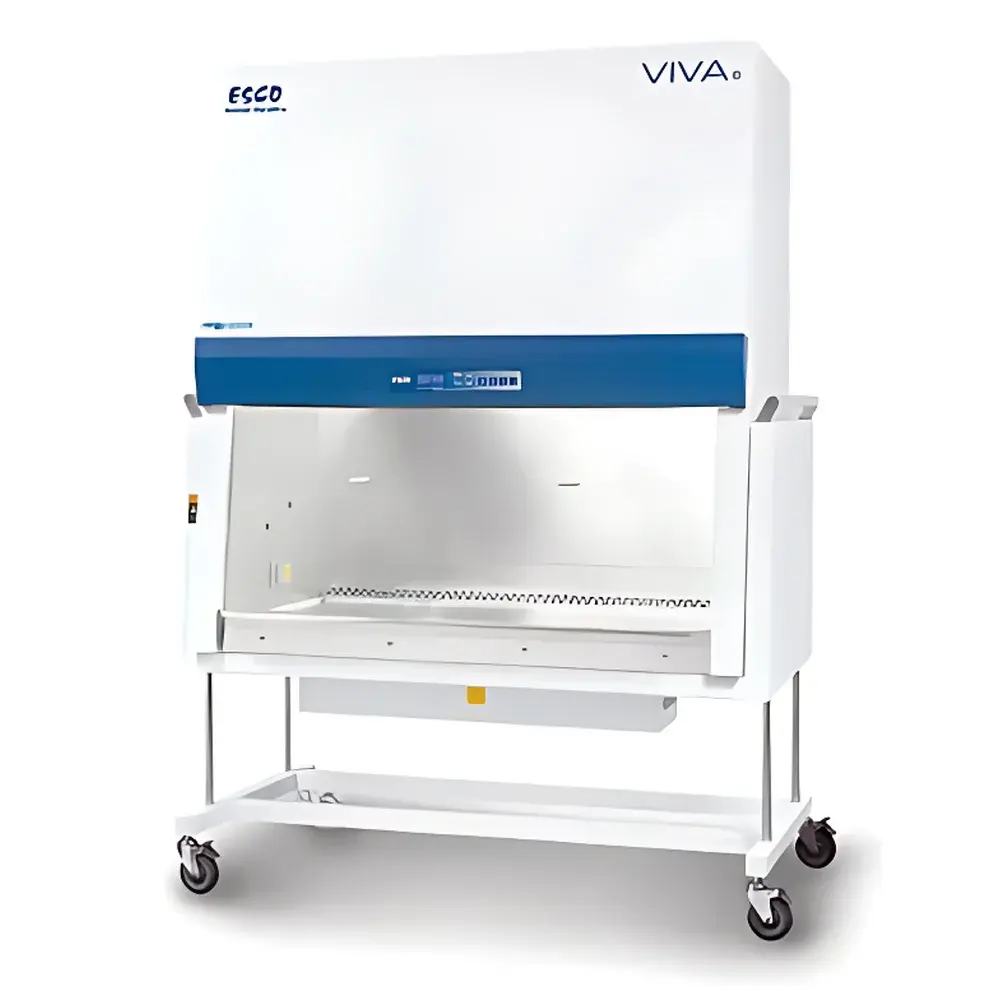
Esco VIVA VA2-A1-E Class II A1 Biological Safety Cabinet for Animal Handling
| Brand | Esco |
|---|---|
| Origin | Singapore |
| Manufacturer | Esco Micro Pte Ltd |
| Product Type | Class II Type A1 Biological Safety Cabinet |
| External Dimensions (L×W×H) | 1423 × 815 × 1510 mm (VA2-4A1-E) / 2030 × 815 × 1510 mm (VA2-6A1-E) |
| Internal Work Area Dimensions (L×W×H) | 1270 × 623 × 680 mm (VA2-4A1-E) / 1870 × 620 × 680 mm (VA2-6A1-E) |
| Inflow Velocity | 0.45 m/s (90 fpm) |
| Downflow Velocity | 0.35 m/s (70 fpm) |
| ULPA Filter Efficiency | ≥99.999% at MPPS (0.12 µm) |
| Pre-filter | Polyester, 85% arrestance |
| Power Supply | 220–240 VAC, 50/60 Hz |
| Compliance | NSF/ANSI 49-2022, EN 12469:2000, ISO 14644-1 Class 3 (ISO 3), USP <797>, GLP/GMP-ready |
Overview
The Esco VIVA VA2-A1-E is a Class II Type A1 biological safety cabinet specifically engineered for animal handling procedures requiring simultaneous personnel, product, and environmental protection. It operates on a validated air recirculation principle derived from the established airflow dynamics of Class II A2 cabinets—yet optimized for low-risk animal work where aerosolized allergens, dander, and non-volatile particulates pose primary hazards. Air enters the work area through a front grille at a controlled inflow velocity of 0.45 m/s, forming a protective curtain across the operator’s hands and arms. Approximately 70% of the total airflow is recirculated downward after passing through dual ULPA filters (one for downflow, one for exhaust), delivering ISO Class 3 (equivalent to Federal Standard 209E Class 1) clean air to the work surface—over 100× cleaner than conventional Class 100 cabinets. The remaining 30% is exhausted externally via a dedicated ducted system, ensuring containment of airborne contaminants generated during animal manipulation.
Key Features
- Dual ULPA filtration system: One filter supplies laminar downflow (0.35 m/s) to maintain ISO 3 cleanroom conditions; the second treats exhaust air to ≥99.999% efficiency at MPPS (0.12 µm), exceeding HEPA performance.
- Integrated pre-filtration: High-capacity polyester pre-filter (85% arrestance) installed beneath the work surface captures coarse particulates, extending ULPA service life and reducing maintenance frequency.
- ESCO Sentinel™ microprocessor control: Real-time monitoring of inflow and downflow velocities, sash position, UV lamp status, and filter loading. LCD interface displays operational parameters with intuitive navigation.
- Fail-safe airflow protection: Automatic shutdown triggered by loss of inflow or downflow velocity below set thresholds (monitored via thermal anemometry), preventing unsafe operation.
- ISOCIDE® antimicrobial powder coating: EPA-registered silver-ion infused finish applied to all exposed interior and exterior surfaces inhibits bacterial colonization per ISO 22196 and ASTM E2149 standards.
- Ergonomic sloped front profile and adjustable height stand (optional): Reduces operator fatigue during prolonged animal handling; motorized electro-hydraulic lift supports seated or standing workflows with precise height control (±1 mm repeatability).
Sample Compatibility & Compliance
The VIVA VA2-A1-E accommodates standard rodent cages (up to IVC size), surgical instrumentation, centrifuges, and microinjection rigs within its certified work envelope. Its airflow architecture meets the containment requirements for BSL-1 and BSL-2 agents when used in conjunction with appropriate PPE and institutional biosafety protocols. Certified to NSF/ANSI 49-2022 and EN 12469:2000, it supports compliance with USP environmental controls for sterile compounding adjacent to animal workspaces, as well as GLP and GMP audit readiness through full traceability of airflow logs and alarm history. Optional UV germicidal irradiation (253.7 nm) is interlocked with sash position and includes programmable timer control via Sentinel™—ensuring validated decontamination cycles without operator exposure.
Software & Data Management
The Sentinel™ control system records time-stamped airflow data, sash position history, UV activation events, and alarm triggers (e.g., low inflow, high filter resistance, door breach). All logs are exportable via USB port in CSV format for integration into LIMS or electronic lab notebooks. Audit trail functionality satisfies FDA 21 CFR Part 11 requirements when paired with user authentication modules (available as add-on). No cloud connectivity is embedded; local data retention ensures IT security compliance in regulated academic and pharmaceutical research environments.
Applications
- Routine rodent handling, dosing, and sample collection under allergen-controlled conditions
- ELISA-based allergen isolation validation studies requiring quantifiable airborne particle containment
- Preclinical pharmacokinetic sampling where cross-contamination between animal cohorts must be eliminated
- Genetically modified organism (GMO) handling under institutional biosafety committee (IBC)-approved protocols
- Training laboratories requiring robust, repeatable airflow performance for student instruction in containment principles
FAQ
Is the VA2-A1-E certified to NSF/ANSI 49?
Yes—the unit is fully certified to NSF/ANSI 49-2022 for Class II Type A1 cabinets, including third-party verification of inflow velocity, downflow uniformity, and containment integrity.
Can this cabinet be used for volatile chemical work?
No. While equipped with activated carbon filtration for odor abatement in exhaust streams, it is not designed for volatile organic compound (VOC) containment. Use only with low-volatility agents consistent with Class II A1 operational limits.
What is the recommended ULPA filter replacement interval?
Under typical animal facility use (8 hrs/day, 5 days/week), ULPA filters require replacement every 3–5 years; pre-filters should be inspected monthly and replaced quarterly or as pressure drop exceeds 250 Pa.
Does the cabinet support remote monitoring?
Local USB data export is supported; Ethernet or Wi-Fi interfaces are not included but may be integrated via external industrial IoT gateways compliant with IEC 62443.
Is ISOCIDE® coating re-certified after surface cleaning?
The antimicrobial efficacy remains intact following routine disinfection with 70% ethanol or quaternary ammonium compounds, as verified per ISO 22196 post-cleaning recovery testing.




