ESSA ESSAY-3 SAR Measurement System
| Brand | ESSA |
|---|---|
| Origin | Imported (Non-China) |
| Manufacturer Type | Authorized Distributor |
| Model | ESSAY-3 |
| Price | Upon Request |
| SAR Probe Frequency Range | 10 MHz – 10 GHz |
| Probe Spatial Resolution | ≤ 25 mm³ |
| Probe Dynamic Range | 2 mW/kg – 100 W/kg |
| Robot Position Repeatability | < 0.01 mm |
| SAM Phantom Compliance | IEEE Std 1528-2003 / IEC 62209-1 |
| Angular Isotropy | ±0.2 dB |
| Probe Impedance | ≈2 MΩ |
| Dipole Length | 2.0 mm |
| Tip O.D. | 4.0 mm |
| Offset | 2.0 mm |
| Robot Payload Capacity | 6 kgf |
| Robot DOF | 6-axis vertically articulated |
| Motor Type | DC servo |
| Robot Weight | 58 kg |
| Flat Phantom Dimensions | 42 cm × 36 cm × 19 cm |
| Phantom Shell Thickness | 2.0 mm ± 0.2 mm |
| Phone Fixture Angular Tolerance | ±1° |
| Fixture Material | εᵣ < 5, tanδ ≤ 0.05 |
Overview
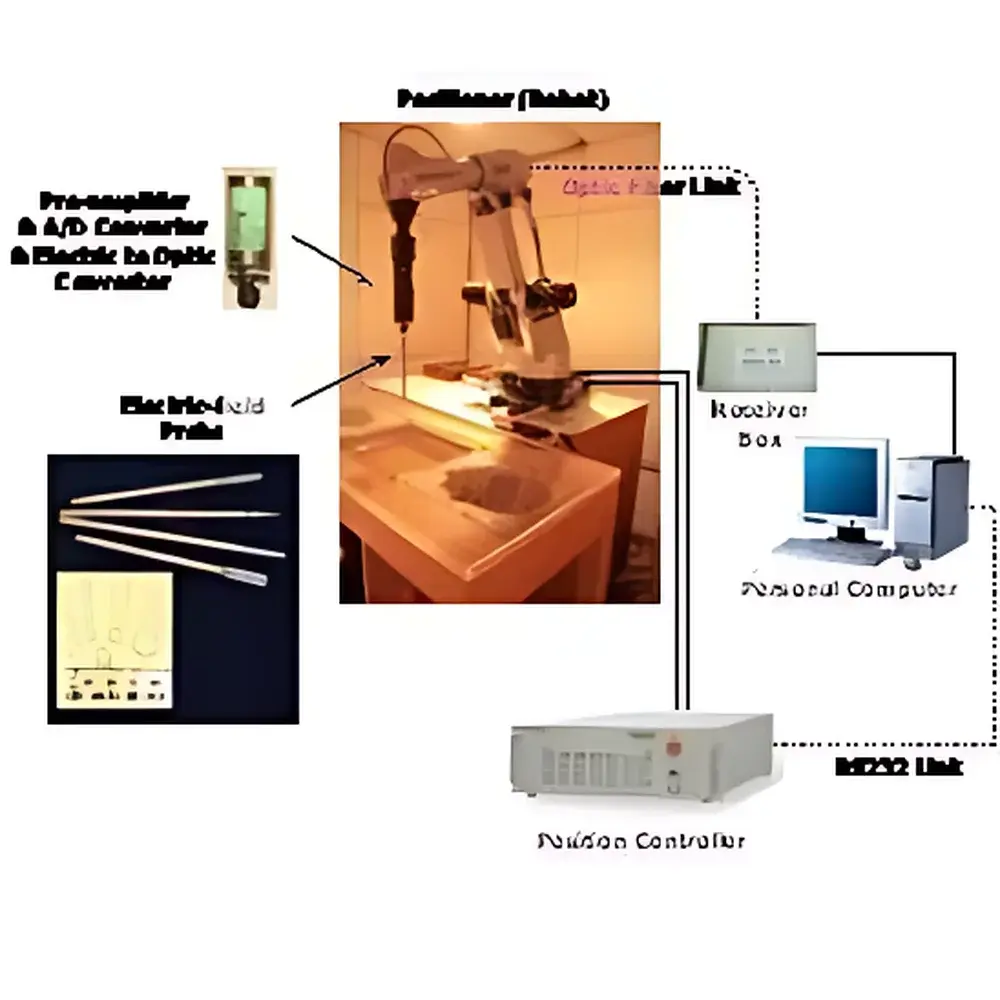
The ESSA ESSAY-3 SAR Measurement System is a fully integrated, standards-compliant platform engineered for precise, repeatable Specific Absorption Rate (SAR) evaluation of wireless communication devices operating across 10 MHz to 10 GHz. Designed in strict adherence to IEEE Std 1528-2003 (P1528/D1.2) and aligned with IEC 62209-1 requirements, the system implements the standardized electric field scanning methodology within anatomically representative phantoms—primarily the Specific Anthropomorphic Mannequin (SAM) and flat-tissue-equivalent phantoms. SAR quantification is derived from high-fidelity E-field measurements using a calibrated isotropic probe, coupled with robotic spatial mapping and validated tissue-simulating liquid formulations. The system’s architecture supports both head and body exposure configurations, enabling compliance testing for mobile phones, tablets, wearables, and other RF-emitting portable transmitters under controlled laboratory conditions.
Key Features
- IEEE 1528-2003–compliant SAR measurement architecture, incorporating updated probe calibration, phantom positioning, and data acquisition protocols introduced in the 2003 revision.
- High-isotropy E-field probe with gold-plated Schottky diode sensor, 6-axis vertically articulated robot (DC servo-driven), and sub-10 µm position repeatability under full payload (≤6 kgf).
- Optimized probe geometry: 2.0 mm dipole length, 4.0 mm tip outer diameter, and 2.0 mm mechanical offset—minimizing perturbation while maintaining broadband sensitivity from 10 MHz to 10 GHz.
- Dual-phantom support: Separated left/right SAM phantom (shell thickness 2.0 mm ± 0.2 mm, εᵣ < 5, tanδ < 0.05) and flat phantom (42 × 36 × 19 cm, bottom thickness 2 mm) conforming to IEEE 1528 and IEC 62209 dimensional and dielectric specifications.
- Low-dielectric phone fixture with angular positioning accuracy ±1°, constructed from materials meeting εᵣ < 5 and tanδ ≤ 0.05—ensuring minimal RF scattering and measurement uncertainty contribution.
- Probe dynamic range spanning 2 mW/kg to 100 W/kg, enabling characterization of both low-power IoT devices and high-output cellular handsets without range switching or sensor saturation.
Sample Compatibility & Compliance
The ESSAY-3 accommodates commercial handheld and wearable RF transmitters—including GSM, UMTS, LTE, Wi-Fi (2.4/5 GHz), Bluetooth, and 5G NR devices—mounted in standardized positions relative to the SAM or flat phantom surface. All phantom shells are manufactured to CAD-defined geometries per IEEE 1528 Annex A and IEC 62209-1 Clause 6, with dielectric properties verified at multiple frequencies (including 900 MHz, 1800 MHz, 2.4 GHz, and 5.8 GHz) using coaxial transmission line or waveguide methods. The system supports GLP-aligned test documentation workflows and is compatible with audit-ready reporting structures required for FCC, CE, IC, and MIC regulatory submissions. While not inherently FDA 21 CFR Part 11–certified, its software architecture permits integration with validated LIMS environments supporting electronic signatures and audit trails.
Software & Data Management
Control, scanning, and SAR computation are managed via ESSA’s proprietary measurement suite, which implements automated probe calibration routines, robot path planning (including contour-following near phantom surfaces), and real-time E-field vector reconstruction. Raw probe voltage outputs are converted to SAR (W/kg) using frequency-dependent conversion factors traceable to NIST-traceable E-field standards. Data export formats include CSV, HDF5, and XML, supporting post-processing in MATLAB, Python (SciPy/NumPy), or third-party EM simulation tools. The software enforces mandatory metadata tagging—including device ID, test date, operator, phantom lot number, liquid conductivity/permittivity values, and environmental temperature/humidity—ensuring full traceability per ISO/IEC 17025 clause 7.5.
Applications
- FCC SAR certification testing for Part 2.1093 and Part 24.232 compliance.
- CE RED Directive (2014/53/EU) conformity assessment, including harmonized standard EN 62209-1:2016 implementation.
- Pre-compliance screening for mobile device design validation prior to accredited lab submission.
- Research-grade SAR distribution mapping for antenna placement optimization and near-field exposure modeling.
- Verification of tissue-simulating liquid stability over extended test campaigns (e.g., thermal drift monitoring at 22 °C ± 1 °C).
- Support for emerging use cases including SAR assessment of foldable displays, multi-antenna arrays, and millimeter-wave (24–39 GHz) modules via probe extrapolation protocols per IEEE P1528.2.
FAQ
Does the ESSAY-3 support both head and body SAR measurements?
Yes—the system includes both SAM (head/torso) and flat phantom configurations, with robot kinematics programmed for standardized separation distances (e.g., 5 mm for head, 10 mm for body-worn scenarios) per IEEE 1528-2003 Section 5.
Is probe calibration performed in-house or by an accredited lab?
ESSA provides factory calibration certificates traceable to NIST standards; however, users must perform periodic in-situ verification using reference field sources (e.g., TEM cell or calibrated dipole) as specified in IEEE 1528-2003 Annex C.
Can the system be upgraded to meet newer standards such as IEEE 1528-2013 or IEC 62209-2?
Hardware is backward-compatible; software updates and revised phantom positioning algorithms are available through ESSA’s maintenance agreement, enabling alignment with IEC 62209-2:2019 for multiple simultaneous transmitters and heterogeneous tissue modeling.
What environmental conditions are required for valid SAR testing?
Ambient temperature must be maintained at 22 °C ± 1 °C, relative humidity 30–60 % RH, and ambient RF noise floor ≤ −120 dBm/Hz at all test frequencies—verified prior to each measurement session.
Is robot motion programmable for custom scan patterns beyond standard grids?
Yes—the control interface exposes low-level motion scripting (via ASCII command protocol), allowing user-defined trajectories for research applications such as edge-field mapping or curved-surface interpolation.