
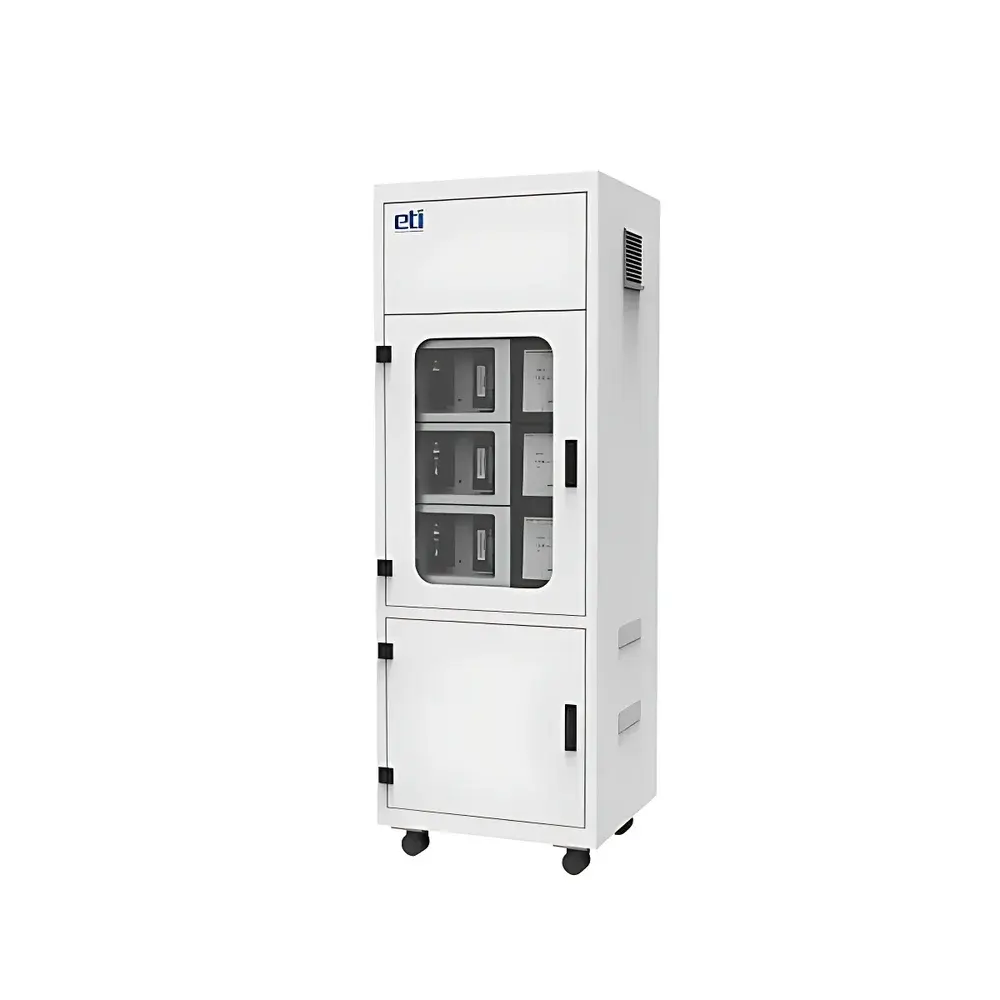
ETI 2020 Ammonia-N Online Water Quality Analyzer
| Brand | ETI |
|---|---|
| Origin | Guangdong, China |
| Manufacturer Type | Authorized Distributor |
| Country of Manufacture | China |
| Model | 2020 Ammonia-N |
| Detection Principle | Salicylate or Nessler Spectrophotometry |
| Measurement Range | 0–10 mg/L and 0–150 mg/L (expandable) |
| Measurement Modes | Cyclic, Triggered, Point, Continuous, Manual |
| Verification Modes | Remote, Manual, Auto (time-based & threshold-triggered) |
| Output Signals | 4–20 mA, RS232 / RS485 |
| Power Supply | 220 ± 22 VAC, 50 ± 0.5 Hz |
| Module Dimensions | 490 × 400 × 210 mm (W×D×H) |
| Cabinet Dimensions | 600 × 550 × 1750 mm (W×D×H) |
| Key Features | Intelligent Dilution, Auto-Range Switching, High-Precision Syringe Pump, Multi-Channel Rotary Valve Sampling, Integrated QC Protocols (Standard Spike Recovery, Blank Check, Calibration Verification), Modular Multi-Analyte Configuration Support |
Overview
The ETI 2020 Ammonia-N Online Water Quality Analyzer is an industrial-grade, CE-compliant continuous monitoring system engineered for reliable, unattended quantification of total ammonia nitrogen (NH₃-N + NH₄⁺-N) in diverse aqueous matrices. It operates on two standardized spectrophotometric methods—salicylate and Nessler reagent-based detection—both compliant with ISO 7150-1:1984 and ASTM D1426-15 for ammonia determination in water. The analyzer employs a dual-beam optical path with temperature-stabilized LED light sources and precision photodiode detection to minimize drift and ensure long-term baseline stability. Designed for 24/7 operation in municipal, industrial, and environmental monitoring applications, it delivers trace-level sensitivity and robust interference rejection—particularly against common matrix constituents such as chloride, calcium, magnesium, and suspended solids—without requiring pre-filtration in most operational scenarios.
Key Features
- Intelligent dilution algorithm dynamically adjusts sample-to-reagent ratios based on real-time absorbance feedback, enabling seamless auto-ranging across 0–10 mg/L and 0–150 mg/L spans without manual intervention.
- High-accuracy syringe pump (±0.5% volumetric repeatability) ensures precise metering of sample, reagents, and standards—critical for compliance with EPA Method 350.1 and ISO 14911 quality requirements.
- Multi-position rotary valve manifold minimizes carryover and reagent consumption by >40% compared to peristaltic systems; all fluidic paths are chemically resistant (PTFE, PEEK, borosilicate glass).
- Integrated power-loss recovery: retains calibration coefficients, measurement history, and active method parameters during outages; resumes scheduled cycles within <60 seconds after power restoration.
- Modular architecture supports co-location of up to four independent analyzers (e.g., NH₃-N, NO₃⁻-N, COD, TP) in a single 1750 mm cabinet—reducing footprint, shared utilities, and cross-platform diagnostics via unified HMI.
Sample Compatibility & Compliance
The ETI 2020 is validated for use with raw surface water, drinking water distribution systems, wastewater influent/effluent streams, and industrial process effluents (pH 5.5–9.5, turbidity ≤ 200 NTU, particle size < 100 µm). It meets EN 14181 (QAL1–QAL3) requirements for automated water analyzers and supports full audit trails aligned with ISO/IEC 17025:2017 laboratory management principles. All calibration and verification events—including standard addition recovery tests, blank checks, and multi-point linearity verification—are timestamped, user-annotated, and exportable in CSV/Excel format for regulatory submission. Optional 21 CFR Part 11-compliant software module enables electronic signatures, role-based access control, and immutable data logging for GLP/GMP environments.
Software & Data Management
Control and configuration are managed via embedded Linux-based firmware with web-accessible interface (HTTPS, TLS 1.2). The system supports OPC UA and Modbus TCP protocols for integration into SCADA, DCS, or cloud-based IoT platforms (e.g., Azure IoT Hub, AWS IoT Core). Raw absorbance spectra, reaction kinetics curves, and diagnostic logs (pump actuation counts, valve cycle status, heater duty cycle) are stored locally for ≥90 days and synchronizable to external NAS or FTP servers. Firmware updates are delivered over secure SFTP with SHA-256 signature validation. Remote diagnostics include live flow-path pressure monitoring, photometer dark-current trending, and reagent shelf-life tracking with automated low-volume alerts.
Applications
- Real-time compliance monitoring at wastewater treatment plant discharge points per EU Urban Wastewater Treatment Directive (91/271/EEC) and US Clean Water Act NPDES permit limits.
- Early-warning detection of ammonia breakthrough in granular activated carbon (GAC) or ion exchange polishing units within municipal drinking water facilities.
- Process optimization in aquaculture recirculating systems where NH₃-N thresholds must remain below 0.02 mg/L (unionized fraction) to prevent fish gill damage.
- Industrial pretreatment verification for electroplating, semiconductor rinse water, and fertilizer manufacturing effluents prior to sewer discharge.
- Long-term trend analysis in watershed-scale environmental monitoring networks, supporting ISO 5667-3 sampling strategy alignment.
FAQ
What ammonia species does the ETI 2020 measure?
It measures total ammonia nitrogen (TAN), encompassing both unionized ammonia (NH₃) and ammonium ion (NH₄⁺), as defined in ISO 7150-1 and EPA Method 350.1.
Can the analyzer operate without daily maintenance?
Yes—routine maintenance intervals are specified at 7-day calibration verification and 30-day reagent replacement under typical municipal influent conditions; extended service kits support 90-day operation in low-turbidity applications.
Is remote firmware update supported?
Yes—updates are delivered via authenticated SFTP with cryptographic integrity verification and rollback capability in case of incomplete installation.
Does it support automatic spike recovery testing?
Yes—the built-in QC engine executes programmable standard addition sequences (e.g., 50% and 100% spike levels) with automatic recovery calculation and pass/fail flagging per ISO 8466-2 criteria.
How is interference from chlorine or heavy metals managed?
The salicylate method inherently suppresses hypochlorite interference; optional thiosulfate quenching is available. For high-Cu/Zn matrices (>0.5 mg/L), integrated chelation pretreatment can be enabled via auxiliary reagent channel.
Related Products







