
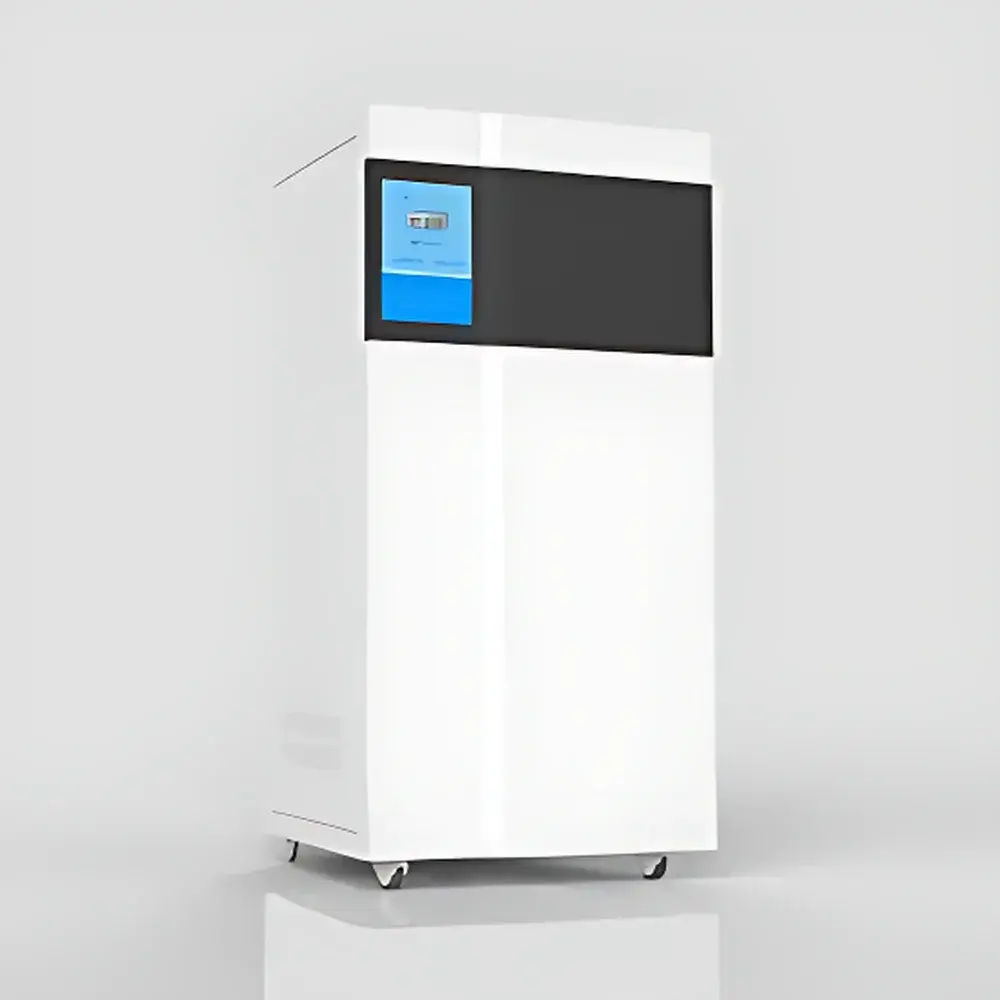
EU-T Floor-Standing Ultra-Pure Water System by Jihepu
| Brand | Jihepu |
|---|---|
| Model | EU-T |
| Type | Floor-standing ultra-pure water system |
| Feed Water | Municipal tap water (0.1–0.5 MPa, 5–45 °C) |
| Output Capacity | 40–100 L/h |
| Pure Water Flow Rate | 1.5–2.0 L/min |
| RO Water Conductivity | ≤2% of feed water conductivity |
| UP Water Resistivity | 15–18 MΩ·cm @ 25 °C |
| TOC | ≤15 ppb |
| Microbial Count | ≤1 CFU/mL |
| Particles (>0.1 � | m): ≤1/mL |
| Heavy Metals & Soluble Silica | ≤0.1 ppb |
| Endotoxins | ≤0.001 EU/mL |
| Compliance | GB/T 6682–2008 Grade I laboratory water standard |
| Membrane | Imported Dow Filmtec™ RO membrane (98% salt rejection) |
| Safety | Low-voltage operation (≤24 V DC control circuit), GLP-compliant insulation and corrosion-resistant ABS + powder-coated steel chassis |
| Automation | Microprocessor-controlled with touch interface, real-time resistivity/TOC monitoring, scheduled RO membrane cleaning, consumables life tracking, and multi-layer safety interlocks (low-pressure alarm, dry-run protection, tank overflow cutoff) |
Overview
The EU-T Floor-Standing Ultra-Pure Water System is an engineered solution for laboratories requiring continuous, reliable supply of Type I ultrapure water per GB/T 6682–2008 and aligned with ASTM D1193–2020 Type I specifications. Designed around a dual-stage purification architecture—comprising pretreatment, high-rejection reverse osmosis (RO), and post-RO polishing via mixed-bed ion exchange, activated carbon adsorption, and 0.1 μm final filtration—the system delivers water suitable for critical applications including HPLC mobile phase preparation, ICP-MS calibration, cell culture media formulation, and molecular biology workflows. Its floor-standing configuration optimizes footprint efficiency in central utility rooms or core lab facilities, while the integrated RO membrane—sourced from Dow’s Filmtec™ line—ensures consistent desalination performance under variable municipal feed conditions. All electrical control logic operates at safety extra-low voltage (SELV), and mechanical construction adheres to GLP-aligned structural integrity standards, including reinforced ABS polymer housing and electrophoretically coated steel panels resistant to chemical splashes and long-term humidity exposure.
Key Features
- Microprocessor-based control system with capacitive touch interface and backlit LCD display for real-time monitoring of resistivity, TOC, flow rate, and system status
- Automated RO membrane maintenance cycle—including timed flush protocols and manual override for on-demand cleaning—minimizing fouling and extending membrane service life
- Multi-tier safety architecture: low-inlet-pressure warning, pump dry-run shutdown, full-tank cut-off, and overpressure relief valve integration
- Modular quick-connect fluidic design enabling tool-free replacement of prefilter cartridges, RO housings, and UP polishing packs—reducing mean time to repair (MTTR)
- Constant-pressure delivery (±0.02 MPa regulation) compatible with high-precision analytical instruments such as automated clinical analyzers, ELISA washers, and capillary electrophoresis systems
- Energy-efficient operation: 30–80 W nominal power draw across load conditions; no external booster pump required within specified inlet pressure range (0.1–0.5 MPa)
Sample Compatibility & Compliance
The EU-T system produces water meeting or exceeding the stringent physicochemical limits defined in GB/T 6682–2008 for Grade I laboratory water, including resistivity ≥15 MΩ·cm (typical 18.2 MΩ·cm), TOC ≤15 ppb, microbial count ≤1 CFU/mL, endotoxin ≤0.001 EU/mL, and particle count ≤1 particle/mL (>0.1 μm). These specifications support compliance-driven environments governed by ISO/IEC 17025, CLIA, and Good Manufacturing Practice (GMP) Annex 1 requirements for water used in pharmaceutical process rinsing or diagnostic reagent preparation. While not inherently 21 CFR Part 11 compliant out-of-the-box, audit-ready data logging (resistivity trend, alarm history, cartridge usage timestamps) can be exported in CSV format for inclusion in quality documentation packages. All wetted materials—including EPDM gaskets, PEEK manifolds, and sanitary-grade stainless-steel fittings—meet USP Class VI biocompatibility criteria.
Software & Data Management
The embedded firmware records operational parameters—including daily output volume, cumulative runtime, RO rejection ratio trends, and consumable usage counters—with timestamped entries stored in non-volatile memory. Alarms (e.g., “Pre-filter expired”, “RO flux decline >15%”) trigger visual indicators and audible alerts, and are logged with severity classification (warning vs. critical stop). Data export is performed via USB port; no cloud connectivity or remote access capability is implemented, preserving network security boundaries in regulated labs. Optional RS-232 or Modbus RTU interfaces (available upon request) enable integration into centralized facility monitoring systems for predictive maintenance scheduling.
Applications
- HPLC, UHPLC, and LC-MS mobile phase and blank preparation
- Atomic absorption spectroscopy (AAS), atomic fluorescence spectroscopy (AFS), and ICP-OES sample dilution
- Cell culture media and buffer preparation where endotoxin and nuclease contamination must be minimized
- Feed water for downstream systems such as steam autoclave reservoirs or environmental test chambers
- Calibration standards preparation for clinical chemistry analyzers (e.g., Roche Cobas, Beckman AU series)
- Genomic DNA/RNA extraction kits requiring low-ionic-strength, nuclease-free water
FAQ
What is the expected service life of the Dow RO membrane under typical municipal feed conditions?
Under recommended pretreatment (sediment + carbon filtration) and adherence to scheduled cleaning intervals, the Filmtec™ RO element typically achieves 2–3 years of stable performance before replacement is indicated by sustained >15% decline in salt rejection or permeate flux.
Does the system support connection to a building’s central purified water loop?
No—the EU-T is a point-of-use system designed for standalone operation. It lacks pressure-boosting capability for distribution loops and does not include loop circulation or return-line instrumentation.
Can TOC measurement be validated independently per USP ?
The built-in TOC sensor provides real-time trending but is not certified for pharmacopeial validation. Users must perform periodic off-line verification using EPA Method 415.3 or ASTM D5903-compliant laboratory TOC analyzers.
Is the UP water outlet compatible with pressurized glassware or vacuum manifolds?
Yes—the system includes a dedicated UP water port rated for continuous gravity-fed or low-backpressure (<0.1 MPa) delivery; optional pressure-regulated dispensing arms are available as accessories.
How is firmware updated, and is version history documented?
Firmware updates require physical USB stick upload and are accompanied by release notes detailing functional changes, bug fixes, and calibration coefficient adjustments—all archived in the user manual revision log.



