
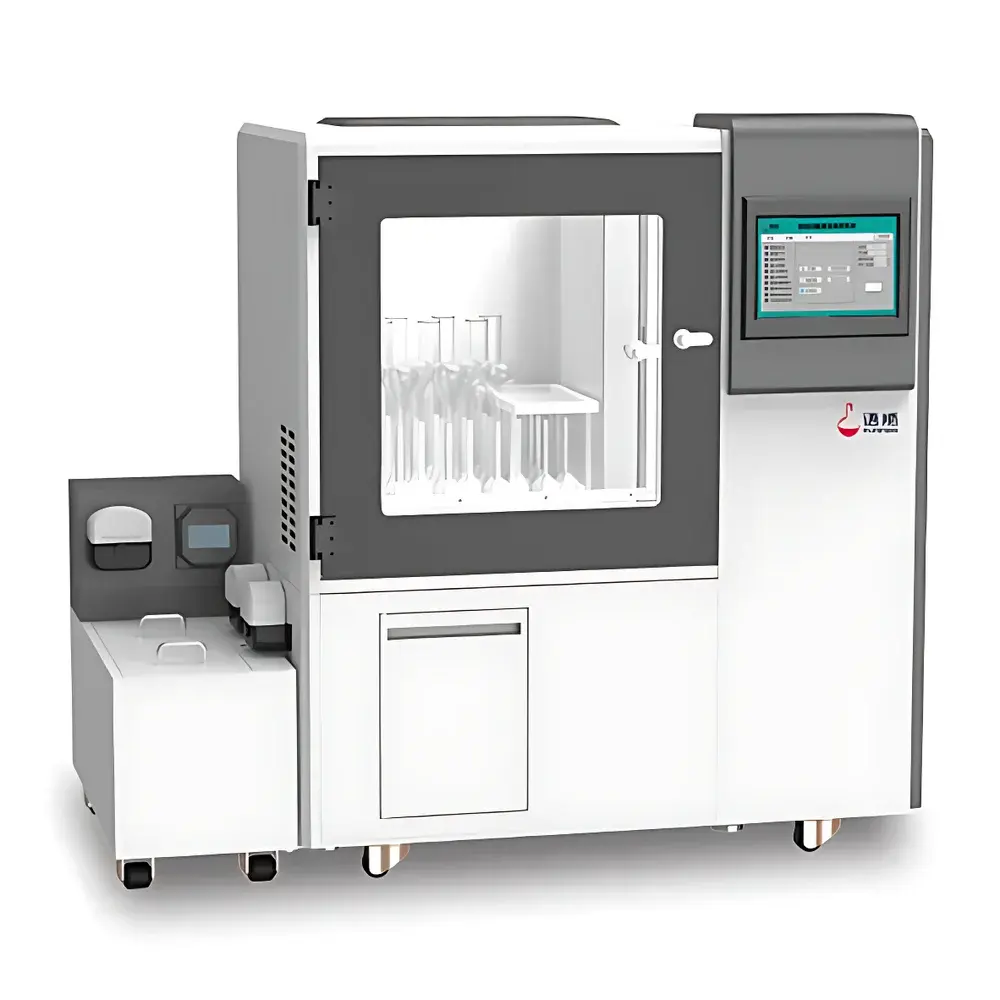
EURPING Acide3000 Fully Automated Acid Counter-Current Cleaning System
| Brand | EURPING |
|---|---|
| Origin | Tianjin, China |
| Manufacturer Type | Direct Manufacturer |
| Product Origin | Domestic (China) |
| Model | Acide3000 |
| Chamber Volume | 80 L |
| Heating Power | 500 W |
| Maximum Cleaning Temperature | 120 °C |
| Compatible Cleaning Agents | Nitric Acid (HNO₃), Ultrapure Water |
| External Dimensions (L×W×D) | 747 × 500 × 1100 mm |
Overview
The EURPING Acide3000 Fully Automated Acid Counter-Current Cleaning System is an engineered solution for ultra-low-background sample preparation in inorganic trace analysis laboratories. It operates on the principle of unidirectional, non-recirculating acid vapor condensation and saturated reflux—where high-purity nitric acid vapor is generated at sub-boiling temperatures, directed upward into a sealed cleaning chamber, and allowed to condense uniformly across the interior and exterior surfaces of labware. This thermodynamically controlled process enables efficient removal of metal ion residues (e.g., Al, Fe, Cr, Ni, Pb) from quartz, borosilicate glass, PFA, PTFE, and TFM components used in ICP-MS, ICP-OES, and cleanroom-grade analytical workflows. Unlike conventional ultrasonic or spray-jet washers, the Acide3000 eliminates cross-contamination risks by avoiding recirculation of vapors or rinse water, ensuring compliance with stringent blank-level requirements defined in ISO/IEC 17025, ASTM D5127, and USP for elemental impurity testing.
Key Features
- Unidirectional acid vapor generation and reflux system—prevents re-deposition of volatilized contaminants and ensures consistent surface decontamination.
- Integrated three-stage fully automated cycle: sub-boiling acid vapor cleaning → ultrapure water rinse (120 L/min flow rate, self-priming internal pump) → HEPA-filtered hot-air drying (adjustable 25–120 °C, airflow 168 m³/h).
- 7-inch full-touch LCD interface with microprocessor-based control; supports 20 preloaded SOP-compliant programs and user-defined protocol creation, storage, and selective execution (e.g., rinse-only or dry-only mode).
- Real-time monitoring of chamber temperature, cycle duration, drainage pH (displayed continuously), and acid bath level—with audible/visual end-of-cycle alerts.
- Triple-tier password access control (operator, supervisor, administrator) aligned with GLP/GMP documentation integrity requirements.
- Integrated EP-series exhaust gas neutralization module—captures and neutralizes NOx and acidic fumes instantaneously, enabling safe benchtop operation without mandatory fume hood installation.
- Front-opening dual-layer transparent door with mechanical interlock—ensures visual process verification while preventing accidental exposure during active acid vapor phase.
Sample Compatibility & Compliance
The Acide3000 accommodates standard and custom analytical vessels up to 80 L total chamber volume—including volumetric flasks (up to 2 L), digestion tubes, quartz cuvettes, PFA vials, ICP-MS torch injectors, nebulizers, and spray chambers. All wetted materials are chemically inert (quartz-lined acid reservoir, PTFE gaskets, PFA tubing), ensuring compatibility with concentrated HNO₃ (≤70%) and ultrapure water (≥18.2 MΩ·cm resistivity). The system meets ISO 9001:2015 (quality management) and ISO 14001:2015 (environmental management) certification standards. Waste effluent pH is continuously monitored and automatically adjusted to ≥6.5 prior to discharge, supporting regulatory adherence to local environmental codes and EPA Method 6020B wastewater reporting criteria.
Software & Data Management
The embedded firmware logs all critical operational parameters—including start/stop timestamps, acid bath temperature ramp profiles, rinse water conductivity readings, final drain pH values, and error codes—with automatic timestamped export via USB interface. Audit trails comply with FDA 21 CFR Part 11 requirements for electronic records: each action is linked to a unique user ID, includes immutable time stamps, and retains version-controlled program configurations. Optional Ethernet connectivity enables remote diagnostics and integration into centralized laboratory information management systems (LIMS) for workflow traceability.
Applications
- Preparation of ultra-clean labware for trace metal analysis (ICP-MS, HR-ICP-MS, ICP-OES) in environmental, geological, pharmaceutical, and semiconductor metrology labs.
- Decontamination of high-value consumables—such as quartz ICP torches, sapphire injector tips, and fused-silica sample introduction systems—extending service life and reducing consumable replacement frequency.
- Supporting CLIA-certified clinical trace element testing where carryover contamination must remain below 0.1 pg/mL detection limits.
- Enabling ISO/IEC 17025 accredited calibration labs to validate cleaning efficacy per ISO 15195:2018 Annex B protocols using certified reference materials (CRMs) like NIST SRM 3100 series.
FAQ
What acid concentration is recommended for optimal cleaning performance?
Concentrated nitric acid (69–70% w/w) is validated for routine use; diluted solutions may be employed for sensitive substrates under custom-programmed low-temperature cycles.
Can the Acide3000 be integrated into a cleanroom environment?
Yes—the closed-loop vapor path, HEPA-filtered drying air, and zero external venting (via integrated EP scrubber) meet ISO Class 5 (Class 100) particulate and chemical cleanliness requirements when installed with appropriate facility-grade ultrapure water supply.
How does the system prevent acid carryover into the rinse stage?
A gravity-driven, one-way drain valve and timed acid bath isolation ensure complete evacuation of residual acid vapor condensate into the waste collection tank before ultrapure water injection initiates.
Is validation support available for IQ/OQ/PQ documentation?
EURPING provides standardized qualification templates, factory-verified temperature mapping reports, and on-site technician-assisted protocol execution in Tier-1 cities across China, with optional third-party certification coordination.
What maintenance intervals are required for long-term reliability?
Quarterly inspection of HEPA filter integrity, biannual calibration of pH and temperature sensors, and annual replacement of acid bath seals—documented in the included Maintenance Logbook per ISO/IEC 17025 Clause 6.4.10.



