
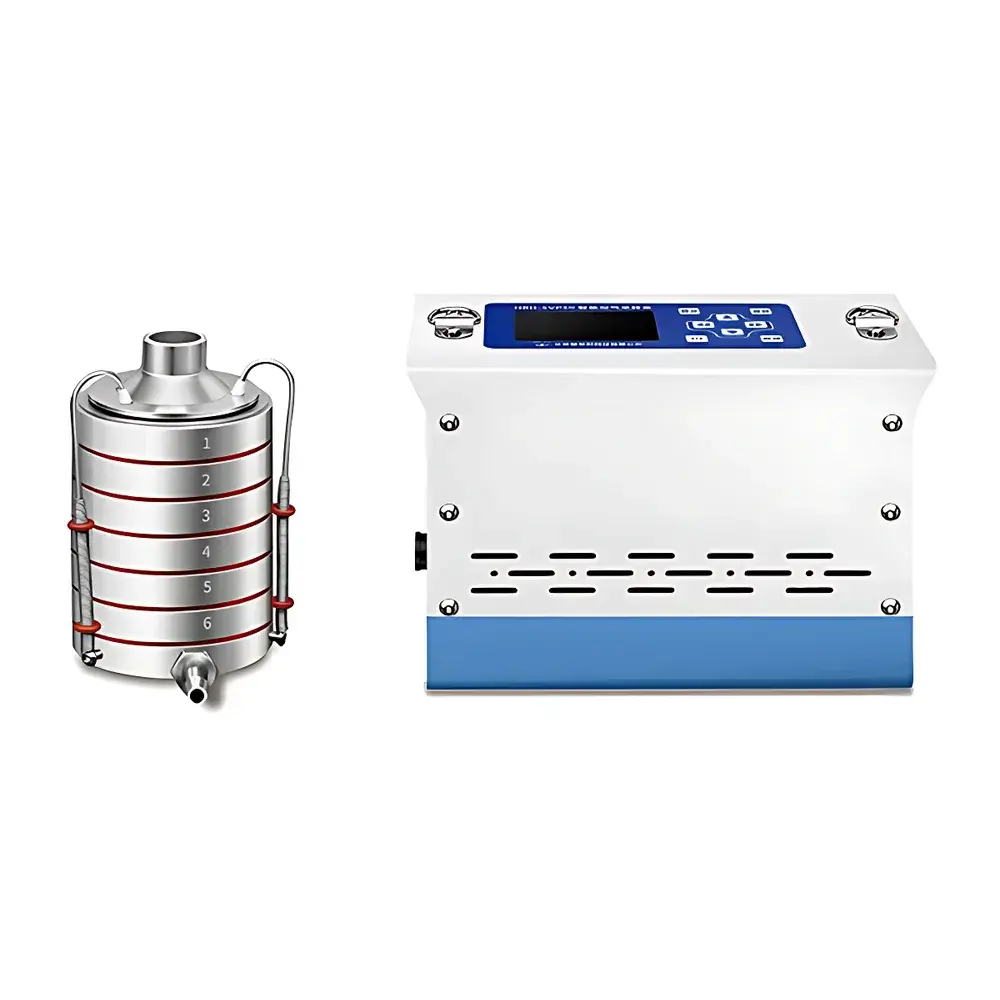
Anderson Six-Stage Air Microbial Sampler
| Brand | Hui Rong He |
|---|---|
| Model | HRH-APS6 |
| Origin | Beijing, China |
| Sampling Flow Rate | 28.3 L/min |
| Cascade Impactor Stages | 6 |
| Stage Orifice Diameters | 1.187, 0.914, 0.711, 0.533, 0.343, 0.254 mm |
| Aerodynamic Cut-Points (� | m): ≥7.0, 4.7–7.0, 3.3–4.7, 2.1–3.3, 1.1–2.1, 0.65–1.1 |
| Compliance | GB/T 39990–2021 Technical Specifications for Bioaerosol Samplers |
| Sample Collection Medium | Standard Agar Plates (e.g., TSA, SDA) |
| Pump Included | Yes |
| Configuration | Benchtop, Portable |
| Power Supply | AC 220 V / 50 Hz |
| Dimensions (L×W×H) | Approx. 280 × 280 × 420 mm |
| Weight | ~8.5 kg |
Overview
The Anderson Six-Stage Air Microbial Sampler (HRH-APS6) is a cascade impactor-based bioaerosol sampling system engineered for quantitative, size-resolved collection of viable airborne microorganisms. It operates on the principle of inertial impaction: aerosol-laden air is drawn at a calibrated flow rate of 28.3 L/min through a series of six vertically stacked stainless-steel stages, each featuring a precision-drilled orifice plate with 400 radially arranged micro-orifices. As airflow velocity increases across successive stages due to decreasing orifice cross-sectional area, particles exceeding the stage-specific aerodynamic cut-point impact onto nutrient agar surfaces placed beneath each plate. This enables physical separation of microbial aerosols by aerodynamic diameter—critical for assessing deposition behavior in respiratory tract models, evaluating environmental bioburden distribution, and supporting exposure risk assessment in occupational and clinical settings.
Key Features
- Six-stage cascade impactor conforming to ISO 14698-1 and GB/T 39990–2021 design criteria for viable bioaerosol samplers
- Precision-machined orifice plates with certified diameters (1.187, 0.914, 0.711, 0.533, 0.343, and 0.254 mm) enabling reproducible aerodynamic cut-points
- Calibrated nominal sampling flow rate of 28.3 L/min—compatible with standard flow meters and rotameters used in ISO/IEC 17025-accredited laboratories
- Integrated low-vibration, oil-free diaphragm pump with thermal overload protection and adjustable flow control
- Modular stainless-steel construction ensuring corrosion resistance, cleanability, and compliance with GLP laboratory hygiene requirements
- Standard Petri dish compatibility (90 mm diameter) for direct incubation and colony-forming unit (CFU) enumeration without transfer artifacts
- Benchtop footprint with ergonomic height and non-slip base—designed for stable operation in biosafety cabinets, cleanrooms, and field-deployable monitoring stations
Sample Compatibility & Compliance
The HRH-APS6 supports standard microbiological media including Tryptic Soy Agar (TSA), Sabouraud Dextrose Agar (SDA), and malt extract agar—enabling recovery of bacteria, yeasts, molds, and spores. Its stage-wise collection geometry aligns with the International Commission on Microbiological Specifications for Foods (ICMSF) and EU GMP Annex 1 guidance for environmental monitoring in pharmaceutical manufacturing. The device satisfies performance verification requirements under GB/T 39990–2021, which specifies calibration protocols, collection efficiency validation methods, and uncertainty thresholds for cut-point accuracy. While not intrinsically compliant with FDA 21 CFR Part 11, its output (agar plate counts) integrates seamlessly into validated electronic lab notebook (ELN) or LIMS workflows when paired with digital colony counters and audit-trail-enabled data entry systems.
Software & Data Management
The HRH-APS6 is a hardware-only instrument requiring no embedded firmware or proprietary software. All operational parameters—including total sampling duration, real-time flow verification (via external flow meter), and environmental conditions (temperature, relative humidity)—must be manually recorded per ISO 14698-2 Annex B documentation practices. For traceability, users are advised to maintain a controlled sampling logbook referencing batch numbers of agar plates, operator ID, location coordinates, and calibration certificate IDs of associated flow measurement devices. When integrated into regulated environments, data generated from CFU enumeration should be managed within a 21 CFR Part 11-compliant LIMS platform supporting electronic signatures, version-controlled SOPs, and automated report generation aligned with ISO/IEC 17025 clause 7.8.
Applications
- Environmental monitoring in ISO Class 5–8 cleanrooms and aseptic processing suites
- Healthcare-associated infection (HAI) source tracking in operating theaters, isolation rooms, and HVAC ductwork
- Aerosolized pathogen dispersion studies (e.g., Mycobacterium tuberculosis, influenza virus surrogates, fungal conidia)
- Validation of air disinfection technologies (UVGI, bipolar ionization, HEPA filtration)
- Occupational hygiene assessments in agricultural, pharmaceutical, and waste management facilities
- Research-grade bioaerosol characterization in atmospheric science and indoor air quality (IAQ) investigations
FAQ
What is the recommended calibration frequency for the HRH-APS6 impactor plates?
Orifice plate integrity and dimensional accuracy should be verified annually using optical profilometry or certified gauge pins, per GB/T 39990–2021 Section 6.3. Flow rate calibration must be performed before each sampling campaign using a NIST-traceable primary standard.
Can the sampler be used with liquid impingers instead of agar plates?
No—the HRH-APS6 is mechanically and aerodynamically optimized for solid-phase impact onto agar. Substitution with liquid collection media alters inertia dynamics, invalidates cut-point assignments, and violates GB/T 39990–2021 scope limitations.
Is the pump suitable for continuous 8-hour sampling?
Yes; the integrated diaphragm pump is rated for continuous duty at 28.3 L/min with thermal protection. Ambient temperature must remain between 10–30°C, and inlet air must be free of particulates >10 µm to prevent orifice clogging.
How are stage-specific collection efficiencies determined?
Efficiency curves are derived from polystyrene latex (PSL) sphere challenge tests per ISO 21501-4, with correction factors applied for biological particle density and morphology using the method described in Hinds (1999), Aerosol Technology.







