
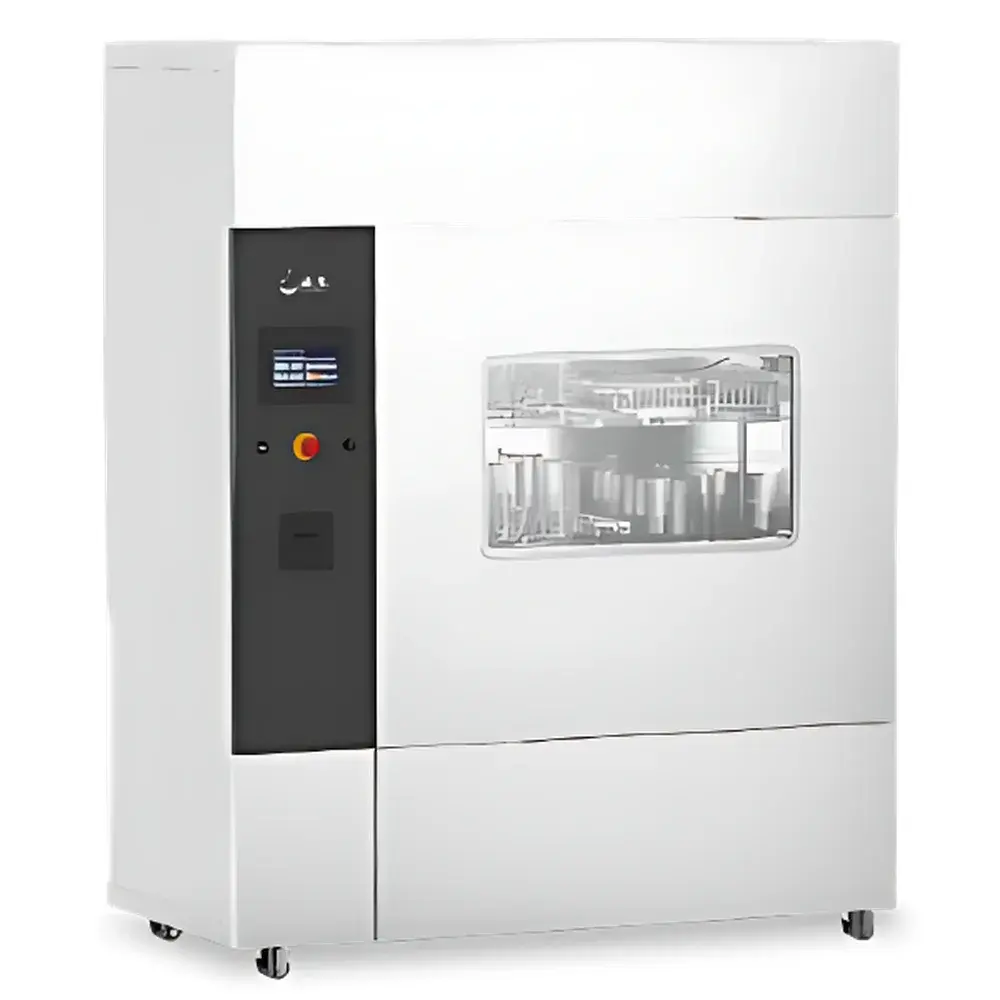
EURPING Q2900D Laboratory Bottle Washer
| Brand | EURPING |
|---|---|
| Origin | Tianjin, China |
| Manufacturer Type | Direct Manufacturer |
| Country of Origin | China |
| Model | Q2900D |
| Chamber Volume | 680 L |
| Heating Power | 2100 W (Main Heater: 9 kW) |
| Max. Cleaning Temperature | 95 °C |
| Compatible Detergents | Acidic & Alkaline Cleaning Agents |
| External Dimensions (L×W×H) | 1560 × 790 × 1980 mm |
| Power Supply | 380 V, 50 Hz |
| Max. Total Power | 10 kW |
| Internal Cavity Material | ASTM A240 Grade 316L Stainless Steel |
| Outer Casing Material | ASTM A240 Grade 304 Stainless Steel |
| Surface Roughness (Internal) | ≤ 0.6 µm |
| Touchscreen Interface | ≥7-inch Color HMI |
| User Access Levels | ≥4 Tiers with Role-Based Permissions |
| Data Storage | ≥32 GB SD Card with Immutable Audit Trail |
| Drying Airflow | ≥420 m³/h |
| HEPA Filtration | ISO Class 5 Compliant (HEPA H14) |
| Drying Temp Range | Ambient to 120 °C |
| Drying Duration | 0–300 min |
| Compliance | cGMP, FDA 21 CFR Part 11 (Audit Trail, Electronic Signatures), ISO 13485-aligned Design, GLP/GMP Data Integrity Principles |
Overview
The EURPING Q2900D Laboratory Bottle Washer is an engineered solution for fully automated cleaning, thermal disinfection, and controlled drying of glassware and plastic labware in regulated environments. Designed for compliance-critical laboratories—including pharmaceutical QC/QA, biotechnology R&D, clinical diagnostics, and contract testing facilities—the Q2900D operates on a validated cycle-based methodology grounded in fluid dynamics, thermally stable detergent delivery, and precision-controlled air filtration. Its core architecture integrates a high-capacity 680 L wash chamber fabricated entirely from electropolished ASTM A240 316L stainless steel (Ra ≤ 0.6 µm), ensuring corrosion resistance against aggressive acidic and alkaline detergents while meeting surface finish requirements per ISO 15883-1 and USP . The system employs a closed-loop recirculation strategy with real-time pressure and rotational speed monitoring, enabling reproducible mechanical action across heterogeneous load configurations—from narrow-neck volumetric flasks and serological pipettes to wide-mouth reagent bottles and conical flasks.
Key Features
- Triple-layer filtration system with dedicated debris collection sump—prevents particulate ingress into circulation pumps and spray arms
- PLC-based control architecture with ≥7-inch color HMI; supports time-synchronized operation via SCADA network integration
- Four-tier user permission model with encrypted password management, session timeout, and immutable audit trail per FDA 21 CFR Part 11 §11.10(d)
- Automated detergent dosing via three-channel peristaltic pump—enabling sequential or simultaneous introduction of pre-rinse, main wash, and neutralizing agents
- Back-fed rack supply system with top-down injection nozzles ensuring complete internal wetting of tall or narrow vessels
- HEPA-filtered (H14 grade) forced-air drying system with differential pressure monitoring, real-time airflow calibration, and adjustable temperature/time profiles (ambient–120 °C, 0–300 min)
- Electronic safety interlock with EULA-driven motorized door actuation, overtemperature cutoffs (heater, blower, pump, condenser), and leak-detection circuitry
- Integrated sampling diaphragm valve for manual post-cycle water quality verification (conductivity, TOC, endotoxin)
- SD card-based data logging (≥32 GB) with tamper-evident file structure, PDF report export, and automatic backup upon cycle completion
Sample Compatibility & Compliance
The Q2900D accommodates standard laboratory glassware up to 1000 mL capacity—including Class A volumetric flasks (10–1000 mL), graduated cylinders (10–1000 mL), Erlenmeyer flasks (50–2000 mL), test tubes (12–25 mm OD), pipettes (up to 100 mL), and custom-configured racks for irregular geometries. All internal surfaces comply with ASME BPE-2022 surface finish standards for pharmaceutical process equipment. The system meets the functional requirements of ISO 13485:2016 Clause 7.5.2 (Validation of Processes), ASTM E2500-13 (Science-Based Approach to Validation), and EU GMP Annex 15. It supports full validation documentation packages (IQ/OQ/PQ), including thermocouple mapping reports, detergent residue testing protocols, and microbial challenge studies using Bacillus atrophaeus spores.
Software & Data Management
The embedded software platform implements ALCOA+ data integrity principles (Attributable, Legible, Contemporaneous, Original, Accurate, Complete, Consistent, Enduring, Available). Cycle logs record timestamped events—including door status, temperature ramps, pressure transients, detergent dispense volumes, and alarm triggers—with cryptographic hashing to prevent silent modification. Electronic signatures are enforced for critical actions (e.g., program override, manual abort, audit trail review). Integration with LIMS, MES, and SCADA systems occurs via OPC UA or Modbus TCP, supporting structured data exchange in CSV or XML format. All PDF reports include digital watermarking, unique cycle ID, operator ID, and checksum verification metadata.
Applications
- Pharmaceutical manufacturing: Cleaning validation of primary packaging components prior to fill-finish operations
- Clinical labs: Reprocessing of reusable specimen containers under CLIA and CAP-accredited workflows
- Contract research organizations: High-throughput preparation of analytical glassware for HPLC, GC, and ICP-MS sample introduction
- Academic core facilities: Centralized washing infrastructure supporting multi-user access with granular usage tracking
- Vaccine development labs: Sterile-grade rinsing of serum bottles and bioreactor accessories using WFI-compatible cycles
FAQ
Does the Q2900D support regulatory-compliant validation documentation?
Yes—EURPING provides IQ/OQ/PQ templates aligned with ASTM E2500-13 and EU GMP Annex 15, including thermographic mapping reports, detergent residue verification SOPs, and microbial reduction validation protocols.
Can the system interface with our existing LIMS platform?
Yes—via configurable OPC UA or Modbus TCP drivers; custom API wrappers are available upon request for proprietary LIMS architectures.
What is the maximum allowable load weight per cycle?
The standard triple-tier rack configuration supports up to 45 kg total mass, distributed evenly across all levels; overload detection triggers immediate cycle suspension.
Is HEPA filter replacement tracked within the software?
Yes—filter service intervals are logged automatically; differential pressure alarms notify operators when ΔP exceeds preset thresholds (typically 250 Pa for H14 filters).
How is data integrity ensured during power interruption?
All active cycle parameters and sensor readings are written to non-volatile memory every 2 seconds; upon recovery, the system resumes from last valid checkpoint without data loss.



