
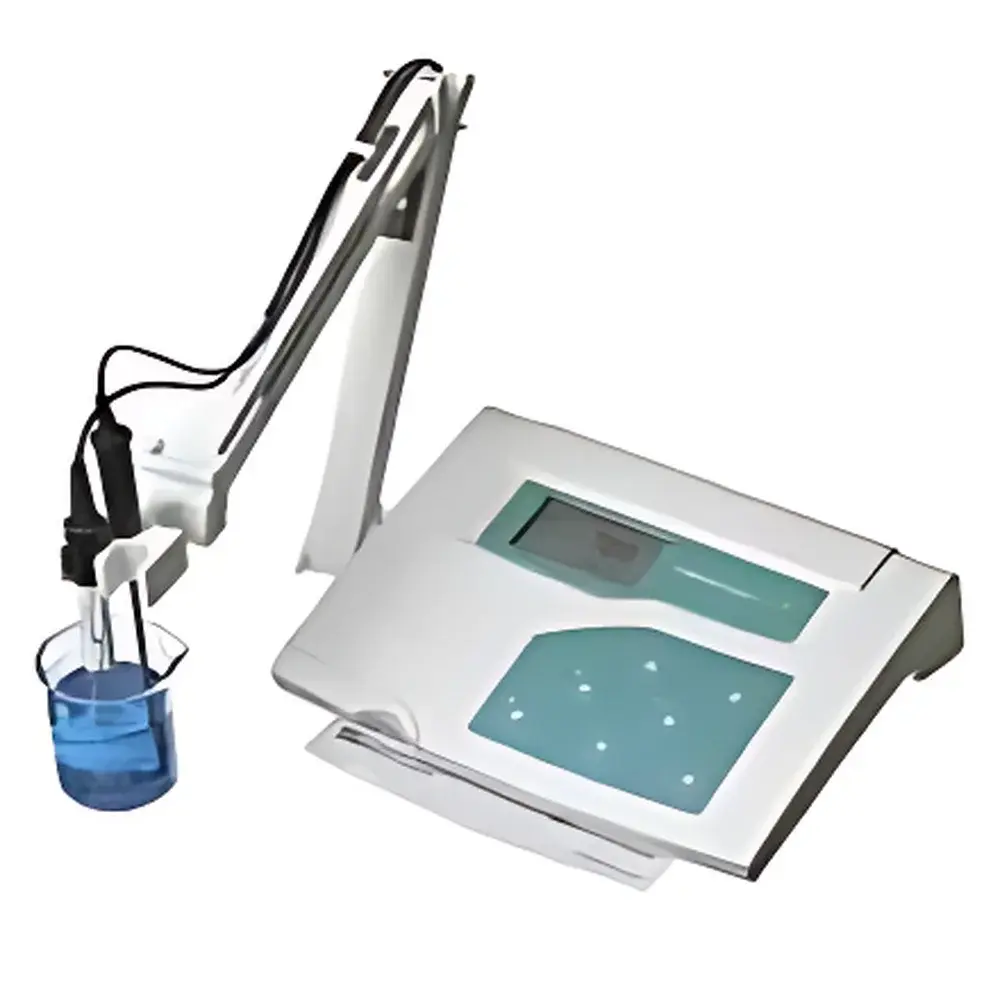
Eutech CyberScan pH510 Benchtop pH/ORP Meter
| Brand | Thermo Fisher Scientific |
|---|---|
| Origin | Singapore |
| Manufacturer | Eutech Instruments (a Thermo Fisher brand) |
| Model | pH510 |
| Type | Benchtop Electrochemical Meter |
| Compliance | CE, RoHS, IP54 |
| Calibration | Up to 5-point, auto-buffer recognition (USA/NIST) |
| pH Range | 0.00–14.00 pH |
| pH Resolution | 0.01 pH |
| pH Accuracy | ±0.01 pH |
| Temperature Range | 0.0–100.0 °C |
| Temp. Resolution | 0.1 °C |
| Temp. Accuracy | ±0.3 °C |
| ORP/mV Range | ±1999 mV |
| mV Resolution | 0.1 mV (≤±199.9 mV), 1 mV (>±199.9 mV) |
| mV Accuracy | ±0.2 mV (≤±199.9 mV), ±2 mV (>±199.9 mV) |
| Temperature Compensation | Auto/manual (0–100 °C) |
| Data Storage | 100 readings with timestamp & temperature |
| Display | LCD (5.9 × 3.2 cm) |
| Input | BNC pH input, phono ATC input, DC socket |
| Output | Analog recorder output (0–1 V or 0–20 mA configurable) |
| Power | 9 V DC regulated adapter (100–220 VAC, linear supply) |
| Dimensions (H×W×D) | 23 × 18 × 6 cm |
| Weight | 750 g (unit), 1100 g (packaged) |
| Operating Environment | 0–50 °C, ≤85% RH non-condensing |
Overview
The Eutech CyberScan pH510 is a precision benchtop electrochemical meter engineered for routine pH and oxidation-reduction potential (ORP) measurements in academic laboratories, quality control environments, and industrial process support settings. Based on potentiometric measurement principles, the instrument determines hydrogen ion activity via a glass electrode coupled with a reference system—typically Ag/AgCl—and computes ORP using a noble metal (e.g., platinum or gold) indicator electrode referenced against the same internal junction. Its design adheres to fundamental electrochemical standards outlined in ASTM D1293 (pH of water), ISO 7888 (water quality — determination of pH), and USP (pH measurement in pharmaceutical preparations). The pH510 operates within a rigorously controlled analog signal path and employs high-impedance input circuitry (>1012 Ω) to minimize loading errors during high-resistance electrode use—critical for accurate low-ionic-strength sample analysis.
Key Features
- High-accuracy pH measurement with ±0.01 pH tolerance and 0.01 pH resolution across the full 0.00–14.00 range
- Extended ORP/mV capability: ±1999 mV range with dual-resolution readout (0.1 mV up to ±199.9 mV; 1 mV beyond)
- Intelligent calibration logic supporting up to five-point pH calibration with automatic buffer recognition for both USA (4.01, 7.00, 10.01) and NIST (4.01, 6.86, 9.18) standard series
- Integrated automatic temperature compensation (ATC) via optional ECPH5TEMB01P probe or manual entry (0.0–100.0 °C), ensuring thermodynamic correction per the Nernst equation
- On-screen display of electrode slope (%), offset (mV), and diagnostic status—including junction potential alerts and electrode response time indicators
- 100-point data storage with embedded temperature stamping and sequential ID tagging for traceable recordkeeping
- Dual-mode operation: simultaneous pH/mV selection with real-time “Ready” stabilization indicator and auto-hold functionality upon signal convergence
- IP54-rated enclosure for dust resistance and protection against water splashes during benchtop use
- Ergonomic integrated electrode stand with lateral adjustability for optimal probe immersion geometry and reproducible positioning
Sample Compatibility & Compliance
The pH510 accommodates aqueous and low-conductivity samples including purified water, buffer solutions, biological media, wastewater effluents, and mild chemical formulations. It is not intended for non-aqueous solvents, highly viscous suspensions, or aggressive hydrofluoric acid environments. Electrode compatibility follows standard BNC connectivity and supports double-junction configurations for chloride-rich or sulfide-laden matrices. Regulatory alignment includes conformity with IEC 61010-1 (safety requirements for electrical equipment), EN 61326-1 (EMC for laboratory instrumentation), and FDA 21 CFR Part 11-ready data handling when paired with compliant software export workflows. While the meter itself does not embed audit trail functionality, its timestamped storage and calibration logs support GLP/GMP documentation practices under supervised procedural control.
Software & Data Management
Data retrieval is facilitated via analog recorder output (0–1 V or 0–20 mA, field-selectable), enabling direct integration with strip-chart recorders, PLC analog inputs, or legacy SCADA systems. No proprietary software or USB interface is included; however, exported values may be logged externally using third-party DAQ platforms compatible with millivolt-level analog signals. Each stored reading retains pH/mV value, temperature, date/time stamp, and calibration status flag—enabling retrospective verification of measurement integrity. For laboratories requiring digital traceability, the pH510 serves as a robust front-end sensor node when deployed alongside validated LIMS or ELN systems that accept manually entered or analog-converted datasets.
Applications
- Academic teaching labs: foundational instruction in acid-base equilibria, buffer preparation, and electrode theory
- Environmental monitoring: pH and redox profiling of surface water, groundwater, and treated effluent per EPA Method 150.1
- Pharmaceutical QC: raw material and purified water testing aligned with USP and EP 2.2.3
- Food & beverage production: batch consistency checks for dairy, brewing, and juice processing lines
- Electroplating and metal finishing: bath monitoring for acid concentration and oxidizing agent activity
- Boiler water treatment: alkalinity control and corrosion potential assessment in closed-loop systems
FAQ
Does the pH510 support automatic electrode diagnostics?
Yes—the instrument continuously monitors slope (%), offset (mV), and response stability, displaying diagnostic prompts such as “Low Slope” or “Slow Response” to guide maintenance decisions.
Can it be used with non-Eutech electrodes?
Yes, provided the electrode uses standard BNC connectors and delivers a compliant millivolt signal within the input impedance specifications (≥1012 Ω recommended).
Is temperature compensation mandatory during pH measurement?
No—manual temperature entry is supported, but automatic compensation via an ATC probe (e.g., ECPH5TEMB01P) is strongly recommended for accuracy in variable-temperature workflows.
What is the expected service life of the included ECFC7252101B electrode?
Under typical lab use (≤5 measurements/day, proper storage in 3 M KCl), the electrode maintains specification performance for 12–18 months; recalibration frequency should be verified per internal SOPs.
Does the pH510 meet ISO/IEC 17025 traceability requirements?
The instrument itself is not individually certified, but its metrological performance—when operated with NIST-traceable buffers and calibrated electrodes—supports compliance when documented within an accredited laboratory’s uncertainty budget framework.
Related Products





