
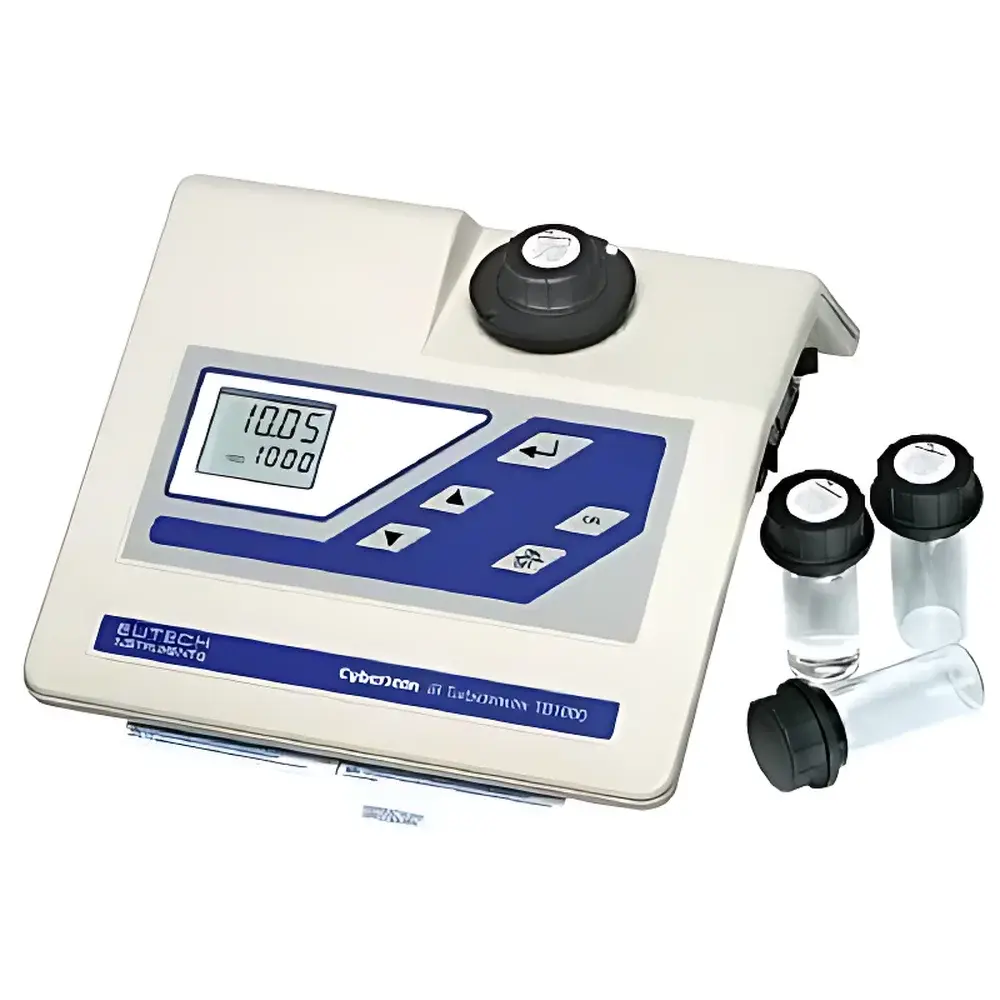
Eutech CyberScan TB 1000 Portable Turbidimeter
| Origin | Singapore |
|---|---|
| Manufacturer Type | Authorized Distributor |
| Origin Category | Imported |
| Model | TB 1000 |
| Product Type | Portable |
| Measurement Range | 0.00–9.99 NTU |
| Resolution | 0.01 NTU (0–9.99 NTU) |
| Operating Temperature | 0–40 °C |
| Accuracy | ±2% of reading |
| Repeatability | ≤±1% of reading |
| Response Time | <6 s |
| Sample Volume | 30 mL |
| Light Source | Tungsten lamp (white light), compliant with US EPA Method 180.1 |
| Calibration | 1–3-point automatic calibration (standard points: 0.02, 10.0, 1000 NTU) |
| Calibration Accuracy | ±0.02 NTU at 0.02 NTU point |
| Data Output | RS232C interface |
| GLP Compliance | Date/time stamping, calibration expiry alerts, audit-ready data logging |
| Enclosure | ABS plastic housing |
| Power Supply | UL/CSA-certified 12 VDC regulated adapter |
| Dimensions (instrument) | 25.4 × 23.7 × 12.1 cm |
| Weight (instrument) | 1550 g |
| Packaging Dimensions | 35.5 × 31.5 × 25 cm |
| Gross Weight | 2380 g |
Overview
The Eutech CyberScan TB 1000 is a portable, microprocessor-controlled turbidimeter engineered for high-precision measurement of turbidity across three auto-ranging scales (0.00–9.99 NTU, 10.0–99.9 NTU, and 100–1000 NTU). It operates on the principle of nephelometric detection—measuring scattered light intensity at a 90° angle relative to the incident beam—fully compliant with ISO 7027:2016 for instrumental turbidity determination. The standard tungsten lamp provides broad-spectrum white light output aligned with US EPA Method 180.1, ensuring regulatory acceptability in environmental monitoring applications including drinking water, wastewater effluent, and surface water quality assessment. An optional infrared (IR) light source variant is available for laboratories requiring strict adherence to ISO 7027 and DIN 27027 standards, where spectral insensitivity to color interference enhances measurement robustness in highly colored or chemically complex samples.
Key Features
- Auto-ranging measurement with seamless scale switching and real-time resolution adaptation (0.01 NTU in low range, 0.1 NTU in mid-range, 1 NTU in high range)
- Three-point calibration capability using certified formazin or traceable polymer standards (0.02 NTU, 10.0 NTU, and 1000 NTU reference points)
- Calibration validity tracking with configurable expiry alerts—supports GLP-compliant instrument management protocols
- Integrated time/date stamping on every measurement record, enabling full traceability per 21 CFR Part 11 data integrity requirements
- Rapid optical response (<6 seconds per reading) and minimal sample volume requirement (30 mL) optimize throughput in field and lab environments
- Modular light source design allows quick, tool-free replacement of the tungsten lamp—reducing downtime and maintenance complexity
- Rugged ABS housing rated for continuous operation between 0 °C and 40 °C ambient temperature; sample temperature tolerance up to 50 °C
Sample Compatibility & Compliance
The TB 1000 accommodates standard 25 mm round glass or disposable plastic cuvettes (30 mL fill volume), supporting both routine QA/QC checks and regulatory submission-grade analysis. Its optical architecture minimizes stray light errors through precision-aperture collimation and thermally stabilized detector alignment. The instrument meets ISO/IEC 17025-relevant performance criteria for turbidity analyzers, including repeatability ≤±1% of reading and accuracy within ±2% of true value across the full 0–1000 NTU span. For regulated environments—including municipal water utilities, pharmaceutical manufacturing facilities, and contract environmental labs—the device supports documented calibration procedures, user-access-level controls, and secure data export via RS232C serial interface compatible with LIMS integration.
Software & Data Management
Data generated by the TB 1000 are automatically annotated with timestamp, operator ID (user-definable), calibration status, and measurement range—ensuring full audit trail integrity. The RS232C port enables direct connection to PCs or data loggers using standard terminal emulation or custom SCADA-compatible scripts. Exported records conform to ASCII-delimited formats (.csv or .txt), facilitating import into statistical process control (SPC) platforms, electronic lab notebooks (ELN), or enterprise quality management systems (QMS). Firmware supports firmware-upgradable calibration coefficients and configurable data retention policies—critical for maintaining long-term metrological consistency under ISO 9001 and ISO 14001 quality frameworks.
Applications
- Drinking water treatment: verification of filtration efficiency and post-disinfection clarity
- Wastewater discharge monitoring: compliance reporting against NPDES permit limits
- Pharmaceutical water systems: PW, WFI, and purified water turbidity screening per USP
- Food & beverage production: clarification validation in juice, beer, and dairy processing lines
- Educational laboratories: hands-on instruction in optical scattering theory and environmental analytical methods
- Field-based environmental surveys: rapid turbidity profiling of rivers, lakes, and estuaries
FAQ
Does the TB 1000 support both EPA 180.1 and ISO 7027 measurement modes?
Yes—the standard configuration uses a tungsten lamp meeting US EPA Method 180.1 specifications; an optional IR LED module is available for ISO 7027/DIN 27027 mode.
What is the minimum detectable turbidity level and associated uncertainty?
At the 0.02 NTU calibration point, the instrument achieves ±0.02 NTU absolute accuracy; the lower limit of quantitation (LLOQ) is 0.01 NTU in the 0–9.99 NTU range.
Can calibration data be exported and archived externally?
Yes—calibration history, including date, standard values used, deviation reports, and operator entries, is stored internally and exportable via RS232C.
Is the TB 1000 suitable for GMP-regulated environments?
It supports core GMP data integrity requirements—including time-stamped records, calibration traceability, and user-access controls—though system-level validation must be performed per site-specific SOPs.
How often should the instrument be recalibrated?
Calibration frequency follows risk-based assessment per ISO/IEC 17025; typical practice is daily verification with a mid-range standard and full 3-point calibration weekly or per batch, whichever is more frequent.




