
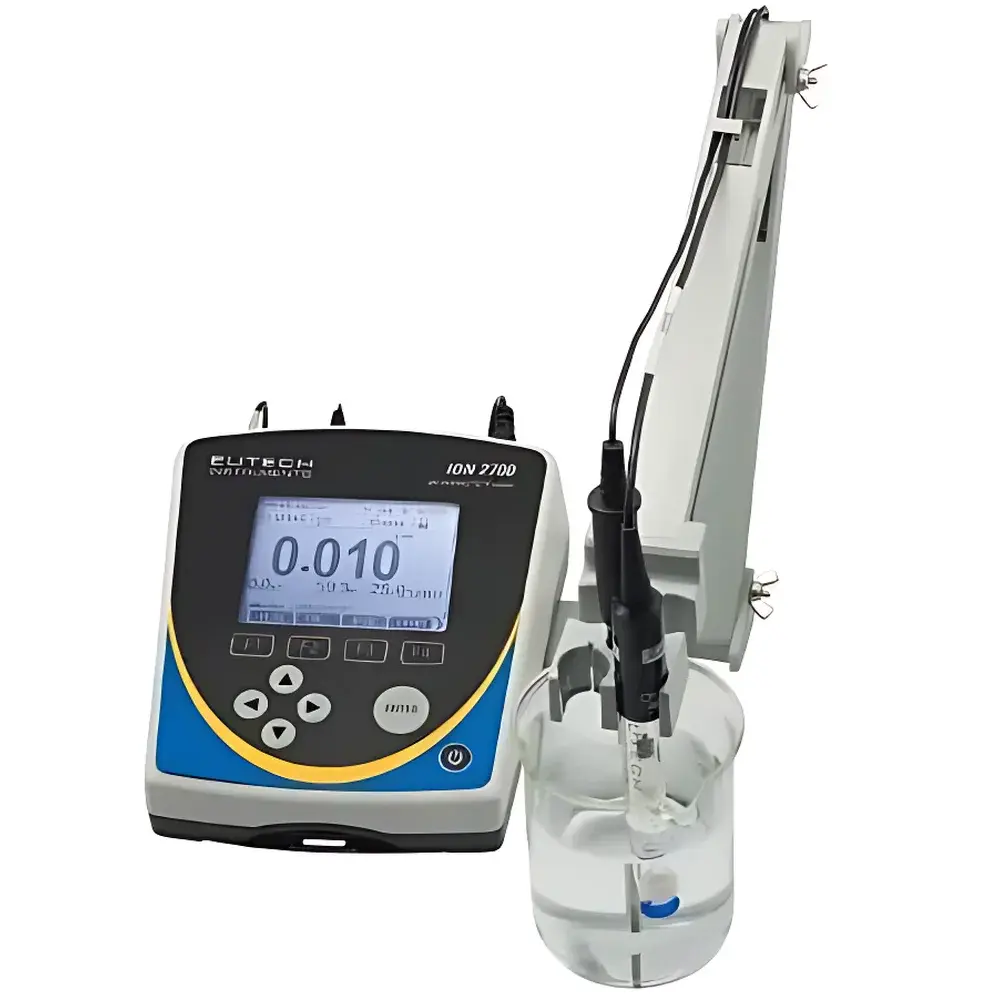
Eutech Ion2700 pH/ION/ORP/Temperature Meter
| Origin | Singapore |
|---|---|
| Manufacturer Type | Authorized Distributor |
| Origin Category | Imported |
| Model | Eutech Ion2700 |
| Instrument Type | Multi-Ion Analyzer |
| pH Range | –2.000 to 20.000 |
| pH Resolution | 0.1 / 0.01 / 0.001 |
| pH Accuracy | ±0.002 pH + 1 LSD |
| pH Calibration Points | Up to 6 |
| Buffer Standards | USA, NIST, DIN, User 1, User 2, Custom |
| Ion Concentration Range | 0.001–19999 ppm (±2000.0 mV) |
| Ion Resolution | 2- or 3-digit |
| Ion Accuracy | ±0.5% of full scale (monovalent), ±1.0% of full scale (divalent) |
| Ion Calibration Points | 2–8 |
| Temperature Range | 0.0–100.0 °C |
| Temperature Resolution | 0.1 °C |
| Temperature Accuracy | ±0.3 °C |
| ORP/mV Range | ±2000.0 mV |
| mV Resolution | 0.1 mV |
| mV Accuracy | ±0.2 mV |
| Temperature Compensation | Automatic or Manual (0–100 °C, pH only) |
| GLP Compliance | Yes |
| Slope/Offset Display | Yes |
| Data Storage | 500 records with timestamp |
| Display | Backlit LCD (5.9 × 7.8 cm) |
| Input Interfaces | BNC (pH/ORP/ion), Phono (ATC probe), Phono (reference electrode), DC socket |
| Output Interface | RS232C |
| Power Supply | 9 V DC regulated adapter (100–240 VAC SMPS, 1.3 A) |
| Operating Temperature | 5–45 °C |
| Dimensions (H×W×D) | 17.5 × 15.5 × 6.9 cm |
| Weight (unit) | 650 g |
| Packaging Dimensions | 30.8 × 23.5 × 12.4 cm |
| Shipping Weight | 1800 g |
Overview
The Eutech Ion2700 is a laboratory- and field-grade benchtop meter engineered for precise, multi-parameter electrochemical analysis of aqueous samples. It integrates pH, ion-selective electrode (ISE) response, oxidation-reduction potential (ORP), and temperature measurement within a single robust platform—designed for routine water quality monitoring, environmental compliance testing, wastewater treatment process control, and academic research applications. The instrument operates on potentiometric principles: pH and ORP are measured via high-impedance voltage detection across glass or redox electrodes; ion concentration is determined using the Nernst equation, where the measured potential (mV) is converted to concentration (ppm or mol/L) based on user-defined valence and calibration data. Its dual-mode temperature compensation—automatic (via integrated ATC probe) or manual input—ensures thermally corrected readings across the full 0.0–100.0 °C operating range. Built to meet GLP (Good Laboratory Practice) documentation requirements, the Ion2700 supports traceable, auditable measurements through timestamped data logging, calibration history retention, and electrode diagnostic reporting.
Key Features
- Simultaneous display of up to six real-time parameters: pH, ORP, ion concentration, temperature, electrode status (slope/offset), calibration point, and system time/date.
- Advanced electrode diagnostics: automatic calculation and on-screen display of pH electrode slope (%), asymmetry potential (mV offset), and ISE response linearity—enabling proactive maintenance and verification of sensor integrity prior to critical measurements.
- Flexible calibration architecture: up to six-point pH calibration with auto-buffer recognition (USA, NIST, DIN, and two customizable standards); 2–8 point ISE calibration supporting monovalent and divalent ions with configurable charge valence input.
- GLP-compliant data management: 500 internal storage slots with automatic timestamping (YYYY-MM-DD HH:MM), password-protected menu access, and calibration expiration alerts to enforce procedural rigor.
- Backlit graphical LCD (5.9 × 7.8 cm) with large, high-contrast characters optimized for low-light lab environments and extended visual clarity during prolonged operation.
- Dual communication interface: isolated RS232C port for bidirectional data transfer to PCs or LIMS systems—supporting ASCII export compatible with spreadsheet and laboratory informatics software.
Sample Compatibility & Compliance
The Ion2700 is validated for use with standard combination pH electrodes, single-junction or double-junction reference electrodes, and a broad portfolio of commercially available solid-state and liquid-membrane ISEs—including fluoride, nitrate, ammonium, calcium, potassium, sodium, chloride, and cyanide sensors. It accommodates both aqueous and low-ionic-strength matrices typical of drinking water, surface water, groundwater, and treated effluent. The instrument conforms to international performance standards referenced in ASTM D1293 (pH of water), ASTM D3868 (ion-selective electrode methods), and ISO 7888 (electrical conductivity and pH of water). Its firmware and data handling architecture support audit-ready workflows aligned with FDA 21 CFR Part 11 requirements when paired with compliant PC-based data acquisition software and electronic signature protocols.
Software & Data Management
Data capture and export are managed exclusively via the built-in RS232C serial interface—no proprietary drivers or cloud dependencies required. Raw measurement logs (including date/time stamp, parameter values, electrode ID if encoded, calibration coefficients, and operator ID when entered) are transmitted as plain-text ASCII packets, facilitating direct import into Excel, LabArchives, or custom SQL-based LIMS platforms. The instrument does not include embedded software updates or remote connectivity; all configuration changes—including password setup, unit selection (ppm/mg/L/mol/L), temperature compensation mode, and alarm thresholds—are performed locally via intuitive soft-key navigation. GLP reports generated upon request include calibration verification summaries, electrode diagnostic metrics, and measurement uncertainty estimates derived from manufacturer-specified accuracy specifications.
Applications
- Regulatory water testing labs performing EPA Method 300.0 (anions), 300.1 (fluoride), and 9056 (ammonia) using ISEs.
- Municipal and industrial wastewater treatment plants monitoring influent/effluent ion profiles for process optimization and discharge compliance.
- Environmental field studies requiring portable yet metrologically traceable ion quantification under variable ambient conditions.
- Academic teaching laboratories conducting fundamental electrochemistry experiments involving Nernstian behavior, selectivity coefficient determination, and buffer calibration validation.
- Pharmaceutical QC labs verifying rinse water purity (e.g., chloride, nitrate) per USP and EP 2.2.38 guidelines.
FAQ
Does the Ion2700 support automatic temperature compensation for ion measurements?
No—temperature compensation is applied automatically only for pH measurements. For ISE readings, users must either maintain constant sample temperature or manually enter the measured temperature value to enable Nernst equation correction.
Can the instrument store calibration data for multiple ion electrodes separately?
Yes—each ISE calibration set (up to eight points) is retained independently per electrode type, with user-assigned identifiers for traceability across different analytes and sensor lots.
Is the RS232 output compatible with modern Windows/macOS systems without legacy serial ports?
Yes—when used with a certified USB-to-RS232 adapter (FTDI chipset recommended), the Ion2700 communicates reliably with current-generation operating systems using standard terminal emulation software (e.g., Tera Term, CoolTerm) or custom Python/Node.js scripts.
What is the minimum detectable ion concentration for monovalent species?
The theoretical lower limit is 0.001 ppm, but practical detection depends on electrode selectivity, sample matrix interference, and calibration stability—not instrument resolution alone.
Does the device meet IP rating requirements for humid or splash-prone environments?
The Ion2700 is rated for indoor laboratory use (IEC 61010-1 CAT II); it lacks an ingress protection (IP) rating and is not designed for continuous exposure to moisture, dust, or corrosive vapors.







