
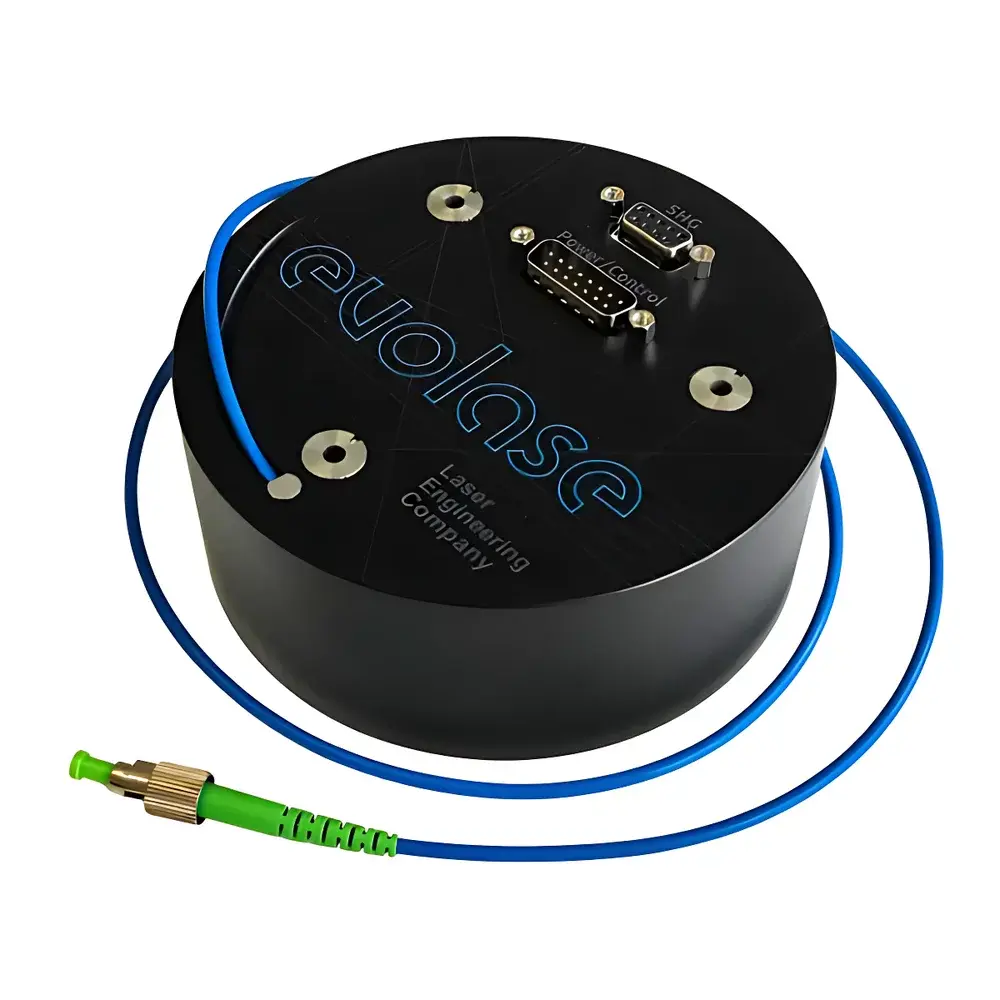
Evolase Auniontech Nanosecond Fiber Laser
| Brand | Evolase (Distributed by Auniontech) |
|---|---|
| Wavelength | 1064 nm / 532 nm |
| Avg. Output Power | 3 W @ 1064 nm, 0.6 W @ 532 nm |
| Repetition Rate | 10 kHz – 1 MHz |
| Pulse Energy | >25 µJ @ 1064 nm, >8 µJ @ 532 nm |
| Pulse Width | 0.7–4 ns |
| Beam Delivery | 10/125 µm fiber with FC/APC connector or free-space collimated output |
| Input Voltage | 24 VDC |
| Control Interface | RS232 via D-Sub 9-pin connector |
| Dimensions | 130 × 80 × 80 mm |
| Weight | <1.2 kg |
| Operating Temperature | 15–35 °C |
| Cooling | Conductive + passive fin散热 (no forced air or water required) |
Overview
The Evolase Auniontech Nanosecond Fiber Laser is a compact, air-cooled, diode-pumped solid-state (DPSS) laser system engineered for high-repetition-rate pulsed operation with precise temporal and spatial control. Based on master oscillator power amplifier (MOPA) architecture integrated into a monolithic fiber platform, it delivers stable nanosecond pulses at fundamental (1064 nm) and frequency-doubled (532 nm) wavelengths. Its design emphasizes minimal footprint, low power consumption (<7 W typical system draw), and robustness against mechanical vibration and thermal drift—making it suitable for integration into OEM instruments, portable sensing platforms, and laboratory-grade research setups. Unlike conventional Q-switched bulk lasers, this system leverages all-fiber amplification and nonlinear harmonic generation within polarization-maintaining (PM) fiber components, ensuring excellent beam quality (M² < 1.3), high pulse-to-pulse stability (<1.5% RMS over 8 hours), and intrinsic alignment-free operation.
Key Features
- Ultra-compact form factor (130 × 80 × 80 mm) optimized for embedded integration in space-constrained systems
- Adjustable repetition rate from 10 kHz to 1 MHz via RS232 command protocol—enabling flexible duty-cycle tuning without hardware modification
- Sub-4 ns pulse width with near-transform-limited temporal profile, supporting time-resolved fluorescence lifetime measurements and time-of-flight (ToF) applications
- Dual-wavelength capability: simultaneous or selectable 1064 nm and 532 nm outputs via internal SHG module with >65% conversion efficiency
- High pulse energy (>25 µJ at 1064 nm, >8 µJ at 532 nm) combined with high average power, enabling ablation, LIBS, and nonlinear excitation without external amplification
- Integrated thermal management using passive conduction cooling—eliminates need for fans, chillers, or external heat sinks
- FC/APC fiber-coupled output as standard; optional free-space collimated beam with adjustable divergence (<1.5 mrad)
Sample Compatibility & Compliance
The laser is compatible with standard optical tables, motion stages, and vacuum-compatible enclosures (with appropriate feedthroughs). Its emission characteristics comply with IEC 60825-1:2014 Class 4 laser safety requirements when operated above nominal threshold powers; integrated interlock circuitry supports external emergency stop and door-sensor integration per EN 61511. The system meets CE marking directives for electromagnetic compatibility (EN 55032, EN 55035) and low-voltage operation (2014/35/EU). For regulated environments—including GLP-compliant analytical labs and medical device R&D—the laser’s RS232 interface supports audit-trail-capable control logging when paired with validated host software. It is routinely deployed in setups conforming to ASTM E2912 (laser-induced breakdown spectroscopy) and ISO 21348 (spacecraft radiation environment testing using pulsed lasers).
Software & Data Management
The laser operates via ASCII-based RS232 commands (baud rate 115200, 8N1), allowing seamless integration into LabVIEW, Python (PySerial), MATLAB, or custom C++ instrument control frameworks. Aboard the controller FPGA are real-time monitoring registers for output power, internal temperature, pulse count, and fault status—accessible via polling or interrupt-driven queries. While no proprietary GUI is bundled, Auniontech provides open-source Python example scripts and detailed command reference documentation. For traceable calibration workflows, users may log timestamped parameter sets alongside external sensor data (e.g., photodiode readings, spectrometer triggers) using industry-standard HDF5 or TDMS file formats. All firmware updates are delivered as signed binary packages with SHA-256 checksum verification to ensure integrity during field deployment.
Applications
- Lidar systems for atmospheric aerosol profiling and wind speed measurement—leveraging high pulse energy and narrow linewidth for improved SNR in coherent detection
- Time-resolved photoluminescence spectroscopy in semiconductor physics and perovskite material characterization
- Laser-induced breakdown spectroscopy (LIBS) for elemental analysis of metals, soils, and biological tissues
- Micromachining of transparent dielectrics (e.g., fused silica, sapphire) where sub-nanosecond pulse control reduces thermal damage zones
- Optogenetics stimulation protocols requiring precise temporal gating of visible-light pulses at kilohertz repetition rates
- Calibration sources for streak cameras, SPAD arrays, and TCSPC modules due to consistent jitter (<15 ps RMS)
FAQ
Is this laser FDA-cleared for medical use?
No—this system is designated for research, industrial, and OEM integration only. Clinical or diagnostic use requires additional regulatory validation under 21 CFR Part 820 and IEC 62304.
Can pulse width be tuned in real time?
Pulse width is factory-set per configuration (0.7 ns, 1.5 ns, or 4 ns options); dynamic adjustment is not supported. However, repetition rate and output power are fully programmable during operation.
What is the beam pointing stability over 8 hours?
Beam pointing drift is ≤7 µrad RMS under constant ambient conditions (±0.5 °C), verified via quadrant photodiode tracking per ISO 11146-1.
Does the system support external TTL triggering?
Yes—TTL sync output is provided on SMA; external trigger input (TTL/CMOS compatible) allows master-slave synchronization with oscilloscopes, detectors, or other lasers.
Is fiber delivery compatible with high-power handling optics?
The 10/125 µm PM fiber is rated for peak powers up to 5 MW/cm²; coupling into scanning galvos or objective lenses requires AR-coated collimators optimized for 1064/532 nm.



