
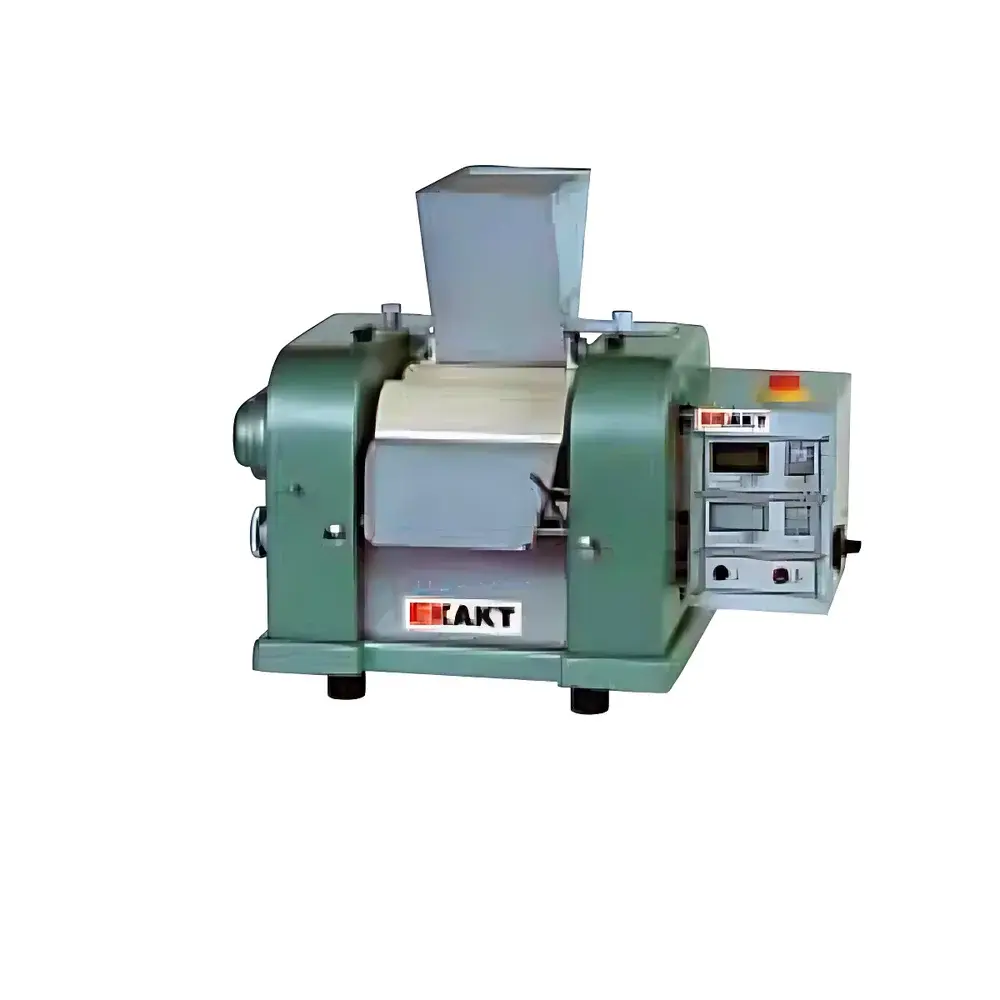
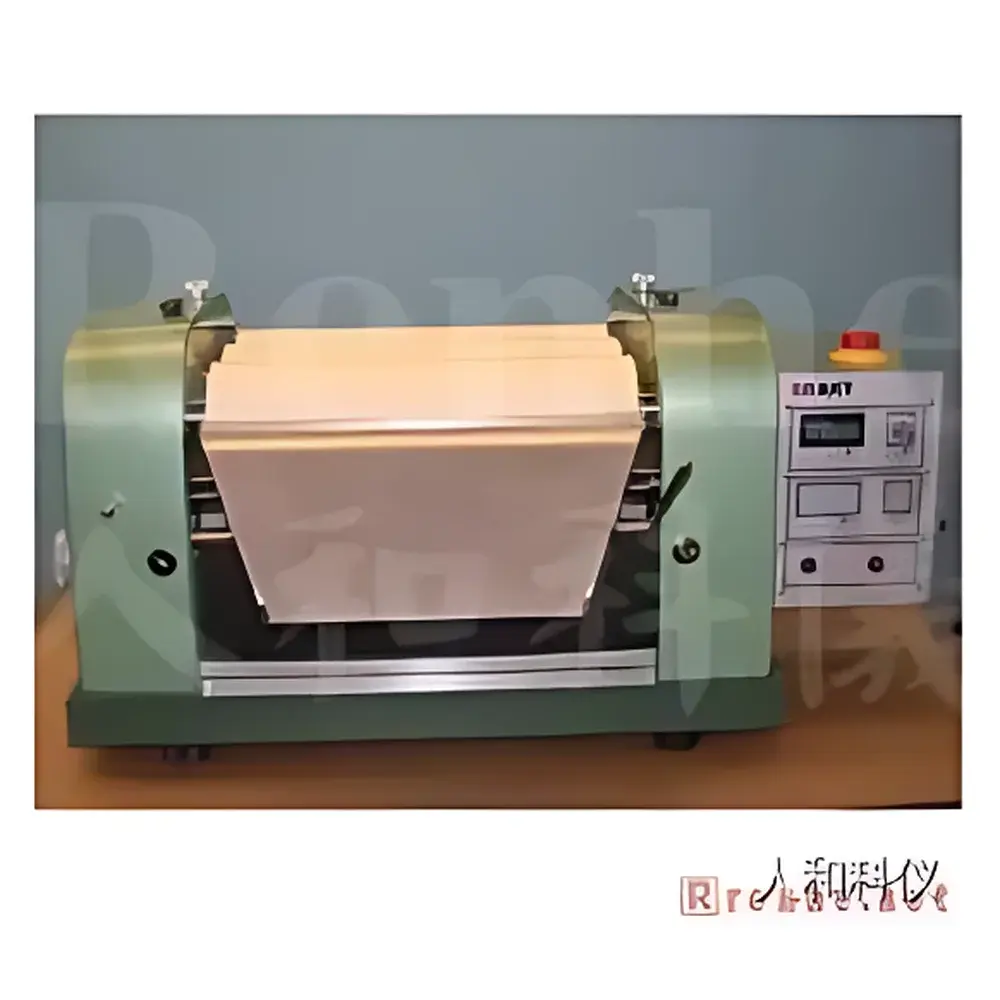
EXAKT 120S-450 Ultra-Fine Three-Roll Mill
| Brand | EXAKT |
|---|---|
| Origin | Germany |
| Model | 120S-450 |
| Instrument Type | Three-Roll Mill |
| Sample Applicability | Soft to semi-viscous materials |
| Feed Particle Size | 5–180 µm |
| Final Output Particle Size | 1–9 µm |
| Throughput Capacity | 0.01–5.7 L/hr |
| Roll Diameter | 120 mm |
| Roll Length | 450 mm |
| Roll Speed Ratio | 2.9 : 1.7 : 1 |
| Roll Material | Hard-chrome-plated stainless steel, polished alumina, or zirconia |
| Roller Surface Finish | Polished alumina or chemically treated zirconia |
| Scraper Materials | Stainless steel, PTFE, alumina, zirconia |
| Drive Options | Single-speed (1.5 kW), dual-speed (0.55/1.1 kW), or inverter-controlled variable-speed (1.5 kW) |
| Cooling/Heating Capability | Standard — up to 80 °C |
| Dimensions (W×D×H, with scraper & hopper) | 820 × 650 × 660 mm |
| Electrical Supply | 230 V / 50 Hz or 400 V / 50 Hz |
| Safety Certification | CE-compliant |
| Optional | ATEX-certified explosion-proof configuration, PFA-coated universal scraper system |
Overview
The EXAKT 120S-450 is a precision-engineered, benchtop three-roll mill designed for ultra-fine dispersion, deagglomeration, and homogenization of soft, pasty, or highly viscous materials in laboratory and pilot-scale R&D environments. Operating on the principle of shear-induced particle size reduction between three horizontally aligned, counter-rotating rolls with precisely controlled speed ratios (2.9 : 1.7 : 1), the system generates high shear gradients within the narrow, adjustable nip zone—enabling consistent sub-micron particle size distribution (PSD) control. Unlike high-energy impact mills, this roll-based architecture avoids thermal degradation and mechanical fragmentation, preserving material integrity—particularly critical for heat-sensitive pigments, conductive pastes, pharmaceutical suspensions, and nanocomposite dispersions. Its compact footprint (820 × 650 × 660 mm) and modular construction support integration into ISO-classified cleanrooms or GLP-compliant analytical laboratories.
Key Features
- Precision pre-tensioned roll alignment system ensures long-term stability of roll gap—minimizing drift in output fineness and enhancing inter-batch reproducibility.
- “One-point gap adjustment” mechanism allows continuous, micron-level fine-tuning of the final nip width without recalibration—critical for process optimization across varying viscosities.
- Roll surface options include hard-chrome-plated stainless steel (standard), polished alumina, and chemically stabilized zirconia—each selected for wear resistance, chemical inertness, and minimal contamination in sensitive formulations.
- Dual-speed or inverter-driven motor configurations enable dynamic adaptation to rheological profiles: low RPM for high-viscosity pastes (>10⁴ Pa·s), higher RPM for lower-viscosity slurries—maintaining optimal shear rate without slippage or roll overload.
- Universal scraper system features spring-loaded mounting, adjustable outlet width, and tool-free scraper tension control—ensuring uniform material removal and eliminating streaking or film thickness variation across the third roll.
- Integrated safety architecture includes CE-compliant emergency stop, electronic dynamic braking, drip-tray-integrated interlock switch, and stainless-steel guarded feed hopper—fully compliant with EN 61000-6-2/6-4 and Machinery Directive 2006/42/EC.
Sample Compatibility & Compliance
The 120S-450 accommodates a broad spectrum of soft-to-pasty samples—including organic/inorganic pigment dispersions, lithium-ion battery cathode/anode slurries, ceramic green tapes, polymer masterbatches, and topical pharmaceutical ointments. Feed particle size range (5–180 µm) and final output (1–9 µm) are validated per ISO 13320:2020 (laser diffraction) and ASTM D2196 (viscosity-dependent dispersion assessment). All wetted parts comply with USP Class VI biocompatibility standards when configured with PFA-coated scrapers or zirconia rolls. Optional ATEX-certified variants (Zone 21/22) meet IEC 60079-0 and -10-2 for explosive dust environments—common in pigment and fine chemical processing labs.
Software & Data Management
While the 120S-450 operates as a standalone mechanical unit, its variable-speed drive supports analog/digital signal input (0–10 V or 4–20 mA) for integration into centralized lab automation platforms (e.g., LabArchives, DeltaV, or custom SCADA). Process parameters—including roll speed setpoints, temperature feedback from integrated PT100 sensors (±0.5 °C accuracy), and runtime logs—are exportable via RS-485 Modbus RTU for audit-ready traceability. When deployed under GxP-regulated workflows, the system supports 21 CFR Part 11-compliant electronic records when paired with validated data acquisition software—enabling full revision history, user authentication, and immutable audit trails.
Applications
- Preparation of stable, narrow-distribution pigment dispersions for inkjet inks and automotive coatings.
- Rheological conditioning of electrode slurries prior to slot-die coating in battery R&D.
- Deagglomeration of nano-ceramic powders (e.g., TiO₂, SiO₂) in solvent-based or aqueous carriers.
- Homogenization of thermosensitive APIs in semi-solid dosage forms (e.g., transdermal gels).
- Production of calibration standards for particle sizing instrumentation requiring certified PSD reference materials.
FAQ
What is the minimum achievable particle size with the 120S-450?
Under optimized conditions—using zirconia rolls, PFA scraper, and low-viscosity carrier fluid—median particle size (D₅₀) down to 1 µm is routinely achieved; sub-500 nm results require multi-pass processing and are material-dependent.
Can the roll temperature be actively controlled during operation?
Yes—standard configuration includes jacketed rolls with external thermostatic circulation (−10 °C to +80 °C); high-temp option extends range to +100 °C for thermally activated dispersion processes.
Is remote monitoring or automation integration supported?
The inverter drive provides industrial communication interfaces (Modbus RTU, analog I/O) enabling seamless integration with PLCs, MES, or LIMS for automated parameter logging and SOP-driven operation.
What maintenance intervals are recommended for long-term reliability?
Roll surface inspection and scraper replacement every 500 operational hours; gear oil change every 2,000 hours; full alignment verification annually or after 10,000 cycles—per EXAKT’s documented maintenance protocol (Revision 4.2, 2023).



