
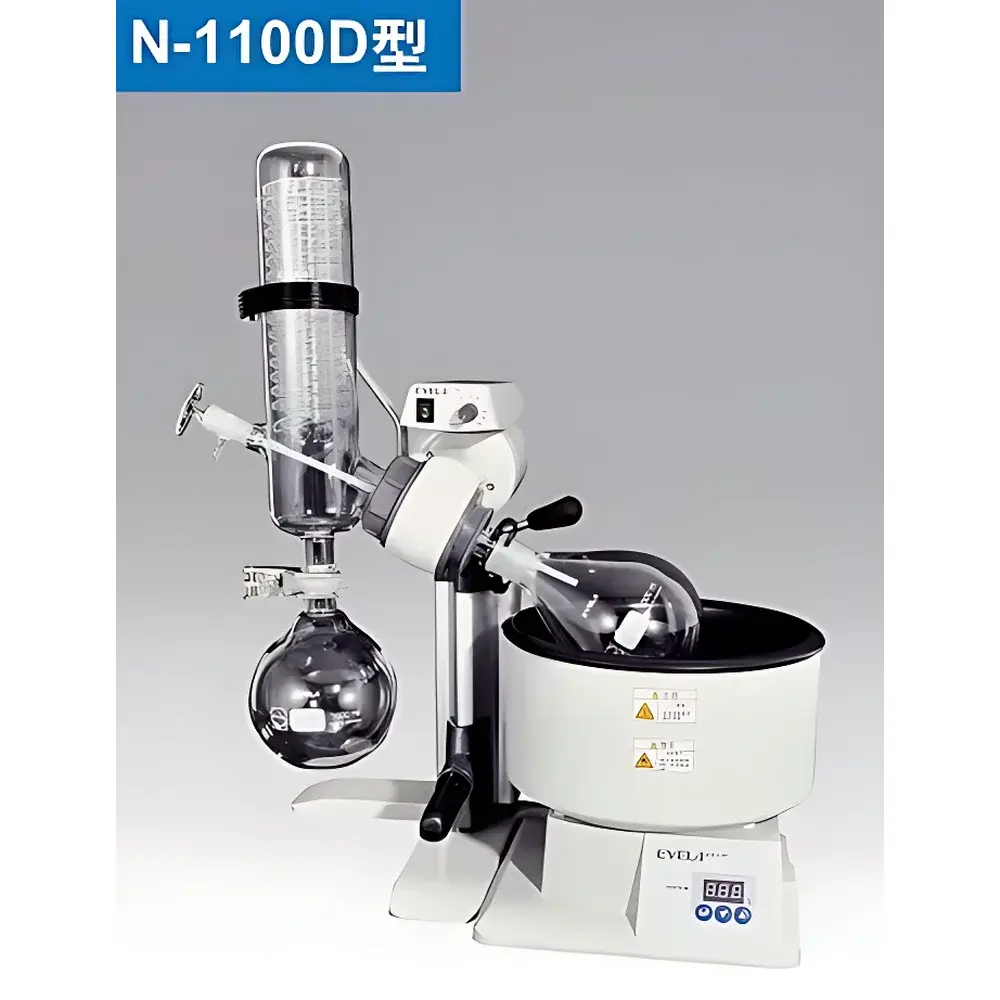
EYELA N-1100V-W Rotary Evaporator
| Brand | EYELA (Tokyo Rikakikai Co., Ltd.) |
|---|---|
| Origin | Japan |
| Model | N-1100V-W |
| Rotational Speed | 20–180 rpm |
| Max. Evaporation Rate | 18 mL/min |
| Ultimate Vacuum | <399.9 Pa (≤3 mmHg) |
| Bath Temperature Range (N-1100V-W) | +5°C to 90°C above ambient |
| Temperature Control Accuracy | ±1.5°C (water bath), ±3.0°C (oil bath) |
| Heating Power | 1 kW |
| Condenser Type | Vertical double-layer coiled condenser |
| Cooling Surface Area | 0.146 m² |
| Flask Capacity | Standard 1 L (max. 3 L), 29/38 standard taper joint |
| Collection Flask | 1 L spherical flask, S35/20 ground joint |
| Lift Mechanism | Manual dual-stage lift (100 mm primary + 150 mm auxiliary extension) |
| Bath Dimensions & Capacity | Ø230 mm × 100 mm depth (~3 L) or Ø240 mm × 120 mm depth (~5.5 L) |
| Overall Dimensions & Weight | 535 W × 355 D × 790 H mm / 11.5 kg (standard configuration) |
| Safety Features | Thermal fuse, dry-run prevention sensor |
| Sealing | Dual-material vacuum seal (PTFE + fluororubber) |
| Glassware | VF-type explosion-resistant coated glass (all condenser, collection, and four-way flasks) |
Overview
The EYELA N-1100V-W Rotary Evaporator is an engineered solution for precise, reproducible solvent removal under reduced pressure in analytical, pharmaceutical, and synthetic chemistry laboratories. Designed according to the fundamental principles of rotary evaporation—where simultaneous rotation, heating, and vacuum application lower the boiling point of solvents while maximizing surface area for efficient vaporization—the N-1100V-W delivers consistent performance across diverse sample matrices. Its vertical dual-layer coiled condenser enables high-efficiency condensation without requiring excessive bench space, while the integrated four-way flask configuration ensures unidirectional solvent flow directly into the collection vessel—eliminating backflow contamination risks common in conventional designs. This architecture is especially critical when handling trace-level analytes, such as those encountered in dioxin analysis or residual solvent quantification per ICH Q3C guidelines.
Key Features
- Vertical condenser with optimized coil density: Despite reduced overall height, the increased number of fine-pitch turns expands effective cooling surface area to 0.146 m²—enhancing condensation efficiency at low vacuum levels.
- Four-way flask system: Enables direct gravitational transfer of condensed solvent from condenser to collection flask, bypassing suction tubing and preventing cross-contamination of feed samples.
- Dual-stage manual lift mechanism: Combines a primary 100 mm vertical travel with a secondary 150 mm telescoping extension (accessible via top-access slot), facilitating compatibility with auxiliary equipment including buffer flasks and small-volume sample vessels.
- VF-type explosion-resistant coated glassware: All major components—including condenser, four-way adapter, and collection flask—are fabricated from borosilicate glass with proprietary anti-shatter coating, maintaining optical clarity and mechanical integrity while mitigating injury risk during accidental breakage.
- Integrated vacuum interface relocation: The vacuum inlet is positioned at the base of the unit, improving hose routing safety and reducing strain on rotary seals during prolonged operation.
- Thermal protection system: Includes both a thermal fuse and a dedicated dry-run prevention sensor that deactivates heating if bath fluid level falls below operational threshold—ensuring compliance with laboratory safety protocols and extending heater lifespan.
Sample Compatibility & Compliance
The N-1100V-W supports standard 29/38 taper joints and accommodates up to 3 L total volume via optional larger flasks, making it suitable for batch processing of organic extracts, natural product isolates, polymer solutions, and reaction mixtures. Its design aligns with key regulatory expectations for analytical instrumentation used in GLP-compliant environments: the sealed vacuum path, PTFE-fluoroelastomer dual-seal rotary joint, and optional 0.2 µm air filtration (on N-1100VD variant) support contamination control during venting—a requirement referenced in USP Analytical Instrument Qualification and FDA 21 CFR Part 11 data integrity frameworks. While the unit itself does not carry CE or UL certification out-of-box, its construction adheres to IEC 61010-1 safety standards for laboratory electrical equipment when operated within specified ambient and load conditions.
Software & Data Management
The N-1100V-W operates via microprocessor-based ON-OFF temperature control with digital setpoint input via membrane keypad and real-time display. Though it lacks embedded data logging or network connectivity, its analog-compatible output signals (e.g., PT100 sensor feedback, relay status) permit integration with external PLCs or SCADA systems for centralized monitoring in regulated facilities. When paired with the optional NVC-series vacuum controller, users gain programmable vacuum ramping and endpoint detection—enabling method reproducibility essential for SOP-driven workflows in QC labs. All parameter settings are retained through power cycling, supporting continuity in multi-shift operations without recalibration.
Applications
- Solvent recovery in preparative chromatography workflows (e.g., flash column eluent concentration)
- Concentration of environmental extracts prior to GC-MS analysis (e.g., EPA Method 1613 for dioxins)
- Removal of low-boiling solvents (e.g., dichloromethane, ethyl acetate) from heat-sensitive APIs during pharmaceutical development
- Lyophilization pre-concentration steps where controlled evaporation precedes freeze-drying
- High-throughput sample preparation in contract research organizations performing ASTM D5292 or ISO 11348-compliant toxicity assays
FAQ
What is the maximum recommended operating vacuum level for this unit?
The N-1100V-W achieves stable operation below 399.9 Pa (≤3 mmHg), which is sufficient for most low-to-medium boiling point solvents (e.g., acetone, methanol, hexane). For high-vacuum applications (<10 Pa), supplemental vacuum pumping capacity must be verified against system conductance and cold trap compatibility.
Can the N-1100V-W be used with oil baths above 90°C?
No—the N-1100V-W variant is rated for water or silicone oil baths up to 90°C. For higher-temperature applications (up to 180°C), the N-1100V-WD model is required, featuring enhanced thermal insulation and a modified heating element configuration.
Is the VF-coated glassware autoclavable?
VF coating is not designed for autoclave exposure. Cleaning should be performed using standard laboratory detergents and rinsing; thermal shock or aggressive alkaline solutions may compromise coating adhesion over time.
Does the unit include a vacuum pump?
No—vacuum generation requires an external diaphragm or scroll pump. EYELA recommends pairing with the C-35B or N-1S series pumps for optimal compatibility and noise reduction.
How often should the PTFE-fluoroelastomer vacuum seal be replaced?
Under continuous daily use, inspect the seal every 6 months; replace if cracking, compression set, or vacuum leakage exceeds 5 Pa/min under static hold test. Seal longevity increases significantly when operated below 80% of maximum rated vacuum.



