
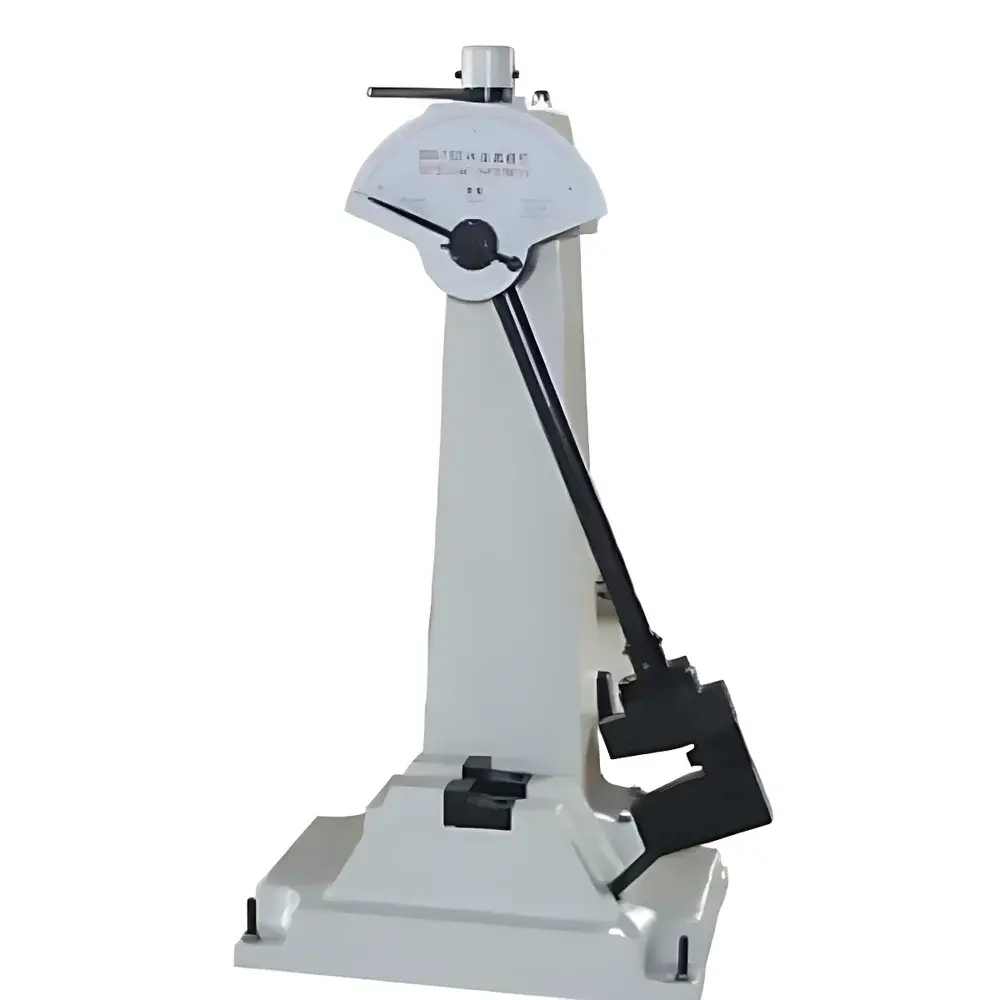
YANRUN JB-300 Manual Pendulum Impact Testing Machine
| Brand | YANRUN |
|---|---|
| Origin | Shanghai, China |
| Manufacturer Type | Direct Manufacturer |
| Product Category | Domestic (China-made) |
| Model | JB-300 |
| Instrument Type | Pendulum Impact Tester |
| Nominal Impact Energy | 300 J (large hammer), 150 J (small hammer) |
| Impact Velocity | 5.0 m/s |
| Pendulum Pre-lift Angle | 135° |
| Support Span | 40 mm |
| Anvil Radius (Support Edge) | R1.0–R1.5 mm |
| Striking Edge Radius (Hammer Nose) | R2.0–R2.5 mm |
| Distance from Pendulum Center to Impact Point | 800 mm |
| Standard Specimen Dimensions | 10 × 10 × 55 mm |
| Overall Dimensions (L×W×H) | 1000 × 630 × 1520 mm |
| Net Weight | 350 kg |
Overview
The YANRUN JB-300 Manual Pendulum Impact Testing Machine is a precision-engineered mechanical testing system designed for Charpy and Izod impact resistance evaluation of metallic and polymeric materials in accordance with international standard test methods. Based on the classical principle of conservation of energy in a gravity-driven pendulum system, the JB-300 measures the energy absorbed by a notched or unnotched specimen during fracture under sudden loading. The instrument employs a rigid cast-iron frame and calibrated pendulum arms with dual-hammer configuration—300 J and 150 J—to accommodate a broad range of material toughness requirements. Its fixed support span of 40 mm, standardized anvil geometry (R1.0–R1.5 mm), and precisely defined striking edge radius (R2.0–R2.5 mm) ensure compliance with ASTM E23, ISO 148-1, GB/T 229, and EN 10045-1 specifications. The pendulum’s pre-lift angle of 135° and nominal impact velocity of 5.0 m/s are optimized to minimize aerodynamic drag and rotational inertia effects, thereby enhancing measurement reproducibility across repeated tests.
Key Features
- Robust cast-iron base and column structure ensuring high rigidity and minimal vibration during impact event
- Dual-pendulum configuration: interchangeable 150 J and 300 J hammers, each independently calibrated and traceable to national metrological standards
- Precision-machined anvil and clamp assembly with adjustable alignment, supporting strict adherence to specimen centering tolerances per ASTM E23 Section 7.3
- Integrated specimen alignment gauge and support span calibrator for rapid, repeatable setup of standard 10 × 10 × 55 mm Charpy specimens
- Mechanically locked pendulum release mechanism with manual trigger lever—no electrical or pneumatic dependencies, minimizing maintenance complexity and failure points
- Calibrated angular scale and digital angle indicator (optional add-on) for verification of pre-lift position and residual swing angle post-impact
- Comprehensive accessory kit including hex key (S=12), pendulum removal tool, anvil leveling jig, and floor-mounting hardware (four M16 anchor bolts)
Sample Compatibility & Compliance
The JB-300 accommodates standard Charpy V-notch (CVN), Charpy U-notch (CUN), and Izod-configured specimens, with primary validation for metallic alloys, structural steels, aluminum extrusions, and engineering thermoplastics. Specimen dimensions conform to ISO 148-1:2016 and ASTM E23-22 requirements (10 × 10 × 55 mm nominal cross-section). Optional adapters enable testing of sub-size specimens (e.g., 5 × 5 × 55 mm or 7.5 × 7.5 × 55 mm) when referenced against validated correlation protocols. All mechanical components—including support anvils, striker blades, and clamping fixtures—are manufactured to dimensional tolerances specified in ISO 148-2 for impact testing accessories. The system supports GLP-compliant documentation workflows when paired with external data loggers or certified manual recording templates aligned with ISO/IEC 17025 laboratory accreditation criteria.
Software & Data Management
As a manually operated mechanical tester, the JB-300 does not incorporate embedded firmware or proprietary software. Impact energy values are determined via direct reading of the pendulum’s residual swing angle on the calibrated arc scale, converted using factory-certified energy coefficients. For laboratories requiring digital traceability, the JB-300 is fully compatible with third-party data acquisition systems—such as National Instruments DAQ modules or LabVIEW-based custom interfaces—that capture analog signals from optional rotary encoders or potentiometric angle sensors. All raw readings comply with FDA 21 CFR Part 11 audit trail requirements when recorded within validated electronic lab notebooks (ELNs) or LIMS platforms configured with user authentication, electronic signatures, and immutable storage protocols.
Applications
- Quality control of hot-rolled and cold-finished steel billets, plates, and forgings in metallurgical production environments
- Toughness verification of weld metal and heat-affected zones (HAZ) per AWS D1.1 and ISO 15614-1
- Low-temperature impact assessment of pipeline steels (e.g., API 5L X65/X70) at –20°C to –60°C using environmental chambers
- Material qualification for pressure vessel fabrication under ASME BPVC Section VIII Div. 1 and PED 2014/68/EU
- Educational use in university materials science laboratories for hands-on demonstration of ductile-to-brittle transition behavior
- Failure analysis investigations where fracture surface morphology must be correlated with absorbed energy metrics
FAQ
Is the JB-300 compliant with ISO 148 and ASTM E23?
Yes—the mechanical geometry, pendulum dynamics, and specimen fixture design meet all dimensional and performance requirements specified in ISO 148-1:2016 and ASTM E23-22 for pendulum impact testers.
Can the JB-300 be used for Izod testing?
Yes, with optional Izod specimen holders and clamping fixtures; the base machine architecture supports both Charpy and Izod configurations through mechanical reconfiguration.
What calibration documentation is provided with the unit?
Each JB-300 is supplied with a factory calibration certificate traceable to CNAS-accredited metrology institutes, covering pendulum moment of inertia, energy coefficient, and anvil alignment verification.
Does the system require electrical power?
No—operation is entirely mechanical; only optional digital readout modules or external data loggers require power.
What maintenance intervals are recommended?
Biannual inspection of pivot bearing play, anvil wear, and striker edge integrity is advised; lubrication of the pendulum pivot and release mechanism every 500 tests ensures long-term repeatability.



