
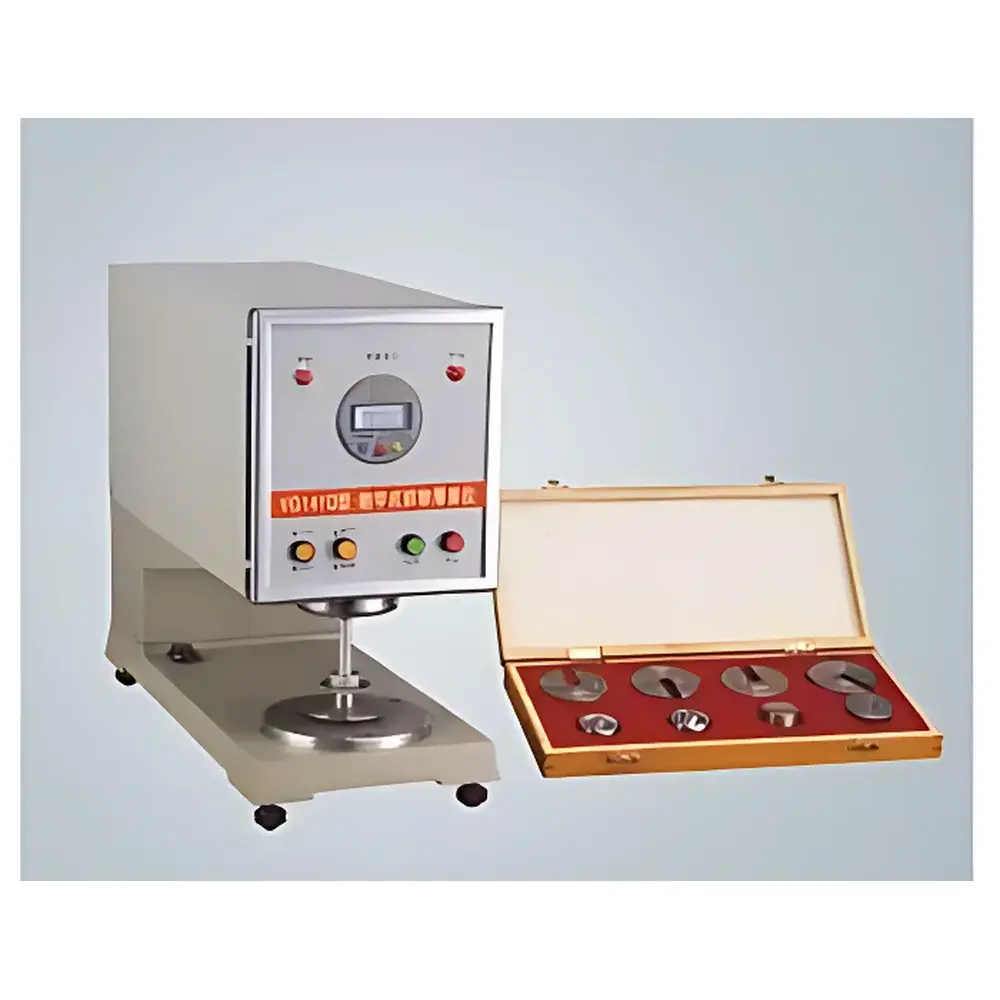
Fangyuan YG141D Digital Fabric Thickness Tester
| Brand | Fangyuan |
|---|---|
| Model | YG141D |
| Measurement Range | 0.1–30 mm |
| Resolution | 0.01 mm |
| Foot Area Options | 100 mm², 2000 mm² |
| Foot Diameter Options | Ø11.28 mm, Ø50.46 mm |
| Applied Pressures | 50 cN, 100 cN, 200 cN |
| Dwell Time Options | 10 s, 30 s |
| Foot Descent Speed | 1.72 mm/s |
| Power Supply | AC 220 V, 50 Hz, 40 W |
| Dimensions (L×W×H) | 410 × 160 × 300 mm |
| Weight | ~25 kg |
| Compliant Standards | GB/T 3820–1997, ISO 5084, ISO 9073-2, ISO 9863, FZ/T 01003 |
Overview
The Fangyuan YG141D Digital Fabric Thickness Tester is a precision mechanical instrument engineered for the standardized measurement of thickness in woven and knitted textiles, nonwovens, technical fabrics, and other uniform thin-sheet materials. It operates on the principle of controlled compressive loading: a calibrated foot applies a defined pressure to the specimen for a preset dwell time, after which the vertical displacement between the foot and anvil—measured via high-resolution digital linear transduction—is recorded as the material’s thickness. This method conforms strictly to the fundamental definition of textile thickness under compression, as codified in international standards such as ISO 5084 (determination of thickness of textile fabrics and products) and GB/T 3820–1997. Unlike optical or ultrasonic alternatives, the YG141D delivers direct, traceable mechanical displacement data without assumptions about material density or acoustic impedance—making it indispensable for quality control laboratories requiring repeatable, audit-ready physical measurements aligned with regulatory and contractual specifications.
Key Features
- High-resolution digital display with 0.01 mm resolution, enabling precise discrimination between subtle thickness variations across fabric batches.
- Dual-foot configuration: interchangeable 100 mm² (Ø11.28 mm) and 2000 mm² (Ø50.46 mm) contact surfaces accommodate both fine-gauge knits and heavy industrial textiles, ensuring representative area sampling per ISO 9073-2 guidelines.
- Three calibrated pressure options (50 cN, 100 cN, 200 cN) allow compliance with material-specific test protocols—for example, 100 cN for general-purpose woven fabrics per GB/T 3820, or 50 cN for delicate lace or technical membranes.
- Precisely timed compression cycles (10 s or 30 s dwell) minimize operator-induced variability and support creep-sensitive evaluations required by ISO 9863 for geotextiles and filtration media.
- Consistent foot descent velocity (1.72 mm/s) ensures reproducible loading kinetics, reducing hysteresis effects and improving inter-laboratory correlation.
- Robust cast-aluminum frame and hardened steel anvil provide long-term dimensional stability and resistance to environmental drift—critical for GLP-compliant environments where instrument qualification records must be maintained over extended service intervals.
Sample Compatibility & Compliance
The YG141D is validated for use with flat, dimensionally stable specimens up to 30 mm thick, including but not limited to cotton and polyester weaves, elastane-blend knits, bonded nonwovens, coated technical textiles, and laminated composites. Its design accommodates standard specimen sizes (typically ≥100 mm × 100 mm) and supports edge-effect mitigation through proper specimen centering and foot alignment verification. The instrument meets essential metrological requirements outlined in ISO/IEC 17025 for testing laboratories: all critical parameters—including foot geometry, applied force calibration, and timing accuracy—are traceable to national standards via documented manufacturer certification. It is routinely employed in third-party testing labs accredited to ISO/IEC 17025 for textile evaluation and serves as a reference instrument in supplier qualification programs governed by AATCC, ASTM D1777, and OEKO-TEX® Standard 100 Annex 6 thickness verification clauses.
Software & Data Management
The YG141D operates as a standalone electromechanical tester with no embedded microprocessor or digital connectivity. All measurements are displayed locally on a high-contrast LED screen and require manual transcription into laboratory notebooks or LIMS databases. While no proprietary software is bundled, its analog output interface (optional RS-232 or 4–20 mA signal module available upon request) permits integration with external data acquisition systems compliant with FDA 21 CFR Part 11 when paired with validated electronic lab notebook (ELN) platforms. For GMP-regulated textile manufacturing sites, users may implement paper-based or hybrid documentation workflows supported by standardized SOPs—ensuring full auditability of measurement conditions (pressure, dwell time, foot size), operator ID, date/time stamp, and raw thickness values per GLP principles.
Applications
- Quality assurance of finished fabrics against purchase specifications (e.g., “1.2 ± 0.1 mm at 100 cN/10 s” in apparel sourcing contracts).
- Process validation in dyeing and finishing lines, where calendering pressure and temperature directly affect final fabric bulk and hand feel.
- Comparative analysis of pre- and post-wash thickness changes to quantify shrinkage and dimensional stability per ISO 6330.
- Thickness profiling of multi-layer composites used in protective workwear, automotive interiors, or medical barrier fabrics.
- Supporting R&D activities in smart textile development, where conductive coating thickness or sensor-integrated layer uniformity must be quantified prior to electrical characterization.
- Third-party conformity assessment for certifications including Oeko-Tex®, GOTS, and bluesign®, where thickness influences breathability, thermal resistance, and regulatory classification thresholds.
FAQ
What standards does the YG141D comply with?
The instrument is designed and verified for conformance with GB/T 3820–1997, ISO 5084, ISO 9073-2, ISO 9863, and FZ/T 01003. Calibration certificates include traceability statements referencing national mass and length standards.
Can the YG141D measure non-textile materials?
Yes—provided the specimen is planar, compressible under low load, and exhibits minimal lateral deformation during measurement. Common non-textile applications include paperboard, gasket materials, foam sheets, and thin polymer films.
Is operator training required for ISO-compliant use?
Yes. Per ISO/IEC 17025 clause 6.2, personnel must demonstrate competency in specimen conditioning (ISO 139), placement technique, foot selection rationale, and result interpretation. Fangyuan provides a bilingual operator manual and application note library covering these topics.
How often should the instrument be recalibrated?
Annual recalibration is recommended; however, frequency must be justified based on usage intensity, environmental conditions, and internal quality policy. Force calibration (using certified deadweights) and dimensional verification (foot diameter and anvil parallelism) are mandatory elements of each cycle.
Does the YG141D support automatic data export?
Not natively. Optional analog or serial output modules enable connection to external DAQ systems. Full digital integration requires custom middleware and validation per site-specific 21 CFR Part 11 or EU Annex 11 requirements.





