
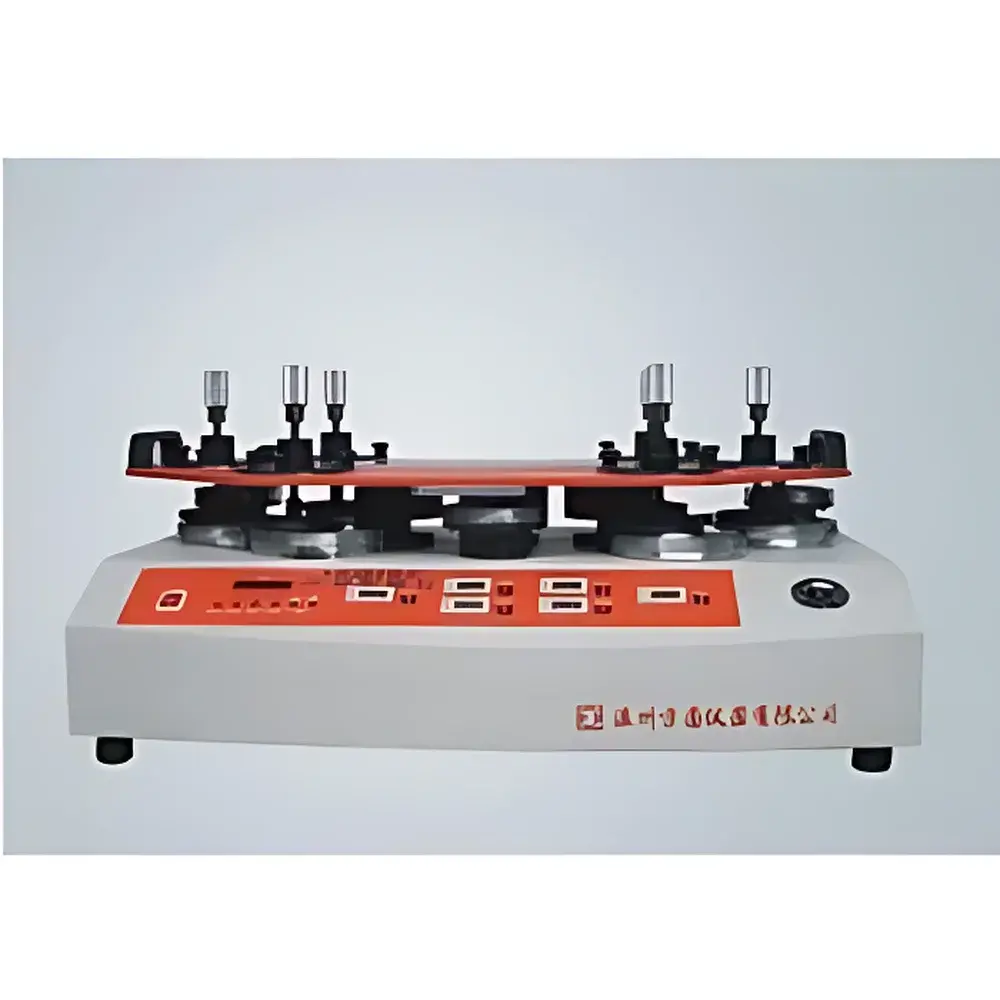
Fangyuan YG401D Digital Fabric Abrasion and Pilling Tester
| Brand | Fangyuan Instruments |
|---|---|
| Model | YG401D |
| Workstations | 6 |
| Pre-set Count Range | 0–99999 cycles |
| Cumulative Count Range | 0–99999 cycles |
| Clamp Mass | 200 ± 1 g |
| Fabric Specimen Weight (Clothing) | 395 ± 2 g |
| Fabric Specimen Weight (Upholstery) | 594 ± 2 g |
| Abrading Block Effective Friction Diameter | Φ28.8 mm / Φ90.3 mm |
| Clamp-to-Table Relative Rotational Speed | 50 ± 2 rpm |
| Loading Hammer Mass | 2385 ± 10 g |
| Dimensions (L×W×H) | 820 × 505 × 410 mm |
| Net Weight | 150 kg |
| Power Supply | AC 220 V, 50 Hz, 300 W |
| Motion Pattern | Lissajous orbits (Ø40 mm and Ø60 mm) |
| Compliance | GB/T 4802.2, GB/T 13775, GB/T 21196, FZ/T 20020, ISO 12945-1/2/3, ISO 12947-1/2/3/4, ASTM D4966, ASTM D4970, JIS L1096, TM196 |
Overview
The Fangyuan YG401D Digital Fabric Abrasion and Pilling Tester is a precision-engineered instrument designed for standardized evaluation of surface durability and pilling resistance in woven and knitted textiles under controlled mechanical stress. It operates on the principle of multi-directional oscillatory motion—specifically Lissajous-pattern abrasion—where fabric specimens are subjected to cyclic rubbing against standardized abrading surfaces under defined load, speed, and motion geometry. This methodology replicates real-world wear mechanisms such as rubbing against adjacent garments or furniture upholstery, enabling quantifiable assessment of fiber migration, surface fuzzing, and eventual pill formation. The instrument conforms to internationally recognized test protocols including ISO 12947 (Martindale method), ISO 12945 (pilling assessment), ASTM D4966 (Martindale abrasion), and GB/T 4802.2 (Chinese national standard for textile pilling testing), ensuring data comparability across global R&D labs, quality control departments, and third-party certification bodies.
Key Features
- Six independent test stations with synchronized yet individually monitored operation—enabling high-throughput comparative testing of multiple fabric samples under identical environmental and mechanical conditions.
- Dual Lissajous motion patterns (Ø40 mm and Ø60 mm orbit diameters) selectable via front-panel interface, supporting both ISO 12947-2 (standard Martindale) and specialized low-amplitude abrasion protocols for delicate fabrics such as silk, fine cotton, and linen.
- Modular digital control architecture with isolated counting circuits per station—ensuring long-term stability, minimal cross-talk between workstations, and traceable cycle logging without software dependency.
- Precision-machined abrading blocks with two standardized friction diameters (Φ28.8 mm and Φ90.3 mm) compliant with ISO 12947-1 and ASTM D4966 specifications for wool, synthetic, and blended textiles.
- Calibrated loading system with three certified mass configurations: 200 ± 1 g clamp assembly, 395 ± 2 g specimen weight for apparel-grade fabrics, and 594 ± 2 g weight for upholstery and technical textiles—each traceable to NIST-equivalent metrological references.
- Integrated 2385 ± 10 g loading hammer for consistent specimen tension during extended wear cycles, minimizing edge slippage and ensuring uniform contact pressure distribution across the abraded zone.
Sample Compatibility & Compliance
The YG401D accommodates flat, non-stretchable, and moderately extensible fabric specimens up to 38 mm × 38 mm (standard Martindale size), with optional custom clamping fixtures available for non-standard geometries. It supports natural fibers (cotton, wool, silk, linen), regenerated cellulose (viscose, lyocell), synthetics (polyester, nylon, acrylic), and their blends. All test procedures align with regulatory and industry frameworks: ISO 12947 series for abrasion resistance classification (Classes 1–5), ISO 12945-2 for pilling grade evaluation (Grades 1–5), ASTM D4966 for Martindale abrasion end-point determination, and GB/T 4802.2 for domestic Chinese textile quality certification. Data generated is suitable for GLP-compliant reporting and supports audit readiness for ISO/IEC 17025-accredited laboratories.
Software & Data Management
The YG401D operates as a standalone hardware platform with embedded firmware-based cycle tracking—eliminating reliance on external PCs or proprietary drivers. Each workstation maintains independent cumulative and pre-set counters with non-volatile memory retention, preserving test history even after power interruption. Cycle logs are exportable via RS-232 serial interface (optional USB-to-serial adapter) for integration into LIMS or ERP systems. While no bundled software is included, raw count data adheres to ASCII-delimited format compatible with Excel, Python pandas, and laboratory informatics platforms. For regulated environments, optional firmware upgrade supports timestamped event logging and operator ID input—meeting baseline requirements for 21 CFR Part 11-aligned audit trails when paired with validated external software solutions.
Applications
- Quality assurance of finished fabrics prior to garment manufacturing—validating batch-to-batch consistency in pilling resistance and surface integrity.
- R&D screening of novel fiber blends, surface finishes (e.g., silicone softeners, anti-pilling resins), and weaving/knitting parameters affecting abrasion performance.
- Comparative benchmarking against competitor materials using standardized Martindale cycles (e.g., 5000, 10000, 20000 cycles) per ISO 12947-2.
- Supporting sustainability initiatives by quantifying fabric lifespan under simulated use conditions—feeding into lifecycle assessment (LCA) models for eco-labeling programs.
- Technical textile validation for automotive interiors, contract furnishings, and medical apparel where ISO 12947-4 (upholstery abrasion) compliance is contractually mandated.
FAQ
What standards does the YG401D support out-of-the-box?
The instrument is factory-configured to meet ISO 12947-1/2/3/4, ISO 12945-1/2/3, ASTM D4966, ASTM D4970, GB/T 4802.2, GB/T 13775, GB/T 21196, FZ/T 20020, JIS L1096, and TM196 test methods.
Can the YG401D perform both abrasion and pilling tests simultaneously?
Yes—each of the six stations can be independently assigned either an abrasion protocol (e.g., ISO 12947-2) or a pilling protocol (e.g., ISO 12945-2) without hardware modification.
Is calibration documentation provided with shipment?
Each unit ships with a factory calibration certificate verifying abrading block dimensions, rotational speed accuracy (±2 rpm), and loading mass tolerances per ISO/IEC 17025 traceable procedures.
What maintenance intervals are recommended for long-term repeatability?
Abrading cloth replacement every 50,000 cycles (or per ISO 12947-1 clause 6.2), annual verification of clamp torque and loading hammer mass, and biannual inspection of drive belt tension and bearing play.
Does the instrument require compressed air or vacuum supply?
No—the YG401D is fully self-contained and operates solely on AC 220 V, 50 Hz power; no ancillary utilities are needed.





