
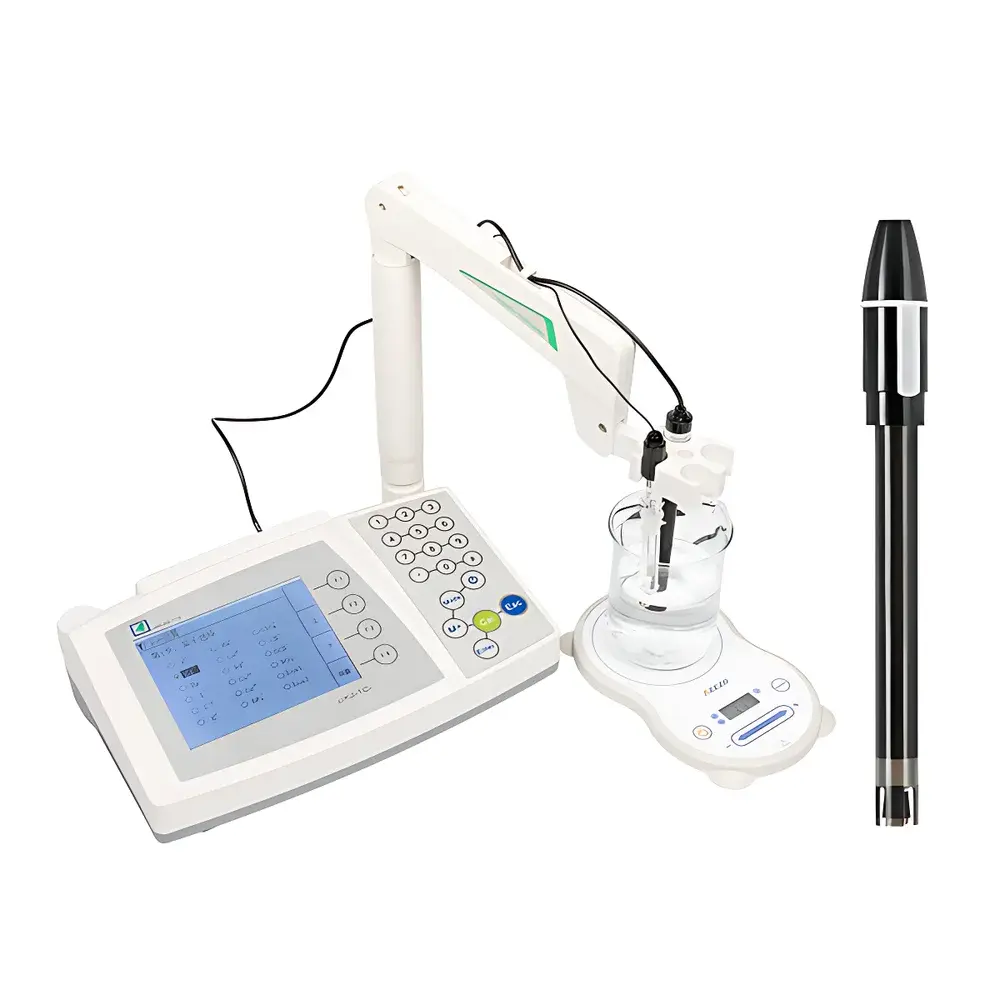
FangZhou PXJ-1C+ Fluoride Ion Meter
| Brand | FangZhou |
|---|---|
| Origin | Sichuan, China |
| Manufacturer Type | Authorized Distributor |
| Product Category | Domestic |
| Model | PXJ-1C+ |
| Instrument Type | Benchtop |
| Ion Measurement Range | 0–99999 ppm |
| Detection Limit | 9999 ppm |
| Response Time | 3 s |
| Measurement Accuracy | ±0.5% FS ±1 digit |
| Temperature Range | −20.0 to 135.0 °C |
| Resolution | 0.001 pH / 0.01 mV / 0.1 °C |
| Data Storage Capacity | 4096 records |
| GLP Compliance | Yes |
| Calibration Points | 2–9 points (ion), up to 5 points (pH) |
| Supported Units | pX, ppm, ppb, ppt, mol/L, mmol/L, µmol/L, nmol/L, %, µg/L, mg/L, g/L, ng/L |
| Temperature Compensation | Automatic (ATC) or Manual |
| Input Impedance | ≥3 × 10¹² Ω |
| Interface | BNC electrode port, Pt1000/NTC temperature input, USB, RS232, 0–20 mV analog output |
Overview
The FangZhou PXJ-1C+ Fluoride Ion Meter is a high-precision benchtop ion concentration analyzer engineered for reliable, trace-level quantification of fluoride and 15 additional common anions and cations—including chloride, bromide, ammonia, nitrate, and sodium—in aqueous environmental, industrial, and regulatory laboratory settings. Based on potentiometric measurement using ion-selective electrodes (ISEs), the instrument operates under the Nernst equation principle, delivering stable electromotive force (EMF) readings proportional to the logarithm of target ion activity. Its dual-mode architecture supports both direct pX (negative logarithm of ion activity) and concentration-based reporting (ppm, mmol/L, etc.), with built-in thermistor-based temperature compensation ensuring accuracy across a wide thermal range (−20.0 to 135.0 °C). Designed for routine compliance workflows, the PXJ-1C+ meets core requirements of GLP (Good Laboratory Practice) frameworks through audit-ready data logging, timestamped records, and structured calibration traceability.
Key Features
- High-resolution 0.001 pH / 0.01 mV / 0.1 °C measurement capability with adjustable resolution settings for pH and mV modes
- Multi-parameter operation: simultaneous measurement of fluoride ion concentration, pH, ORP (redox potential), mV, and temperature
- Comprehensive ion support: pre-configured calibration parameters for 16 standard ions plus two user-defined ions
- Flexible concentration unit conversion: 13 selectable units including ppm, ppb, mol/L, mmol/L, µg/L, and %—all convertible in real time without manual recalculation
- Advanced calibration architecture: 2–9 point ion calibration with automatic standard curve generation; up to 5-point pH calibration with auto-recognition of 18 standardized buffer solutions
- Robust data integrity system: 4096-group storage capacity with embedded date/time stamping (RTC clock), GLP-compliant record structure, and export-ready formatting
- Dual temperature compensation: ATC (Automatic Temperature Compensation) via integrated Pt1000 or NTC sensor, or manual entry with ±0.2 °C accuracy
- Expandable connectivity: USB and RS232 ports for bidirectional communication; 0–20 mV analog output for integration into SCADA or LIMS environments
Sample Compatibility & Compliance
The PXJ-1C+ is optimized for aqueous samples meeting standard EPA, ISO 10304-1, and ASTM D6919 guidelines for ion chromatography and ISE-based analysis. It accommodates standard glass-body or solid-state fluoride ISEs (e.g., LaF₃ crystal membrane electrodes) and supports interchangeable electrode interfaces via optional adapter modules. All measurements adhere to ISO/IEC 17025-relevant validation principles—linearity verification across full range, repeatability assessment (<0.001 pH RSD), and inter-day stability monitoring. The instrument’s firmware enforces GLP-mandated features: operator ID tagging (via software), immutable calibration logs, and tamper-evident data timestamps. While not FDA 21 CFR Part 11–certified out-of-the-box, its audit trail functionality—including event history of calibrations, measurements, and configuration changes—provides foundational infrastructure for GMP-aligned water quality labs conducting USP or pharmacopeial testing.
Software & Data Management
The included “FangZhou pH-Link” PC software enables secure, encrypted data transfer via USB or serial interface. It supports batch export to CSV, Excel, and PDF formats with customizable report templates compliant with internal QA documentation standards. Raw measurement files retain native metadata: electrode ID, calibration coefficients, temperature at acquisition, and operator-assigned sample IDs. The software implements role-based access control (administrator/user modes), electronic signature prompts for critical actions (e.g., calibration reset), and automated backup scheduling. All stored records include SHA-256 hash integrity verification to satisfy data authenticity requirements under ISO 17025 Clause 7.7 and EU Annex 11 expectations for analytical instrument data governance.
Applications
- Environmental monitoring: Fluoride screening in drinking water, groundwater, and wastewater per WHO Guideline Values (1.5 mg/L) and China’s GB 5749–2022
- Industrial process control: Real-time F⁻ monitoring in semiconductor etchant recycling, aluminum smelting effluents, and fluoropolymer manufacturing streams
- Food & beverage safety: Quantification of residual fluoride in bottled water, infant formula reconstitution water, and tea infusions
- Academic research: Multi-ion speciation studies in geochemical leaching experiments and soil porewater extraction
- Regulatory compliance: Support for ISO 10304-1 (determination of anions by liquid chromatography) method validation and reference electrode verification protocols
FAQ
Does the PXJ-1C+ support direct fluoride ion measurement without pH adjustment?
Yes—the instrument performs direct potentiometric fluoride determination using a LaF₃-based ion-selective electrode. TISAB (Total Ionic Strength Adjustment Buffer) addition remains recommended for samples with variable ionic strength or interfering ions (e.g., OH⁻, Al³⁺), but the meter itself does not require pH pre-adjustment for basic operation.
Can the device store calibration data separately for each ion electrode?
Yes—each calibrated ion channel retains independent slope, intercept, and detection limit values. Switching between fluoride and nitrate modes preserves respective calibration curves without cross-contamination of parameters.
Is the 9-point ion calibration function mandatory for routine use?
No—it is optional. For most environmental applications within 0.1–10 ppm F⁻, a 3-point calibration (e.g., 0.1, 1.0, 10 ppm) suffices. The 9-point mode is reserved for high-accuracy certification work or non-linear response characterization near detection limits.
What temperature sensors are compatible with the PXJ-1C+?
The unit accepts Pt1000 RTD probes (standard), 10 kΩ NTC thermistors, or manual temperature entry. Automatic recognition occurs only with factory-programmed Pt1000 sensors; third-party probes require manual coefficient input.
How is data security handled during USB transfer to a Windows host?
pH-Link employs TLS 1.2–encrypted session handshaking and writes files with write-once metadata flags to prevent post-acquisition modification—aligning with ALCOA+ (Attributable, Legible, Contemporaneous, Original, Accurate, Complete, Consistent, Enduring, Available) data integrity principles.







