
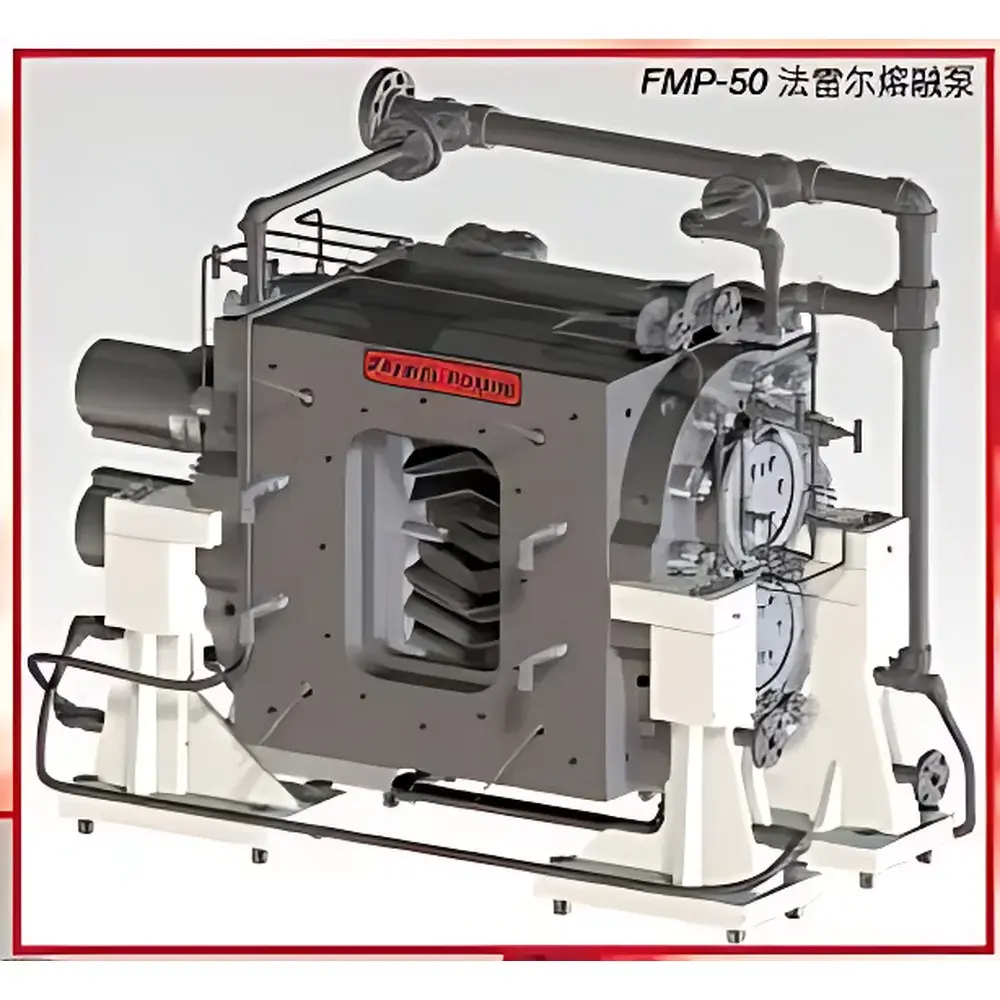
Farrel FMP-50 Melt Pump
| Brand | Farrel |
|---|---|
| Origin | USA |
| Model | FMP-50 |
| Theoretical Capacity | 22,730 kg/h |
| Application | Polymer Melt Metering & Pressurization in Continuous Processing Lines |
| Compliance | Designed for ISO 9001-certified extrusion and compounding systems |
| Configuration | Gear-type positive displacement pump with hardened steel gears and precision-machined housing |
Overview
The Farrel FMP-50 Melt Pump is a precision-engineered gear-type positive displacement pump designed for continuous, high-stability metering and pressurization of thermoplastic and thermoset polymer melts in industrial extrusion, compounding, and post-reactor polymer processing lines. Operating on the principle of volumetric displacement via intermeshing, case-hardened steel gears, the FMP-50 delivers consistent melt flow rates independent of upstream pressure fluctuations—enabling precise control over downstream die fill, gauge uniformity, and final product dimensional stability. Unlike centrifugal or progressive cavity alternatives, the FMP-50 maintains near-zero slip across its operational viscosity range (10²–10⁶ Pa·s), ensuring minimal backflow and exceptional repeatability in high-throughput production environments. Its integration into continuous melt processing trains—particularly following twin-screw extruders or reactive extrusion reactors—supports stringent process validation requirements under ISO 20434 and ASTM D3835 standards for polymer rheological consistency.
Key Features
- High-precision gear geometry with hardened 4340 alloy steel rotors and nitrided housing bores, engineered for extended service life under abrasive and thermally demanding melt conditions.
- Low-slip volumetric displacement design minimizing internal recirculation (<0.8% at rated capacity), thereby preserving polymer residence time distribution and reducing thermal degradation risk.
- Integrated thermal management system with dual-zone heating/cooling jackets enabling precise melt temperature control (±1.5 °C) across the pump body and gear interfaces.
- Direct-coupled drive configuration compatible with variable-frequency motor drives (VFD), supporting flow rate modulation from 10% to 110% of nominal capacity without mechanical reconfiguration.
- Modular flange interface (DIN 11851 or ANSI B16.5 Class 150/300) facilitating seamless integration with Farrel continuous mixers, Berstorff extruders, and Leistritz twin-screw systems.
- Robust architecture compliant with ATEX Zone 2 and IECEx certification options for operation in potentially explosive atmospheres containing combustible polymer dust or vapors.
Sample Compatibility & Compliance
The FMP-50 handles molten polymers including polyethylene (LDPE, HDPE, LLDPE), polypropylene (homopolymer and copolymer), PET, PC, PA6/66, TPU, and reactive systems such as polyurethane prepolymers and epoxy resins. It is validated for use with shear-sensitive biopolymers (e.g., PLA, PHA) where controlled residence time and low specific mechanical energy (SME) input are critical. The pump meets material contact requirements per FDA 21 CFR §177.1520 for food-contact applications and conforms to EC Directive 2014/68/EU (PED) for pressure equipment. Documentation packages include full FAT/SAT protocols, material traceability certificates (MTRs), and third-party calibration reports traceable to NIST standards.
Software & Data Management
While the FMP-50 operates as a stand-alone mechanical unit, it integrates with supervisory control systems via 4–20 mA analog outputs (speed, discharge pressure, bearing temperature) and Modbus RTU/ASCII digital communication. Optional Farrel SmartPump Interface Module provides real-time diagnostics—including gear mesh vibration analysis, thermal gradient mapping, and predictive maintenance alerts—compatible with Siemens SIMATIC PCS 7, Rockwell FactoryTalk, and Emerson DeltaV DCS platforms. Audit trails comply with FDA 21 CFR Part 11 when deployed with validated SCADA configurations, supporting GLP/GMP batch record integrity and electronic signature workflows.
Applications
- Stabilizing melt flow upstream of flat film, blown film, and sheet dies to eliminate thickness variation and improve gauge control.
- Feeding reactive extrusion systems where stoichiometric accuracy and residence time consistency directly impact molecular weight distribution (MWD) and branching architecture.
- Enabling high-viscosity masterbatch dosing in colorant and additive compounding lines with ±0.25% mass flow accuracy.
- Supporting solvent-free adhesive coating lines requiring pulse-free delivery and pressure ripple <±0.5 bar at 22,730 kg/h throughput.
- Providing calibrated melt feed for inline rheometers (e.g., Goettfert RheoScope) and IR/NIR spectroscopic analyzers in closed-loop quality control loops.
FAQ
What is the maximum allowable inlet pressure for the FMP-50?
The FMP-50 is rated for inlet pressures up to 15 bar (217 psi); operation above this threshold requires upstream pressure regulation to prevent gear tooth overload and seal extrusion.
Can the FMP-50 be used with filled or abrasive polymer compounds?
Yes—standard configurations include tungsten carbide-coated gears and hardened stainless-steel bushings; optional ceramic-coated housings are available for highly abrasive mineral-filled compounds (e.g., >40 wt% CaCO₃ or glass fiber).
Is explosion-proof certification available?
ATEX II 2G Ex db IIB T4 Gb and IECEx Ex db IIB T4 Gb certifications are factory-installable options; documentation includes full hazard assessment per EN 13463-1 and EN 60079-0.
How is calibration performed and maintained?
Calibration is based on volumetric displacement verification using certified flow meters traceable to NIST SRM 2197; annual recalibration is recommended, with in-situ verification possible via differential pressure and speed correlation against reference flow curves.
Does Farrel provide technical support for integration into existing extrusion lines?
Yes—Farrel’s Global Process Engineering Group offers commissioning services including piping stress analysis, thermal expansion compensation design, and PLC logic validation per ISA-88 and ISA-95 frameworks.



