
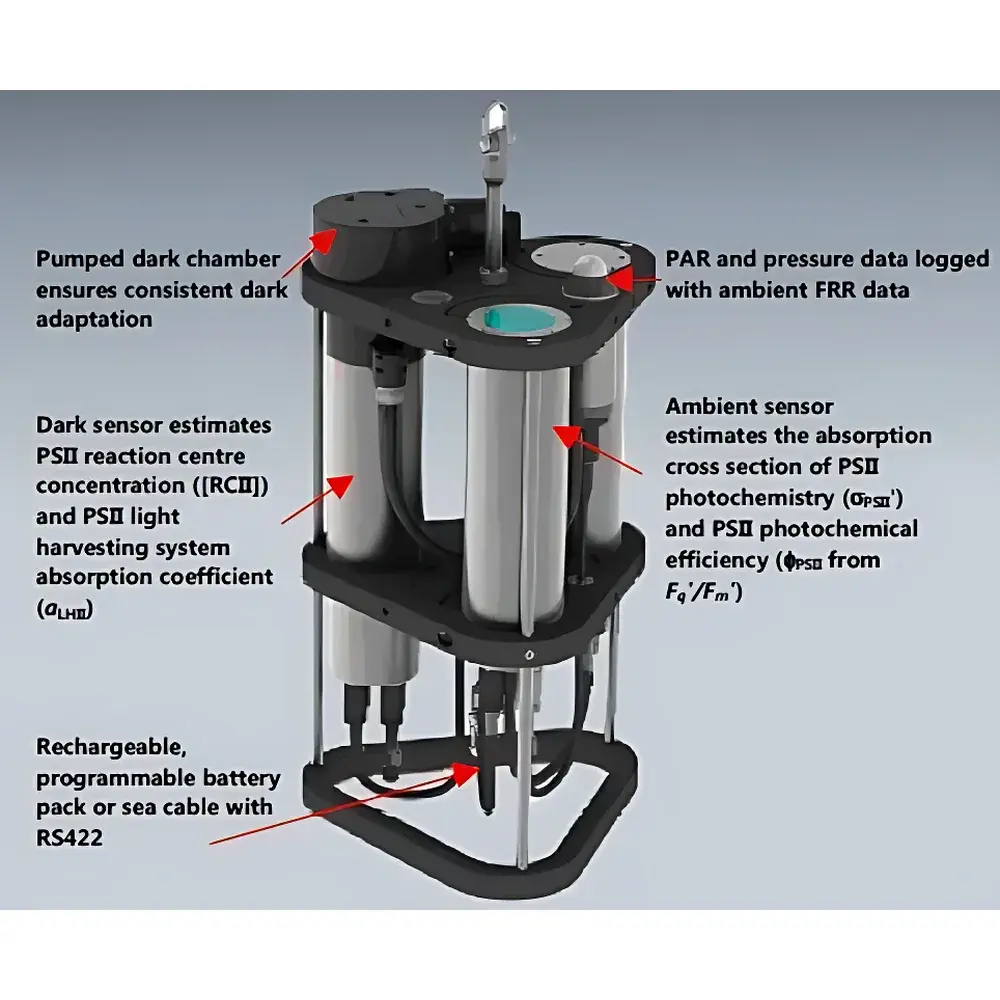
FastOcean APD Fast Repetition Rate Fluorometer System
| Brand | Chelsea |
|---|---|
| Origin | United Kingdom |
| Model | FastOcean APD |
| Excitation Wavelengths | 450 nm, 530 nm, 624 nm |
| Measurement Principle | Multi-wavelength Fast Repetition Rate Fluorometry (FRRf) |
| Sampling Frequency | 10 Hz |
| Dark Adaptation Duration | 2 s |
| Power Supply | Programmable Battery Pack |
| Software Platform | FastPro8 v8.x |
| Compliance | Designed for GLP-aligned marine biogeochemical field studies |
| Sample Environment | In situ seawater profiling (0–1000 m typical), laboratory cuvette mode supported |
| Interoperability | Compatible with FastAct actinometer system and third-party CTD/rosette platforms |
Overview
The FastOcean APD is a dual-sensor, multi-wavelength Fast Repetition Rate Fluorometer (FRRf) system engineered for quantitative, in situ estimation of Gross Primary Productivity (GPP) in marine and freshwater photic zones. Unlike conventional pulse-amplitude-modulated (PAM) fluorometers, the FastOcean APD implements time-resolved, high-frequency excitation (10 Hz sampling) across three discrete LED wavelengths—450 nm (blue), 530 nm (green), and 624 nm (orange)—to resolve wavelength-dependent photosystem II (PSII) photochemistry. Its core measurement principle relies on FRRf: rapid, saturating flash sequences induce transient fluorescence kinetics from which key biophysical parameters—including functional absorption cross-section of PSII (σPSII), electron transport rate through PSII (JPSII), and effective quantum yield (ΦPSII)—are derived with microsecond temporal resolution. Critically, the system integrates a dedicated PAR (Photosynthetically Active Radiation) sensor and supports synchronized dark-adapted (2 s) and light-adapted measurements, enabling direct application of the Oxborough et al. (2012) framework to compute [RCII] (functional reaction center concentration) and aLHII (light-harvesting complex II absorption coefficient). This allows robust, algorithm-driven GPP estimation without empirical calibration against 14C incubations—making it suitable for satellite validation campaigns and high-resolution vertical profiling.
Key Features
- Dual independent FRRf sensors: one configured for ambient-light operation, the other for controlled dark adaptation (2 s), enabling paired physiological snapshots within a single deployment cycle
- Triple-wavelength excitation (450 / 530 / 624 nm) with calibrated photon flux output (reported in photons·m−2·s−1 × 10²²), supporting spectral discrimination of phytoplankton functional groups
- Integrated quantum sensor for PAR (400–700 nm) with NIST-traceable calibration, co-located and time-synchronized with fluorescence acquisition
- Programmable battery-powered operation (up to 72 h continuous profiling at 10 Hz), compatible with standard oceanographic winch systems and autonomous platforms (e.g., gliders, moorings)
- Modular design: individual FastOcean APD probes support both in situ profiling and benchtop cuvette-based assays; interchangeable optical heads enable depth-rated (1000 m) or lab-grade configurations
- Native interoperability with Chelsea’s FastAct actinometer for real-time actinic light field characterization and with industry-standard CTD telemetry interfaces (RS-232, RS-485, SDI-12)
Sample Compatibility & Compliance
The FastOcean APD is validated for use in natural seawater, brackish estuaries, and oligotrophic freshwater systems. Its titanium-housed, pressure-compensated optics (rated to 1000 m) maintain optical alignment and signal fidelity across thermal gradients (−2 to 30 °C) and biofouling-prone environments. All firmware and data processing workflows adhere to principles outlined in ISO 10260 (marine optical sensors) and ASTM D8019-16 (standard practice for phytoplankton productivity measurement). While not FDA-regulated, FastPro8 software supports audit-trail logging and user-access controls aligned with GLP documentation requirements for environmental monitoring programs. Raw fluorescence transients and processed GPP outputs are stored in HDF5 format with embedded metadata (CF-1.8 compliant), ensuring traceability for peer-reviewed publication and satellite ground-truthing archives.
Software & Data Management
FastPro8 (v8.3+) serves as the unified control, visualization, and analysis environment. It provides real-time display of kinetic traces, σPSII, JPSII, ΦPSII, and derived GPP (mmol O2·m−3·h−1). The software automates blank subtraction, baseline correction, and iterative reprocessing upon parameter adjustment—e.g., modifying RCII absorption assumptions or spectral weighting coefficients. All datasets include timestamped GPS coordinates (when interfaced with navigation input), pressure, temperature, and PAR. Export options include NetCDF4 (for OceanSITES compliance), CSV (for spreadsheet integration), and MATLAB .mat files. Batch processing scripts allow reproducible recalibration across multi-cruise datasets, supporting long-term trend analysis per IPCC AR6 marine biogeochemistry protocols.
Applications
- Vertical profiling of GPP across the euphotic zone during research cruises, with sub-meter resolution and real-time GPP mapping
- Satellite algorithm validation: providing in situ GPP and spectral absorption signatures to refine OCx, OCI, and PACE mission retrieval models
- Time-series monitoring of bloom dynamics, including diel photoacclimation responses and stress-induced photoinhibition
- Calibration and intercomparison of autonomous platforms (Bio-Argo floats, gliders) carrying complementary biogeochemical sensors
- Controlled laboratory experiments quantifying light-response curves (PE curves), nutrient limitation effects, and species-specific photochemical efficiency
- Integration into ecosystem models (e.g., ERSEM, MEDUSA) requiring resolved JPSII and RCII-based carbon fixation rates
FAQ
How does FastOcean APD differ from traditional PAM fluorometers?
It employs true FRRf methodology—measuring fluorescence decay kinetics after microsecond-scale saturating flashes—rather than slow, modulated pulses. This enables direct calculation of RCII concentration and functional absorption, critical for absolute GPP quantification.
Can FastOcean APD operate autonomously on a mooring?
Yes. With its programmable battery pack and low-power sleep/wake cycles, it supports unattended deployments up to 72 hours at 10 Hz, with data logged internally or streamed via RS-485 to a central node.
Is FastPro8 software compliant with 21 CFR Part 11?
While not certified for pharmaceutical GMP use, FastPro8 includes electronic signature capability, audit trail export, and role-based access control—features commonly adopted by environmental labs undergoing EPA or ISO 17025 accreditation.
What depth rating is available for profiling applications?
Standard configuration is rated to 1000 m (100 bar); custom housings for hadal-zone deployment (up to 11,000 m) are available under engineering consultation.
Does the system require post-deployment lab calibration?
No. Factory calibration is NIST-traceable and stable over time; field verification uses built-in LED stability monitors and optional FastAct reference standards.







