
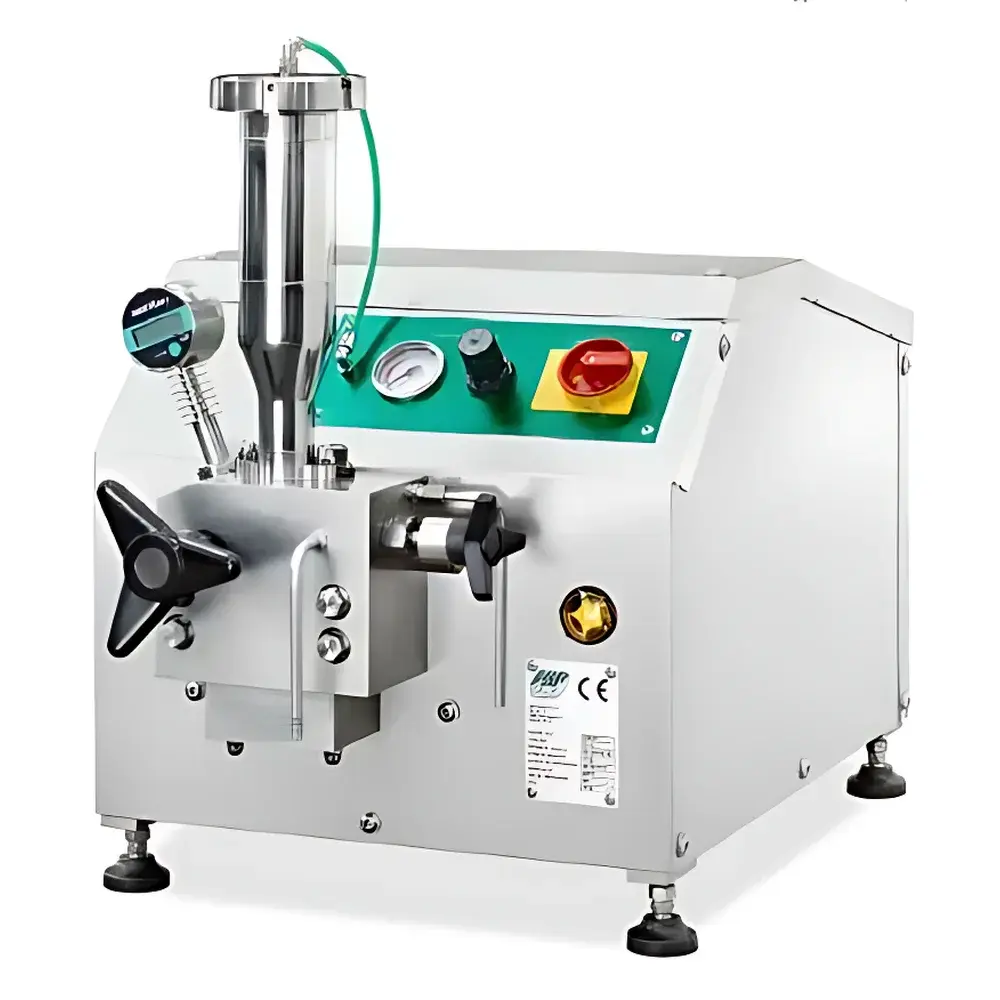
FBF HomoLab Laboratory High-Pressure Homogenizer
| Brand | FBF |
|---|---|
| Origin | Italy |
| Model | HomoLab |
| Instrument Type | High-Pressure Homogenizer |
| Dimensions (W×D×H) | 750 × 460 × 440 mm |
| Processing Capacity | ≥20 L/h |
| Maximum Pressure (Stage 1) | 1850 bar |
| Maximum Pressure (Stage 2) | 150 bar |
| Minimum Sample Volume | 15–20 mL |
| Max. Viscosity | 2000 cP |
| Outlet Temperature | <90 °C |
| Max. Inlet Particle Size | <200 µm |
| Post-Homogenization Avg. Particle Size | <100 nm |
| Cooling System | Integrated Chilled Feed System (Down to –10 °C) |
| Air Pressure Requirement (for Forced Feed) | >8 bar |
| Power Supply | 1500 W, 380 V / 50 Hz |
| Weight | 80 kg |
| IP Rating | IP55 |
| Compliance | CE-marked, Fully GMP-Compliant Design, Conforms to EU Machinery Directive 2006/42/EC |
Overview
The FBF HomoLab Laboratory High-Pressure Homogenizer is an engineered solution for scalable nano- and micro-scale particle size reduction in research and development laboratories. Based on the principle of controlled high-pressure cavitation, impact, and shear, the HomoLab subjects liquid suspensions or emulsions to precisely regulated hydraulic stress within a dual-stage homogenizing valve system. As the sample passes through the first-stage valve at pressures up to 1850 bar, intense acceleration followed by abrupt deceleration generates hydrodynamic cavitation, turbulent eddies, and interfacial shear forces—disrupting aggregates, membranes, and colloidal structures. The second-stage valve (up to 150 bar) further refines droplet or particle distribution while minimizing temperature rise and re-agglomeration. This physics-based mechanism enables reproducible sub-100 nm mean particle size generation—critical for liposome formulation, protein nanoparticle stabilization, nanoemulsion development, and cell disruption in biopharmaceutical process development.
Key Features
- Monobloc pump housing cast from high-strength alloy, integrating all drive components for mechanical stability and minimal vibration transmission
- Two-stage homogenizing valve assembly with wear-resistant ceramic ball valves and precision-machined stainless-steel seat geometry—designed for long-term pressure integrity and consistent flow dynamics
- Manually adjustable pressure regulation via calibrated handwheel, enabling fine-tuned control over both primary and secondary stage pressures
- Forced-feed system with air-pressure interface (≥8 bar) and level-sensing sample rod—ensuring reliable handling of viscous feeds up to 2000 cP without pulsation or air entrapment
- Integrated chilled feed system capable of maintaining inlet temperatures as low as –10 °C, mitigating thermal degradation during high-energy processing of thermolabile biologics or polymers
- Digital GEFRAN pressure transducer with real-time display and programmable overpressure alarm—compliant with functional safety requirements per IEC 61508
- Full GMP-aligned construction: 304 stainless-steel enclosure (IP55-rated), lubrication-by-spray architecture ensuring continuous oil film coverage on all moving parts, and CIP/SIP-ready wetted surfaces
Sample Compatibility & Compliance
The HomoLab accommodates aqueous, organic, and biphasic systems—including protein solutions, lipid dispersions, polymer melts, and cell lysates—with inlet particle sizes up to 200 µm and viscosities up to 2000 cP. Its design adheres to ISO 22000 (food safety), ASTM D7617 (nanoparticle dispersion stability), and USP (liposomal particle size distribution). All electrical and mechanical subsystems comply with EU Machinery Directive 2006/42/EC and Low Voltage Directive 2014/35/EU. CE marking confirms conformity with essential health and safety requirements, while the sealed lubrication system and corrosion-resistant wetted path support GLP/GMP audit readiness. Optional documentation packages include Factory Acceptance Test (FAT) reports and material traceability certificates for 316L contact surfaces.
Software & Data Management
While the base HomoLab operates via analog pressure control and digital readout, optional firmware upgrades enable data logging via RS-485 Modbus RTU interface—compatible with LabVIEW™, SCADA, and MES platforms. Logged parameters include real-time pressure (Stage 1 & 2), total processed volume, runtime, and thermal status. Audit trails meet FDA 21 CFR Part 11 requirements when paired with validated third-party software, supporting electronic signature capture, user access tiers, and immutable record retention. All firmware revisions are version-controlled and documented per ICH Q9 quality risk management principles.
Applications
- Pharmaceutical R&D: Liposome and solid lipid nanoparticle (SLN) production; viral vector purification pre-processing; monoclonal antibody subvisible particle mitigation
- Food Science: Cold-sterilized dairy alternatives (soy, oat, almond milk); nanoemulsified flavor delivery systems; enzymatically stabilized casein micelle restructuring
- Industrial Chemistry: Carbon black dispersion for conductive inks; silica nanoparticle suspension for catalyst supports; polymeric microcapsule synthesis
- Academic Research: Mechanical lysis of Gram-negative bacteria and yeast; exosome isolation enhancement; rheological modification of starch-based hydrogels
FAQ
What is the minimum viable sample volume for method development studies?
The HomoLab supports reproducible processing of 15–20 mL batches using gravity-fed or forced-feed configurations—enabling early-stage formulation screening with minimal reagent consumption.
Can the HomoLab be integrated into a closed-loop recirculation system?
Yes—its inlet/outlet porting (G1/2″ BSP) and pressure-balanced valve design allow seamless integration with external chillers, filtration modules, and buffer exchange units under validated SOPs.
Is validation support available for GMP manufacturing transfer?
FBF provides IQ/OQ protocol templates, calibration traceability documentation, and on-site operational qualification assistance—aligned with Annex 15 and ASTM E2500-13 standards.
How does the dual-stage valve improve emulsion stability compared to single-stage systems?
The second-stage valve applies controlled relaxation pressure that suppresses Ostwald ripening and coalescence post-primary cavitation—yielding narrower PDI (polydispersity index) values and improved long-term physical stability per ISO 13320 guidelines.



