
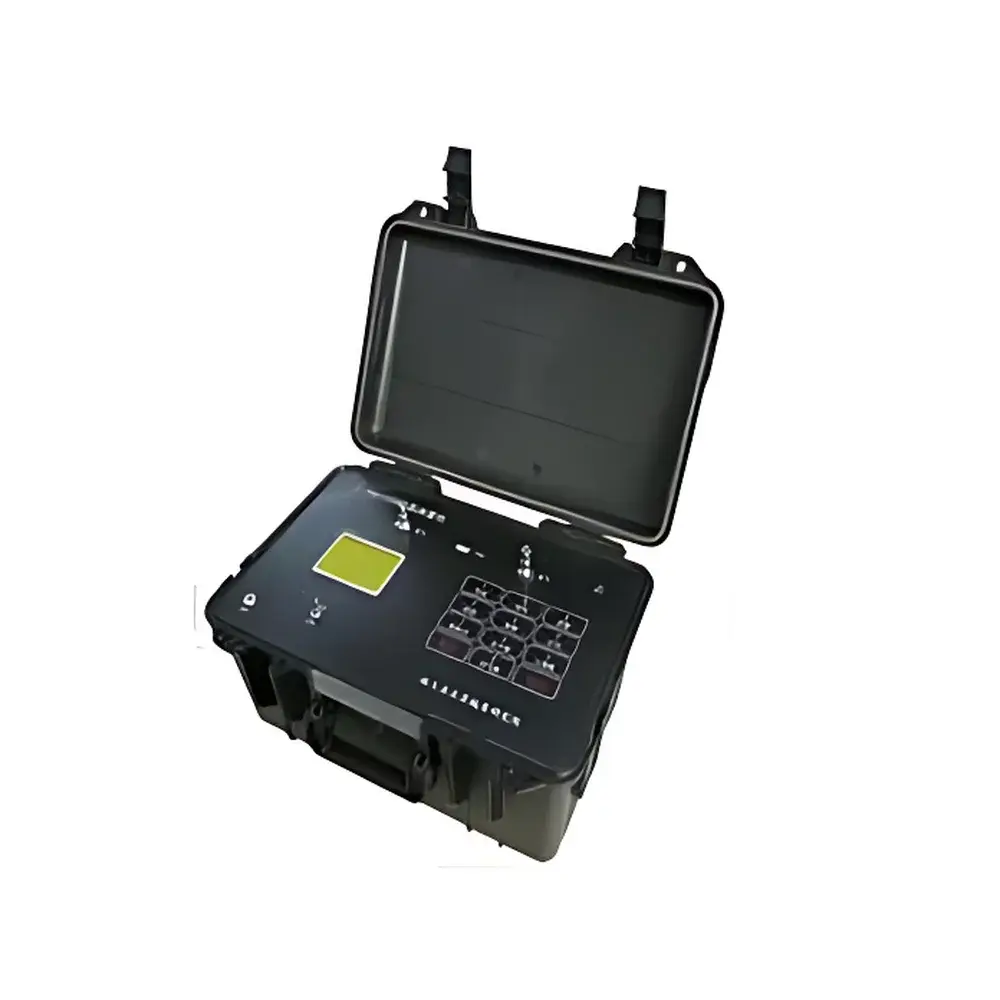
FD216 Environmental Radon Monitor
| Origin | Beijing, China |
|---|---|
| Manufacturer Type | Authorized Distributor |
| Origin Category | Domestic (PRC) |
| Model | FD216 |
| Price Range | USD 1,400–4,200 |
| Sampling Method | Active Pump-Driven |
| Measurement Range | 3–100,000 Bq/m³ |
| Minimum Detectable Concentration | 3 Bq/m³ |
| Response Time (Air) | 30 min |
| Detector System | ZnS(Ag) Scintillation Screen Coupled with Photomultiplier Tube (PMT) |
| Sensitivity | ≥0.68 cpm/(Bq·m⁻³) |
Overview
The FD216 Environmental Radon Monitor is a portable, field-deployable scintillation-based radon detection instrument engineered for quantitative measurement of 222Rn gas concentration in ambient air, soil gas, water, and surface exhalation scenarios. It operates on the principle of alpha-particle-induced scintillation: radon progeny (notably 218Po and 214Po) decay within a sealed, air-tight counting chamber lined with zinc sulfide doped with silver (ZnS(Ag)). Each alpha particle interaction generates a flash of visible light, which is detected and amplified by a low-noise photomultiplier tube (PMT). The resulting pulse count rate is linearly correlated to radon activity concentration under calibrated conditions. Designed in strict accordance with Chinese national standards GB 50325–2001 (2006 Edition) and GB/T 16147–1995—both aligned with ICRP-recommended methodologies for environmental radon assessment—the FD216 delivers metrologically traceable results suitable for regulatory compliance reporting, indoor air quality audits, geological survey support, and long-term environmental monitoring programs.
Key Features
- Compact, ruggedized design: Dimensions 330 × 210 × 170 mm; net weight 5.0 kg (main unit only), enabling single-operator deployment in confined or remote locations.
- Dual-power architecture: Integrated rechargeable lithium-ion battery supports continuous operation for up to 30 hours; AC adapter included for laboratory or fixed-site use.
- Active sampling system: Integrated diaphragm pump ensures consistent volumetric flow rate and minimizes diffusion-related bias during air/soil gas aspiration.
- High-sensitivity ZnS(Ag)/PMT detector assembly: Achieves ≥0.68 cpm per Bq/m³ with background count rate ≤0.3 cpm, ensuring reliable quantification at low-level environmental concentrations (≥3 Bq/m³).
- Multi-matrix capability: Configurable measurement modes for airborne radon (3–100,000 Bq/m³), soil gas radon (300–300,000 Bq/m³), radon exhalation rate (0.001–10.000 Bq/[m²·s]), and aqueous radon (0.003–100 Bq/L).
- Onboard data management: LCD interface with real-time display; internal memory stores up to 6,000 timestamped records including date, time, location ID, and result.
- Communication interfaces: USB 2.0 port for data export to PC; optional Bluetooth module enables direct thermal printing of calibration-corrected reports.
Sample Compatibility & Compliance
The FD216 is validated for use across four primary sample matrices: ambient air (indoor/outdoor), soil gas (via probe insertion), water (using closed-loop emanation technique), and surface radon exhalation (employing accumulation chamber protocol). Its measurement methodology conforms to the fundamental physical principles outlined in ISO 11665-2:2019 (Measurement of radioactivity — Radon-222 — Part 2: Integrated measurement method for determining average activity concentration in air) and supports alignment with EPA Protocol for Radon and Radon Decay Product Measurements in Homes (EPA 402-R-92-002). All units are factory-calibrated against certified radon reference sources and issued with a formal verification certificate from the National Institute of Metrology (NIM), People’s Republic of China—ensuring traceability to SI units via NIM’s primary radon standard. Instrument performance meets requirements for GLP-compliant environmental testing laboratories conducting routine QA/QC and regulatory submissions.
Software & Data Management
Data acquisition and post-processing are supported via proprietary Windows-compatible software (v3.2+), enabling spectral analysis, background subtraction, efficiency correction, and uncertainty propagation per ISO/IEC 17025:2017 Annex A.3 guidelines. Export formats include CSV, XML, and PDF report templates compliant with Chinese Ministry of Ecology and Environment (MEE) reporting frameworks. Audit trail functionality logs all user-initiated parameter changes, calibration events, and firmware updates. While native FDA 21 CFR Part 11 compliance is not embedded, the software architecture supports external electronic signature integration and secure user-role assignment when deployed within validated IT environments.
Applications
- Indoor air quality (IAQ) assessment in residential, commercial, and public buildings per GB 50325–2001 and WHO reference levels (100 Bq/m³).
- Geological radon potential mapping for site characterization prior to construction or nuclear facility siting.
- Soil gas surveys in uranium mining districts and natural high-background radiation areas.
- Radon-in-water screening for drinking water supplies and spa facilities.
- Long-term trend analysis using programmable continuous monitoring mode (1–24 h intervals).
- Educational use in nuclear physics, health physics, and environmental science curricula.
FAQ
What is the minimum detectable activity concentration for airborne radon?
The FD216 achieves a lower limit of detection (LLD) of 3 Bq/m³ under standard operating conditions (25°C, 65% RH, 30-min counting cycle), calculated per Currie’s definition with 95% confidence.
Does the instrument require annual recalibration?
Yes. NIM recommends annual traceable recalibration using certified radon reference chambers. Field verification with check sources is advised before each critical measurement campaign.
Can the FD216 measure radon progeny separately?
No. It measures total alpha activity attributable to short-lived 222Rn progeny in secular equilibrium; progeny discrimination requires alpha spectrometry or pulse-shape analysis not implemented in this model.
Is the battery replaceable by the end user?
The lithium-ion pack is serviceable but requires authorized technical personnel due to safety-critical cell balancing circuitry and enclosure IP rating integrity.
What environmental conditions affect measurement accuracy?
Relative humidity >90% at 40°C may cause condensation inside the scintillation chamber; temperature extremes (40°C) require thermal equilibration prior to measurement to avoid PMT gain drift.







