
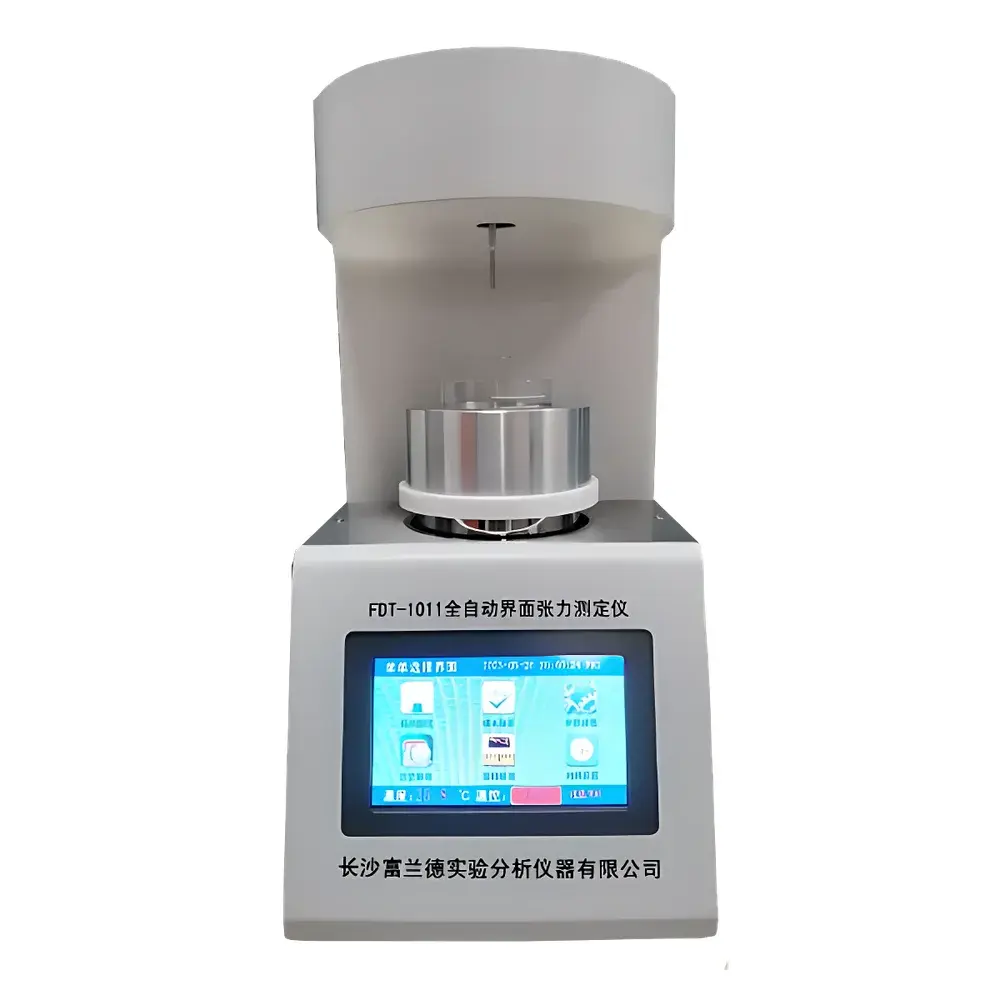
FDT-1011 Fully Automatic Interfacial Tension Analyzer
| Brand | FuLand / csfriend |
|---|---|
| Measurement Range | 2–100 mN/m (for insulating oils) |
| Sensitivity | 0.1 mN/m |
| Repeatability | ±0.3% |
| Accuracy | ±0.1 mN/m |
| Resolution | 0.1 mN/m |
| Power Consumption | 20 VA |
| Operating Temperature | 10–30 °C (typical at 25 °C) |
| Relative Humidity | 20–75 %RH |
| Supply Voltage | AC 220 V ±5%, 50 Hz |
| Net Weight | 15 kg |
| Microcontroller Architecture | High-Capacity Embedded MCU |
| Display | Full-Color LCD Touchscreen Interface |
| Data Handling | Auto-calibration via multi-point linear regression (mg = f(Δ-result)), real-time clock, non-volatile memory backup, auto-lift mechanism, integrated thermal printer |
Overview
The FDT-1011 Fully Automatic Interfacial Tension Analyzer is an engineered solution for precise and reproducible measurement of interfacial tension (IFT) between immiscible liquid phases—primarily designed for routine quality control and condition monitoring of electrical insulating oils in power generation, transmission, and distribution infrastructure. It operates on the Du Noüy ring method, a standardized tensiometric technique defined in ASTM D971 and IEC 62961, where the force required to detach a platinum-iridium ring from the oil–water interface is quantified and converted into interfacial tension values (mN/m). The instrument integrates closed-loop motorized vertical displacement, real-time force transduction, and adaptive zero-compensation algorithms to eliminate operator-dependent variables such as lift speed and immersion depth. Its architecture complies with fundamental metrological requirements for laboratory-grade tensiometers, including traceable calibration, environmental stability compensation, and mechanical hysteresis mitigation.
Key Features
- Full-color capacitive touchscreen interface with intuitive, context-sensitive Chinese/English bilingual prompts—eliminates reliance on external keyboards and reduces training overhead.
- Automated electromechanical lifting system with programmable lift velocity and dwell time, ensuring consistent ring immersion and detachment profiles per ASTM D971 Section 7.3.
- Embedded high-capacity microcontroller unit (MCU) enabling local execution of calibration routines, data smoothing filters, and real-time statistical validation (e.g., standard deviation calculation across triplicate measurements).
- Multi-point linear calibration protocol based on the functional relationship mg = f(Δ-result), supporting up to eight reference points using certified standard oils (e.g., n-hexadecane/water or synthetic ester/water systems).
- Non-volatile memory with timestamped storage for ≥10,000 test records; retains calibration coefficients and user settings during power interruption via onboard RTC (real-time clock) and EEPROM backup.
- Integrated thermal line printer delivering hard-copy reports compliant with internal QA documentation protocols—including sample ID, date/time stamp, ambient temperature/humidity, measured IFT value, and pass/fail status against utility-specific thresholds (e.g., IEEE C57.106 limits).
Sample Compatibility & Compliance
The FDT-1011 is validated for use with mineral-based, synthetic, and natural ester insulating oils, as well as transformer oil-in-water emulsions encountered during moisture ingress diagnostics. It accommodates standard ASTM D971 test vessels (diameter ≥35 mm, depth ≥30 mm) and supports optional temperature-controlled bath integration (not included) for measurements outside the nominal 10–30 °C operating range. Instrument design adheres to IEC 61000-4 electromagnetic compatibility standards and meets CE marking requirements for laboratory electrical equipment. Calibration traceability aligns with ISO/IEC 17025 principles when performed using NIST-traceable reference standards. While not FDA 21 CFR Part 11-certified out-of-the-box, audit trails and electronic signatures can be implemented via external LIMS integration for GLP/GMP-regulated environments.
Software & Data Management
Data acquisition and reporting are handled entirely onboard—no PC dependency is required for basic operation. All measurement sequences generate structured ASCII log files exportable via USB port in CSV format, compatible with Excel, MATLAB, and laboratory information management systems (LIMS). The embedded firmware includes configurable pass/fail logic based on user-defined IFT thresholds (e.g., <30 mN/m indicating advanced oxidation or hydrolytic degradation). Audit-ready metadata—operator ID, calibration date, sensor serial number, and environmental readings—is appended to each record. Optional RS-232 or Ethernet modules (available as accessories) enable remote command execution (SCPI-like syntax) and automated data ingestion into enterprise SCADA or CMMS platforms.
Applications
- Routine assessment of insulating oil aging per IEEE C57.106 guidelines, where declining IFT correlates strongly with polar contaminant accumulation (e.g., sludge precursors, organic acids).
- Diagnostics of moisture-induced interfacial instability in oil-filled bushings and tap changers.
- Verification of oil reclamation efficacy post-vacuum dehydration or clay filtration processes.
- Comparative evaluation of alternative dielectric fluids (e.g., silicone oils, bio-based esters) against legacy mineral oils under identical test conditions.
- Supporting root-cause analysis during transformer failure investigations per CIGRE Technical Brochure 546.
FAQ
What interfacial tension method does the FDT-1011 employ?
It implements the Du Noüy ring method in accordance with ASTM D971 and IEC 62961, utilizing a precision platinum-iridium ring and digital force transduction.
Can the instrument measure surface tension of pure liquids?
Yes—it is equally applicable to surface tension determination of single-phase liquids (e.g., solvents, surfactant solutions) when configured with appropriate ring geometry and meniscus correction factors.
Is external temperature control required for compliance with ASTM D971?
ASTM D971 specifies testing at 25 ± 0.5 °C; the FDT-1011’s built-in environmental monitoring logs ambient temperature but does not regulate it—external thermostatic baths are recommended for strict conformance.
How often must calibration be performed?
Initial calibration is mandatory before first use; subsequent recalibration is advised after every 500 measurements or at least once per month, whichever occurs first, using certified reference oils.
Does the device support network connectivity for centralized data aggregation?
Native USB export is standard; Ethernet or RS-232 communication modules are available as field-installable options for integration into plant-wide data infrastructure.





