
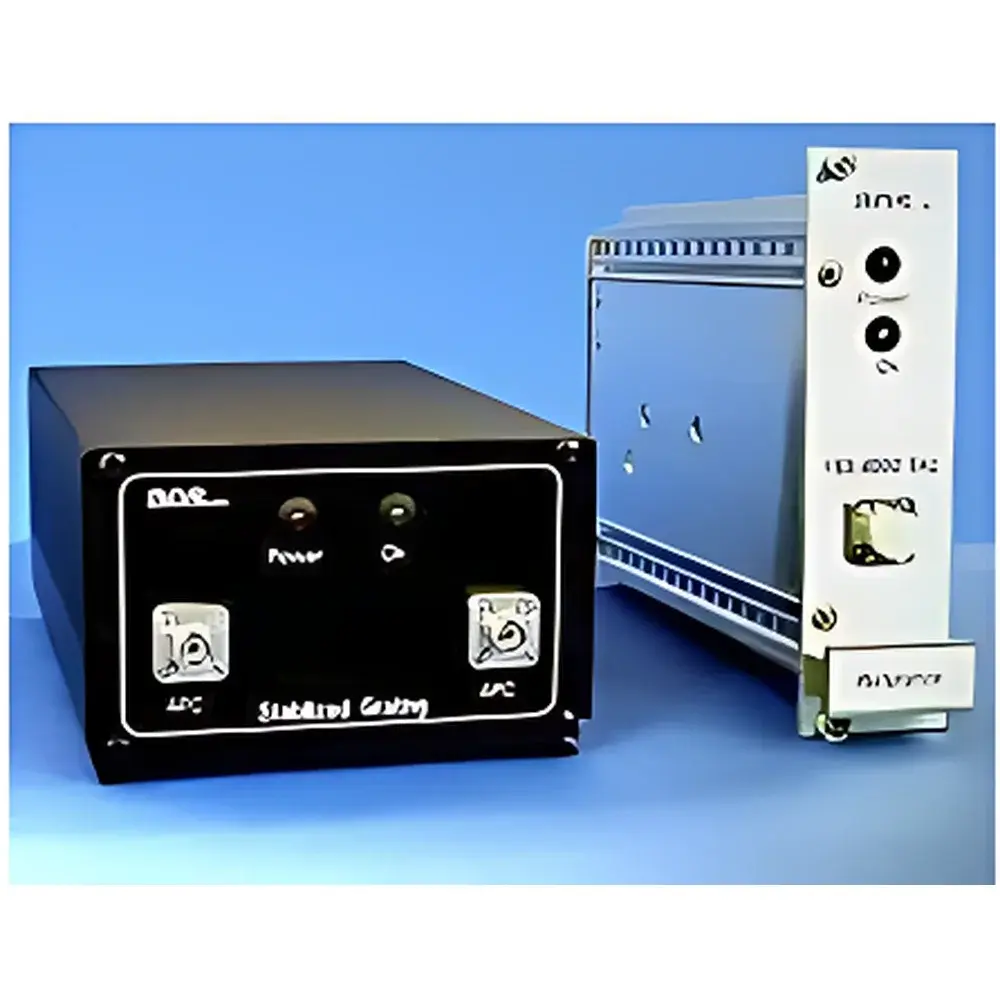
Fiber Bragg Grating Wavelength Reference by AOS – PBT-Certified Optical Calibration Standard
| Brand | AOS/Advanced Optics Solutions |
|---|---|
| Origin | Germany |
| Manufacturer Type | Authorized Distributor |
| Origin Category | Imported |
| Model | Wavelength Reference |
| Pricing | Available Upon Request |
Overview
The AOS Wavelength Reference is a precision-engineered Fiber Bragg Grating (FBG) device designed for traceable, long-term spectral stabilization and calibration in high-accuracy optical systems. Operating on the principle of Bragg reflection, this reference element exhibits a narrowband, highly stable reflection peak whose center wavelength (λB) is defined by the periodic modulation of the core refractive index in photosensitive silica fiber. Unlike conventional gas absorption cells or tunable lasers, the FBG-based reference delivers passive, drift-free wavelength anchoring without active temperature control or external power—making it ideal for embedded metrology, field-deployable instrumentation, and laboratory-grade calibration infrastructure.
Key Features
- Passive, solid-state design with no moving parts or electrical bias requirements
- Dynamically stabilized grating structure ensuring long-term spectral repeatability and minimal thermal hysteresis
- Hermetically packaged unit providing mechanical robustness and environmental immunity (IEC 61300-2-4 compliant packaging)
- Center wavelength stability better than ±0.5 pm over 10 years under constant ambient conditions (based on accelerated aging data per IEC 60793-2-50)
- Traceable calibration certified by Physikalisch-Technische Bundesanstalt (PTB), Germany—the national metrology institute equivalent to NIST in the United States
- Low polarization-dependent loss (<0.05 dB) and insertion loss (<0.3 dB) optimized for integration into DWDM test benches and optical sensor interrogation units
Sample Compatibility & Compliance
This wavelength reference is compatible with standard single-mode fiber (SMF-28e+ or ITU-T G.652.D compliant), enabling plug-and-play integration into optical time-domain reflectometers (OTDRs), optical spectrum analyzers (OSAs), tunable laser sources, and FBG demodulation platforms. It meets key international standards for optical calibration artifacts, including ISO/IEC 17025:2017 (general requirements for competence of testing and calibration laboratories) and EN 61290-1-1 (optical amplifiers — test methods — part 1-1: gain — power method). The PTB certification ensures full traceability to the International System of Units (SI) via primary laser frequency standards, satisfying regulatory expectations for GLP-compliant optical measurement workflows.
Software & Data Management
While the device itself is hardware-only and requires no firmware or driver installation, its use in automated calibration routines is fully supported through industry-standard SCPI and LabVIEW-compatible APIs provided by major OSA and tunable source manufacturers (e.g., Yokogawa AQ6370, Keysight 81600B). Calibration reports—including spectral scan data, uncertainty budgets, and PTB certificate metadata—are delivered in machine-readable XML and PDF formats compliant with ISO/IEC 17025 documentation requirements. Audit trails for calibration events can be maintained within LIMS environments supporting 21 CFR Part 11–compliant electronic signatures when used in regulated photonic manufacturing or telecom equipment qualification processes.
Applications
- Wavelength calibration of dense wavelength division multiplexing (DWDM) channel monitors and channel checkers in production and field service
- Reference standard for optical spectrum analyzer (OSA) wavelength axis verification per IEC 61282-12
- Stabilization anchor in tunable laser source lock-in loops for spectroscopic applications
- Baseline reference in FBG-based structural health monitoring (SHM) systems requiring multi-year baseline integrity (e.g., bridge, pipeline, or aerospace composite monitoring)
- Inter-laboratory comparison artifact in national metrology network studies involving optical frequency metrology
FAQ
Is this FBG reference suitable for use in harsh industrial environments?
Yes—its hermetic metal-ceramic package provides IP67-level protection against humidity, dust, and mechanical shock per IEC 60068-2 series tests.
Does the device require periodic recalibration?
No routine recalibration is required; however, PTB recommends a full re-certification every 5 years for critical metrology applications to maintain traceability validity.
Can it be integrated into custom-built optical interrogators?
Absolutely—the device is supplied with FC/APC or SC/APC connectors and conforms to ITU-T G.671 spectral interface specifications for seamless OEM integration.
What is the typical uncertainty budget for the certified center wavelength?
The PTB certificate states an expanded uncertainty (k=2) of ±1.2 pm at 1550 nm, derived from combined contributions of spectral measurement repeatability, thermal drift modeling, and reference laser linearity.
Is there documentation available for FDA or ISO 13485 compliance in medical photonics applications?
While not a medical device itself, the reference supports ISO 13485-aligned calibration procedures for optical coherence tomography (OCT) system validation and is routinely deployed in Class IIa/IIb medical device manufacturing QA labs.




